
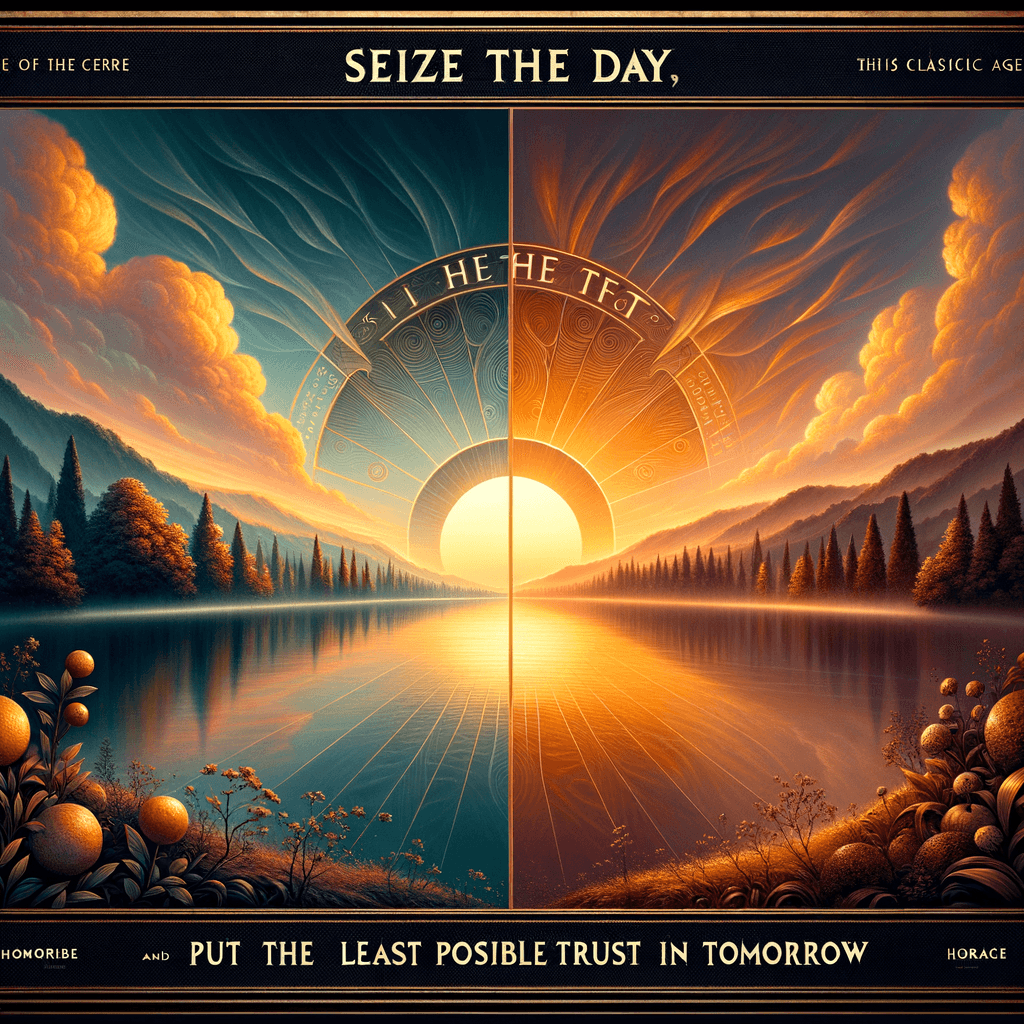
Seize the day, and put the least possible trust in tomorrow. — Horace
—What lingers after this line?
Living in the Present
This quote emphasizes the importance of living in the moment. It encourages individuals to make the most of today rather than deferring actions and ambitions to an uncertain future.
Uncertainty of the Future
Horace advises caution about relying too much on future events. The future is unpredictable and putting too much trust in it can lead to missed opportunities in the present.
Philosophical Outlook
The quote captures a philosophical ethos that values immediate actions and decisions over waiting for ideal future conditions, aligning with the Carpe Diem tradition, which Horace is often associated with.
Proactive Attitude
It advocates for a proactive attitude towards life. By focusing on what can be controlled today, individuals may achieve more and experience greater fulfillment and success.
Historical Context
Quintus Horatius Flaccus, known as Horace, was a Roman poet from the 1st century BC. His works often explored themes of morality, human nature, and the fleeting nature of time, expressing ideas that continue to resonate through the centuries.
One-minute reflection
What's one small action this suggests?
Related Quotes
6 selectedSeize the day, put very little trust in tomorrow. — Horace
Horace
This quote embodies the 'carpe diem' philosophy, encouraging people to live in the present moment and make the most of the opportunities available today.
Read full interpretation →Don't let yesterday take up too much of today. – Will Rogers
Will Rogers
This quote encourages focusing on the present moment rather than dwelling on the past. It suggests that we should not let past experiences and regrets hinder our current well-being and productivity.
Read full interpretation →Yesterday is gone. Tomorrow has not yet come. We have only today. Let us begin. — Mother Teresa
Mother Teresa
This quote emphasizes the importance of focusing on the present moment. Yesterday is already in the past and cannot be changed, and tomorrow is uncertain.
Read full interpretation →Today is the first day of the rest of your life. — Charles Dederich, United States. This quote emphasizes the importance of seizing the present moment and taking positive action towards change and growth. Its universal message encourages individuals from diverse backgrounds to embrace new beginnings, making it a compelling choice for an engaging and expressive visual representation.
Charles Dederich, United States. This quote emphasizes the importance of seizing the present moment and taking positive action towards change and growth. Its universal message encourages individuals from diverse backgrounds to embrace new beginnings, making it a compelling choice for an engaging and expressive visual representation.
This quote encourages individuals to recognize that every new day offers the opportunity for a fresh start, no matter the past. It inspires one to let go of previous failures and look forward to what lies ahead.
Read full interpretation →Bringing awareness to our breathing, we remind ourselves that we are here now, so we might as well be fully awake for whatever is happening. — Jon Kabat-Zinn
Zinn
Jon Kabat-Zinn’s reflection begins with something deceptively ordinary: the breath. By bringing awareness to inhaling and exhaling, we anchor ourselves in the immediate moment rather than drifting into regret about the p...
Read full interpretation →The only way to move forward is to stop pretending that the past is still happening. — Pema Chödrön
Pema Chödrön
Pema Chödrön’s line begins with a gentle but piercing insight: suffering often persists not only because something painful happened, but because part of us keeps reliving it as if it were still unfolding. In that sense,...
Read full interpretation →More From Author
More from Horace →Rule your mind or it will rule you; most burnout is just a failure to set boundaries between your peace and your output. — Horace
At its core, the quotation argues that self-governance is not a luxury but a necessity. To ‘rule your mind’ means refusing to let impulses, anxieties, and external demands dictate the shape of one’s life.
Read full interpretation →Rule your mind or it will rule you. Mastery begins when you stop reacting and start choosing your focus. — Horace
Horace’s line frames the mind as a powerful instrument that can either serve or dominate its owner. The warning is not that thoughts and emotions exist, but that—left unattended—they can steer behavior through impulse, h...
Read full interpretation →Rule your mind or it will rule you. — Horace
Horace’s line distills a political truth into a personal mandate: either you govern your inner life, or it becomes the regime that governs you. By framing the mind as something that can “rule,” he implies it has momentum...
Read full interpretation →Seize the day, put very little trust in tomorrow. — Horace
This quote embodies the 'carpe diem' philosophy, encouraging people to live in the present moment and make the most of the opportunities available today.
Read full interpretation →