
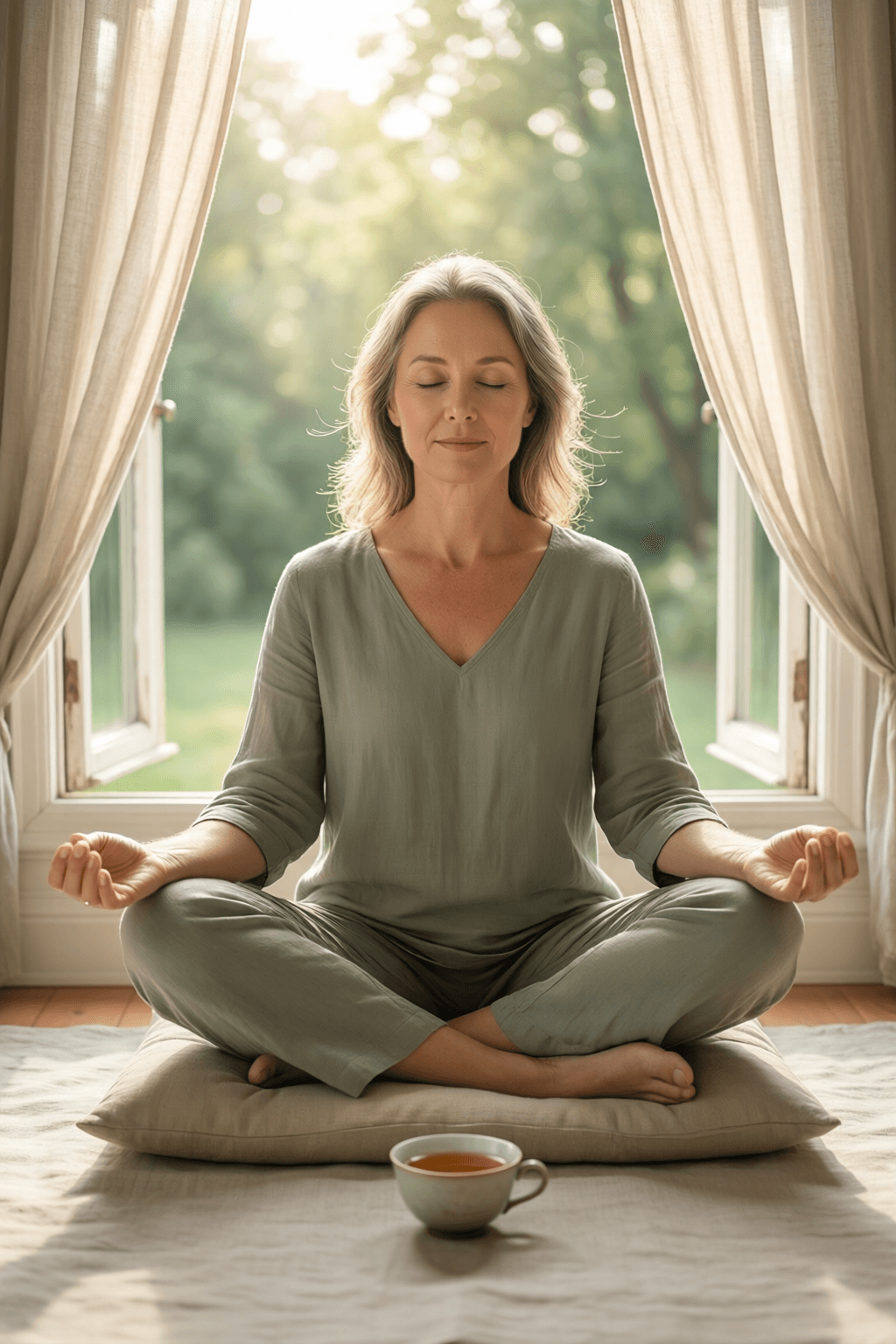
Bringing awareness to our breathing, we remind ourselves that we are here now, so we might as well be fully awake for whatever is happening. — Jon Kabat-Zinn
—What lingers after this line?
Breath as a Doorway to Presence
Jon Kabat-Zinn’s reflection begins with something deceptively ordinary: the breath. By bringing awareness to inhaling and exhaling, we anchor ourselves in the immediate moment rather than drifting into regret about the past or anxiety about the future. In that sense, breathing becomes more than a bodily function; it becomes a practical doorway into presence. From this starting point, the quote gently argues that being here is not enough by itself. We are always somewhere in time, yet Kabat-Zinn invites us to be consciously here now. The breath, because it is always available, offers a steady reminder that wakefulness is not a grand achievement but a moment-by-moment choice.
The Meaning of Being Fully Awake
Once presence is established, the quote moves toward a deeper challenge: to be fully awake for whatever is happening. This kind of wakefulness does not mean forced positivity or heightened excitement. Instead, it suggests a clear, receptive attention to experience as it unfolds, whether the moment is pleasant, dull, or difficult. In this way, Kabat-Zinn’s language echoes Buddhist mindfulness teachings, especially those found in the Satipatthana Sutta, where awareness of the body and breath serves as the foundation for insight. Yet his phrasing remains practical and contemporary, reminding us that awakening is not reserved for monasteries or retreats. It can begin in traffic, at a desk, or in the middle of an ordinary conversation.
Accepting Whatever Is Happening
Significantly, the quote does not say we should become fully awake only for what we enjoy. It says for whatever is happening, which introduces the element of acceptance. This does not mean passive resignation; rather, it means meeting reality before judging it, resisting it, or trying to escape it. That distinction is central to Kabat-Zinn’s work in Full Catastrophe Living (1990), where mindfulness is presented as a way of turning toward life’s stress, pain, and uncertainty with greater steadiness. By noticing the breath in hard moments, we create a small but vital pause. Then, instead of reacting automatically, we gain the freedom to respond with more clarity and compassion.
Awareness as an Antidote to Autopilot
From there, the quote can also be read as a critique of habitual living. Much of daily life is spent on autopilot: eating without tasting, listening without hearing, moving from task to task without truly inhabiting any of them. Breath awareness interrupts that pattern by returning attention to something immediate, rhythmic, and real. Modern psychology supports this insight. Studies on mindfulness-based stress reduction, developed by Kabat-Zinn at the University of Massachusetts Medical Center in 1979, have shown benefits for stress, emotional regulation, and well-being. Thus, the quote is not only philosophical but also behavioral: it points to a small practice that can gradually transform the quality of everyday consciousness.
The Humility of the Present Moment
At the same time, there is humility in the phrase so we might as well be fully awake. It carries no grand promise of perfection, only a simple recognition that this moment is already here. Since we cannot step outside reality, the wisest response may be to meet it with openness rather than distraction. This modesty gives the quote its power. Unlike dramatic calls for self-transformation, Kabat-Zinn offers a grounded invitation: notice the breath, remember you are alive, and participate in your life as it is happening. In the end, the statement suggests that awakening is less about escaping experience than about inhabiting it more completely.
A Practice for Ordinary Life
Finally, the enduring appeal of the quote lies in its usability. It does not require special beliefs, rare insight, or ideal conditions. Anyone can pause before answering an email, standing in a grocery line, or waking in the night and notice a single breath. That small act can become a reset, drawing the mind back from fragmentation into presence. Consequently, Kabat-Zinn’s message is both profound and accessible. By returning to the breath, we remember that awareness is always close at hand. And once we remember that, life itself—messy, fleeting, and unpredictable—becomes the very place where wakefulness is practiced.
Recommended Reading
As an Amazon Associate, we earn from qualifying purchases.
One-minute reflection
Why might this line matter today, not tomorrow?
Related Quotes
6 selectedThe best way to capture moments is to pay attention. This is how we cultivate mindfulness. — Jon Kabat-Zinn
Zinn
Jon Kabat-Zinn’s line rests on a deceptively simple premise: moments don’t become meaningful because they are rare, but because they are noticed. In daily life, much of what we experience passes through the mind like bac...
Read full interpretation →Each morning we are born again. What we do today is what matters most. - Buddha
Buddha
This quote suggests that each day offers a fresh start, an opportunity to begin anew, free from the burdens of past mistakes or achievements.
Read full interpretation →Breathe deeply, let go, and remind yourself that this very moment is the only one you know you have for sure. — Oprah Winfrey
Oprah Winfrey
This quote encourages mindfulness by reminding us to focus on the present moment. Being truly present helps in appreciating life as it happens, rather than being caught up in past regrets or future anxieties.
Read full interpretation →The only way to move forward is to stop pretending that the past is still happening. — Pema Chödrön
Pema Chödrön
Pema Chödrön’s line begins with a gentle but piercing insight: suffering often persists not only because something painful happened, but because part of us keeps reliving it as if it were still unfolding. In that sense,...
Read full interpretation →Whatever you do, don't let the past steal your present. — Cherríe Moraga
Cherríe Moraga
At its core, Cherríe Moraga’s line is a warning about where we place our emotional energy. The past has undeniable power: it can shape identity, inform judgment, and preserve memory.
Read full interpretation →You do not need to know precisely what is happening, or exactly where it is all going. What you need is to recognize the possibilities of the present moment. — Thomas Merton
Thomas Merton
At its heart, Thomas Merton’s line challenges the modern habit of demanding a full map before taking a single step. He suggests that wisdom does not begin with perfect prediction, but with the humility to admit that life...
Read full interpretation →More From Author
More from Zinn →Mindfulness is a way of befriending ourselves and our experience. — Jon Kabat-Zinn
At its core, Jon Kabat-Zinn’s statement reframes mindfulness as an act of friendship rather than self-improvement. To be mindful is not merely to pay attention, but to meet our thoughts, feelings, and bodily sensations w...
Read full interpretation →We are not human doings, we are human beings. — Jon Kabat-Zinn
Jon Kabat-Zinn’s line quietly overturns a habit that defines much of modern life: measuring worth by output. At first glance, the quote sounds simple, yet it confronts the deep assumption that people must constantly perf...
Read full interpretation →Anxiety is a storm, but you are the sky. You cannot control the weather of your thoughts, but you can learn to expand your awareness until the clouds no longer define your horizon. — Jon Kabat-Zinn
At its heart, Jon Kabat-Zinn’s statement separates temporary mental events from the deeper field of awareness that holds them. Anxiety appears as a storm—loud, shifting, and sometimes frightening—while the self is compar...
Read full interpretation →The best way to capture moments is to pay attention. This is how we cultivate mindfulness. — Jon Kabat-Zinn
Jon Kabat-Zinn’s line rests on a deceptively simple premise: moments don’t become meaningful because they are rare, but because they are noticed. In daily life, much of what we experience passes through the mind like bac...
Read full interpretation →