
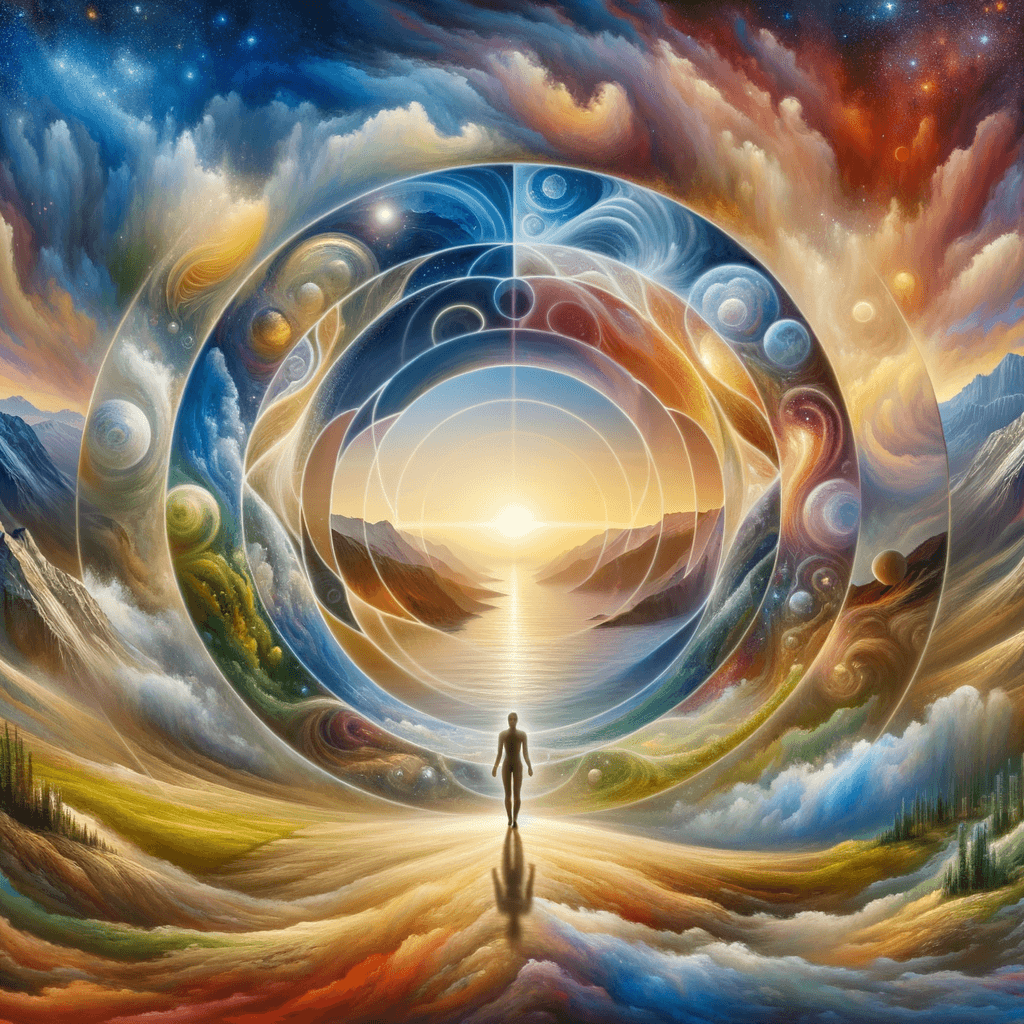
One’s destination is never a place, but a new way of seeing things. — Henry Miller
—What lingers after this line?
The Journey Over the Destination
This quote suggests that achieving a goal or reaching a physical destination is not as significant as the transformation in perspective that occurs along the way. The true ‘destination’ lies in how you've grown and what you've learned during your journey.
Personal Growth
Henry Miller emphasizes that travel, or life experiences in general, are less about the end result and more about the internal change they provoke in an individual. The person’s mindset and worldview evolve, which is the ultimate reward.
Expanded Perception
The idea touches on the notion that travel (literal or metaphorical) enriches one’s understanding of the world. It gives people new perspectives, opening their eyes to diverse cultures, ideas, and experiences, which transforms their way of perceiving life.
Adventure and Discovery
This quote aligns with the concept that the most valuable part of any journey is the discovery of new ways of thinking. Whether physically moving to a new place or embarking on a new life chapter, it’s the experience and broadened awareness that matter.
Emotional and Philosophical Reflection
Miller’s words invite deeper contemplation. They imply that changing your external environment may not be as impactful as shifting how you interpret and interact with the things around you. It’s an invitation to reflect on the philosophical and emotional reshaping of the self.
One-minute reflection
Where does this idea show up in your life right now?
Related Quotes
6 selectedWhere you stand determines what you see and what you do not see; a change in where you stand changes everything. — Søren Kierkegaard
Søren Kierkegaard
Kierkegaard’s insight begins with a simple but unsettling claim: vision is never neutral. Where we stand—socially, emotionally, spiritually, or intellectually—determines not only what comes into view but also what remain...
Read full interpretation →The point is to have a long-term perspective. — Dalai Lama XIV
Dalai Lama XIV
At its core, the Dalai Lama XIV’s remark urges us to lift our eyes from the pressures of the present moment and consider the wider arc of life. A long-term perspective does not deny today’s difficulties; rather, it place...
Read full interpretation →Sometimes all it takes is a tiny shift of perspective to see something familiar in a totally new light. — Dan Brown
Dan Brown
At first glance, Dan Brown’s quote seems simple, yet its force lies in how little it asks of us: not a total reinvention, but a slight adjustment in viewpoint. He suggests that familiarity can dull perception, making peo...
Read full interpretation →Everything is a season, and this is just a chapter, not your whole story. — Glennon Doyle
Glennon Doyle
At its core, Glennon Doyle’s quote reframes hardship and change by comparing life to the natural cycle of seasons. Just as winter does not cancel spring, a painful or uncertain period does not define a person forever.
Read full interpretation →Sometimes you just have to stop, take a deep breath, and put things into perspective. — Katrina Mayer
Katrina Mayer
At its core, Katrina Mayer’s remark highlights the quiet power of interruption. In moments of stress, urgency often convinces us that we must react immediately, yet the simple act of stopping can break that spell.
Read full interpretation →To know what you can now do, you have to be willing to throw yourself into the unknown. — Henry Miller
Henry Miller
This quote highlights the necessity of stepping outside of one's comfort zone. To discover new abilities and potentials, one must be open to new experiences, even if they are uncertain or frightening.
Read full interpretation →More From Author
More from Henry Miller →I see that my steadfast desire was alone responsible for whatever progress or mastery I have made. — Henry Miller
Henry Miller’s statement begins with a simple but demanding insight: achievement is not primarily the result of luck, talent, or external approval, but of a desire that refuses to disappear. By calling his desire “steadf...
Read full interpretation →The present is the ever-moving shadow that divides yesterday from tomorrow. — Henry Miller
Henry Miller’s image of the present as an “ever-moving shadow” turns a familiar idea into something vivid and unstable. Rather than treating the present as a solid point we can hold, he depicts it as a shifting boundary...
Read full interpretation →To know what you can now do, you have to be willing to throw yourself into the unknown. — Henry Miller
This quote highlights the necessity of stepping outside of one's comfort zone. To discover new abilities and potentials, one must be open to new experiences, even if they are uncertain or frightening.
Read full interpretation →The magic is in the mystery. — Henry Miller
This quote highlights that the sense of wonder and enchantment exists in the unknown. It is the mysteries of life that evoke curiosity and excitement, making existence magical.
Read full interpretation →