
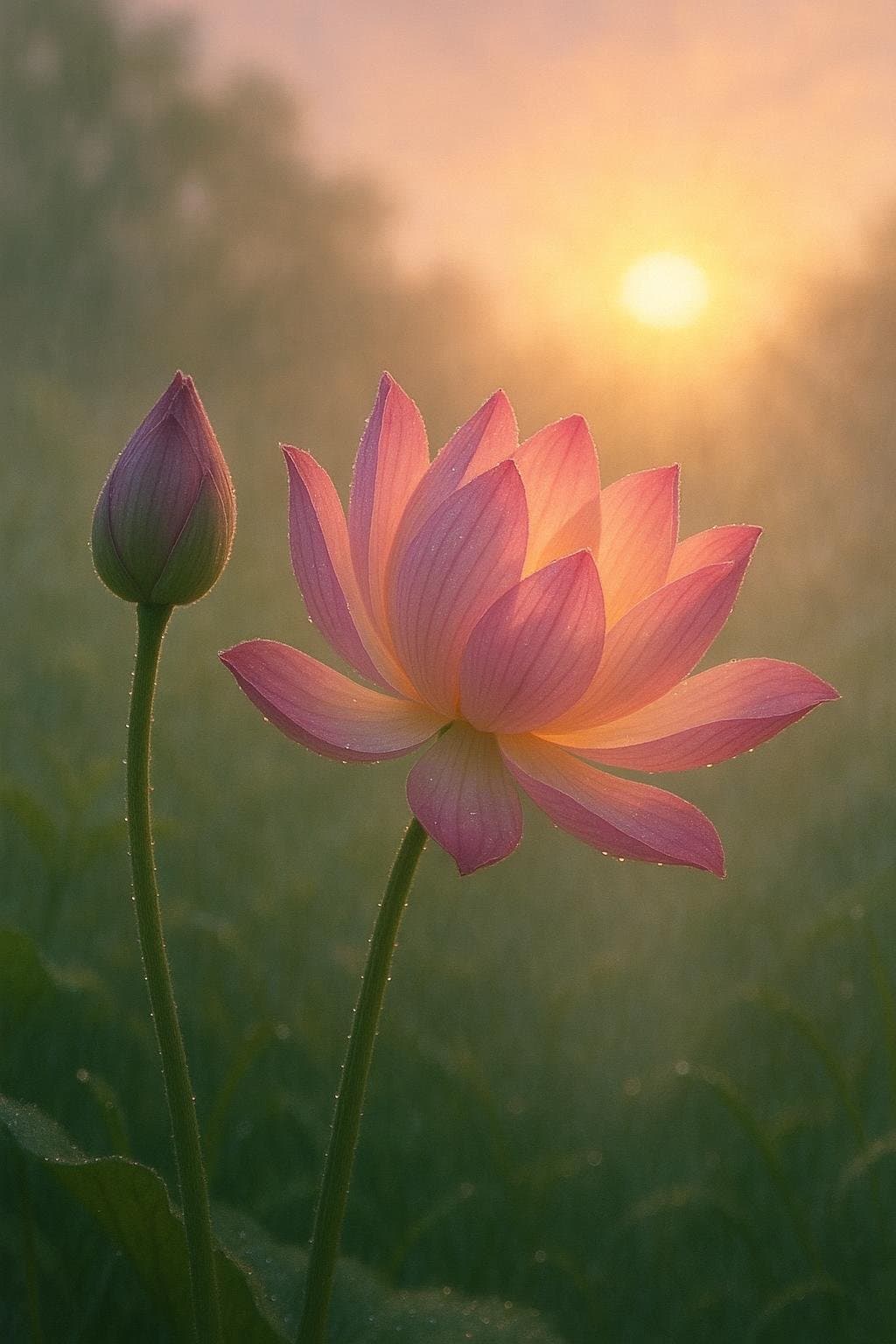
To blossom means to trust yourself, to trust life, to trust that there is an opening in every new moment. — Clarissa Pinkola Estés
—What lingers after this line?
Trust as the Soil for Personal Growth
Clarissa Pinkola Estés invokes the metaphor of blossoming to emphasize that personal growth requires foundational trust. Just as a flower needs fertile soil to bloom, individuals need to believe in themselves, in the ebb and flow of life, and in the possibilities each moment offers. This trust enables us to break free from fear and uncertainty, preparing the ground for our authentic selves to emerge.
Embracing Uncertainty and Possibility
Building on trust, Estés highlights the idea that each new moment contains an ‘opening’—an invitation to growth, change, or understanding. Life by its nature is unpredictable, but when we trust in its unfolding, we become more open to discovery. This echoes the teachings of mindfulness traditions, where present moment awareness is seen as a gateway to transformation (e.g., Jon Kabat-Zinn’s work on mindfulness, 1990).
The Role of Self-Trust in Flourishing
Central to Estés’ vision is self-trust: believing in our own abilities and resilience. Without this, even the richest soil cannot yield blossoms. This concept mirrors Carol Dweck’s research on the ‘growth mindset’ (2006), showing that those who trust their capacity to learn and adapt are more likely to thrive. Thus, self-trust is both a prerequisite for and a product of blossoming in life’s garden.
Finding Opportunities in Every Challenge
Estés also reminds us that every moment, even the challenging ones, holds an ‘opening.’ Historical moments of adversity often spur unexpected growth—consider how Helen Keller’s trust in herself and her teacher enabled her to communicate and inspire millions. By viewing difficulties as opportunities rather than obstacles, we foster resilience and hope, even during life’s darkest seasons.
Cultivating Trust Through Everyday Practice
Finally, the process of blossoming through trust isn’t a single leap but a series of small, daily choices. Practicing gratitude, keeping promises to ourselves, and reflecting on past triumphs all reinforce this cycle of trust. Over time, these acts accumulate, much like petals on a flower, revealing the full beauty of a life lived openly and courageously—true to Estés’ guiding vision.
One-minute reflection
Where does this idea show up in your life right now?
Related Quotes
6 selectedQuietly and without fuss, you must trust your own heart. Your instincts are more reliable than the noise of the world. — Clarissa Pinkola Estés
Clarissa Pinkola Estés
At its core, Clarissa Pinkola Estés’s line invites a quiet act of courage: to believe that the heart can perceive truths the outside world often obscures. Rather than demanding dramatic rebellion, she emphasizes trust ex...
Read full interpretation →You are not broken. You are becoming. — Clarissa Pinkola Estés
Clarissa Pinkola Estés
At its core, Clarissa Pinkola Estés’s line transforms the way we interpret hardship. Instead of treating pain, confusion, or loss as proof of damage, she invites us to see them as signs of movement.
Read full interpretation →You grow in confidence when you keep the promises you made to yourself. — Ash Pryor
Ash Pryor
Ash Pryor’s statement points to a simple but powerful truth: confidence is not built mainly through praise, luck, or public achievement. It grows when a person repeatedly proves to themselves that their word has weight.
Read full interpretation →The most gifted members of the human species are at their creative best when they cannot have their way, and must compensate for what they miss by realizing and cultivating their capacities. — Bryant H. McGill
Bryant H. McGill
Bryant H. McGill’s observation begins with a striking reversal: gifted people may not reach their highest potential when everything comes easily, but when something blocks their path.
Read full interpretation →A mind grows by staying with difficulty long enough for the experience to change it. — Mary Catherine Bateson
Mary Catherine Bateson
Mary Catherine Bateson’s observation begins with a quiet but demanding truth: the mind does not grow merely by encountering difficulty, but by remaining with it. Challenge becomes transformative only when we resist the u...
Read full interpretation →Consistency is a superpower. — Ryan Holiday
Ryan Holiday
Ryan Holiday’s line begins with a deceptively simple idea: greatness is rarely built through dramatic gestures. More often, it emerges from repeated actions that seem ordinary in isolation but become extraordinary over t...
Read full interpretation →More From Author
More from Clarissa Pinkola Estés →Quietly and without fuss, you must trust your own heart. Your instincts are more reliable than the noise of the world. — Clarissa Pinkola Estés
At its core, Clarissa Pinkola Estés’s line invites a quiet act of courage: to believe that the heart can perceive truths the outside world often obscures. Rather than demanding dramatic rebellion, she emphasizes trust ex...
Read full interpretation →To create one must be willing to be stone stupid, to sit upon a throne on top of a jackass and spill rubies from one's mouth. — Clarissa Pinkola Estés
Clarissa Pinkola Estés begins with a provocation: anyone who wants to create must accept appearing “stone stupid.” In other words, genuine making starts where polish, certainty, and social dignity begin to fail. The arti...
Read full interpretation →You are not broken. You are becoming. — Clarissa Pinkola Estés
At its core, Clarissa Pinkola Estés’s line transforms the way we interpret hardship. Instead of treating pain, confusion, or loss as proof of damage, she invites us to see them as signs of movement.
Read full interpretation →If you have not been called a defiant, incorrigible, unmannerly woman, there is still time. — Clarissa Pinkola Estés
Clarissa Pinkola Estés turns a familiar set of accusations—“defiant,” “incorrigible,” “unmannerly”—into a kind of initiation rather than a shame sentence. The line suggests that these labels often appear not when someone...
Read full interpretation →