
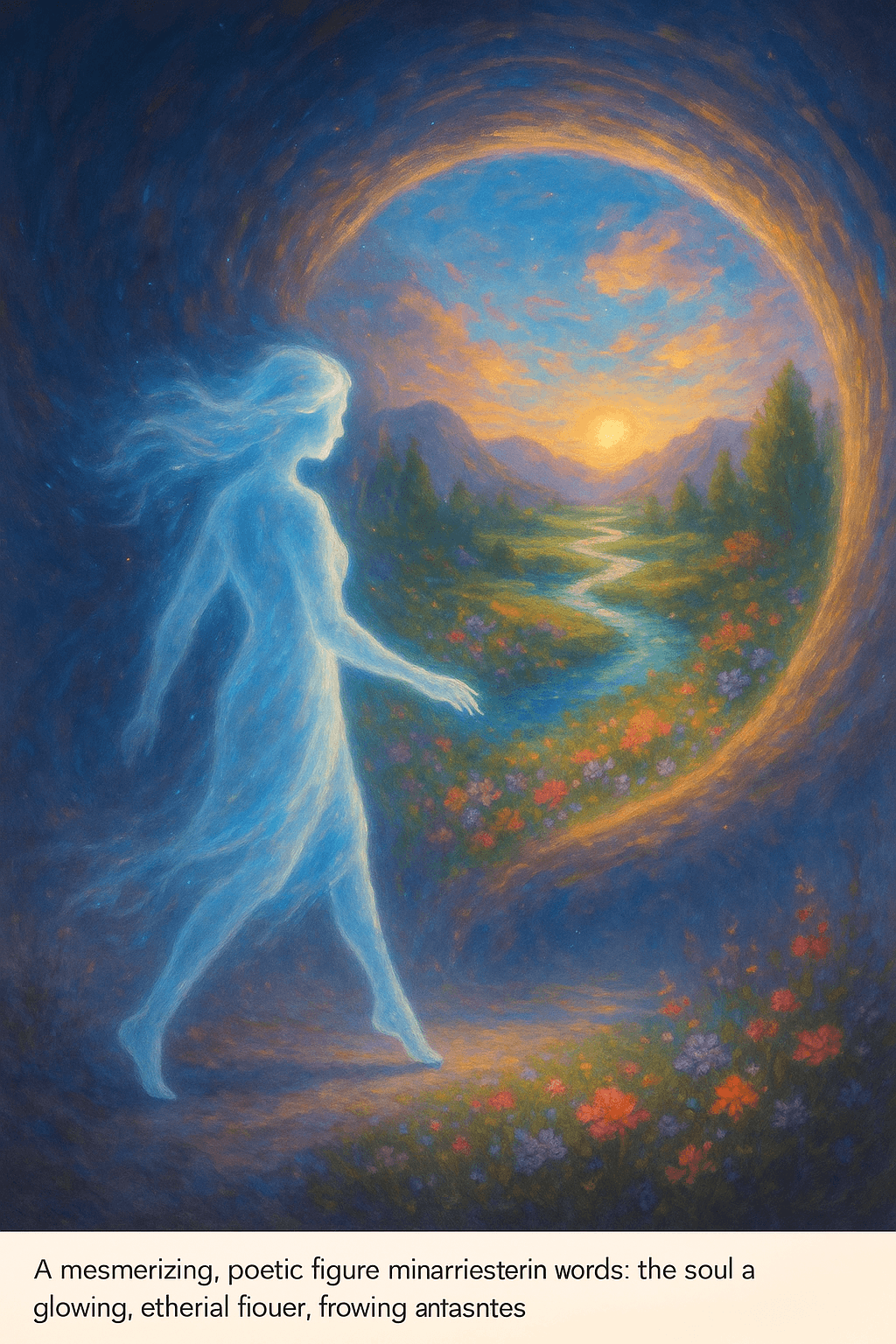
When the soul wants to experience something she throws out an image in front of her and then steps into it. — Rumi
—What lingers after this line?
Rumi’s Metaphor of the Soul and Image
Rumi’s poetic wisdom often invites readers to explore the soul’s intricate workings. In this quote, he presents the soul as an active participant in its own journey, projecting an image—an aspiration or desire—before stepping into it. This metaphor highlights the transformative power of imagination, suggesting that our inner visions are not idle fancies but blueprints for lived experience.
Imagination as the Seed of Transformation
Building on Rumi’s insight, imagination becomes the first step toward transformation. By 'throwing out an image,' the soul shapes its potential reality, much like artists envisioning their creations before setting brush to canvas. Psychological studies, such as Carl Jung’s concept of 'active imagination,' emphasize how individuals can access deeper layers of their psyche to facilitate growth and change.
The Creative Process in Human Experience
Furthermore, the creative process itself mirrors Rumi’s idea. Whether in art, philosophy, or innovation, envisioning a possibility precedes its realization. For example, Leonardo da Vinci’s sketches were projections of inventions and anatomical discoveries he yearned to explore. This act of imagining, then embodying, underscores how vision shapes achievement.
Spiritual Implications of Stepping Into One’s Visions
Rumi’s Sufi background frames these images not just as goals, but as spiritual invitations. Stepping into the projected image symbolizes an act of faith—trusting that the soul’s yearnings are worthy of pursuit. This echoes mystical traditions where inward longing compels seekers to embody virtues or mysteries glimpsed in meditation or prayer, much like the allegories in Sufi poetry.
Practical Applications: Imagery and Personal Growth
Finally, modern practice affirms Rumi’s wisdom through visualization techniques in therapy and sports psychology. Athletes, for instance, rehearse success in their minds before performance, often stepping into their visualized outcomes. By understanding the soul’s tendency to project and then inhabit its images, we are empowered to shape our destinies consciously, weaving vision into reality as Rumi so beautifully describes.
One-minute reflection
What feeling does this quote bring up for you?
Related Quotes
6 selectedAnxiety is just the imagination working overtime, and most of that overtime is completely unpaid. — Alain de Botton
Alain de Botton
At first glance, Alain de Botton’s remark frames anxiety with disarming humor: the mind behaves like an overworked employee, generating scenarios, rehearsing disasters, and collecting no reward for the effort. By calling...
Read full interpretation →Creativity is not the finding of a thing, but the making something out of it after it is found. — James Russell Lowell
James Lowell
James Russell Lowell’s line shifts attention away from the romantic myth of the sudden genius who invents from nothing. Instead, he argues that creativity truly begins after the initial encounter—after an idea, object, p...
Read full interpretation →The journey of spirituality is not about perfection, but about progress and evolution. — Anonymous (Replaced with: The greatest adventure is the journey of the soul, exploring the depths of our own being. — Paramahansa Yogananda)
Paramahansa Yogananda
Paramahansa Yogananda’s statement reframes adventure in a striking way: the most profound voyage does not cross oceans or continents, but moves inward through the landscape of the self. Rather than presenting spiritualit...
Read full interpretation →In art, the hand can never execute anything higher than the heart can imagine. — Ralph Waldo Emerson
Ralph Waldo Emerson
Emerson’s line shifts attention from technique to inner vision. At first glance, he seems to be speaking about painting or sculpture, yet his deeper claim is that craftsmanship cannot surpass the emotional and imaginativ...
Read full interpretation →It is the main earthly business of a human being to make his home, and the immediate surroundings of his home, as symbolic and significant to his own imagination as he can. — G. K. Chesterton
G. K. Chesterton
Chesterton begins with a striking claim: making a home is not a secondary chore but one of our central earthly tasks. By calling it our “main earthly business,” he elevates domestic life into something almost moral and a...
Read full interpretation →A rock pile ceases to be a rock pile the moment a single man contemplates it, bearing within him the image of a cathedral. — Antoine de Saint-Exupéry
Exupéry
At first glance, Saint-Exupéry’s line seems to describe an ordinary heap of stones. Yet the moment someone looks at it while carrying the image of a cathedral within, the pile is transformed in meaning.
Read full interpretation →More From Author
More from Rumi →Everything that happens is a form of instruction if you choose to listen. — Rumi
At its core, Rumi’s line reframes ordinary experience as a living classroom. Nothing is merely random noise if one approaches it with attention; instead, each success, disappointment, encounter, or delay carries the poss...
Read full interpretation →Do not mistake movement for progress; a spinning top stays in one place, while a seed grows by staying rooted in the dark. — Rumi
Rumi’s image draws an immediate contrast between busyness and true development. A spinning top dazzles with speed and motion, yet it remains fixed in essentially the same place.
Read full interpretation →You don't need to escape the chaos to find peace—it's already inside you, waiting to be remembered. — Rumi
At first glance, Rumi’s line overturns a common assumption: that peace must be found by fleeing noise, conflict, or uncertainty. Instead, he suggests that peace is not an external destination but an inner condition alrea...
Read full interpretation →Confidence is silent. Insecurities are loud. Do not feel the need to broadcast your worth to a world that doesn't understand your path. — Rumi
At its core, this saying contrasts two very different emotional states: confidence, which rests quietly within, and insecurity, which seeks constant outward expression. The point is not that confident people never speak,...
Read full interpretation →