
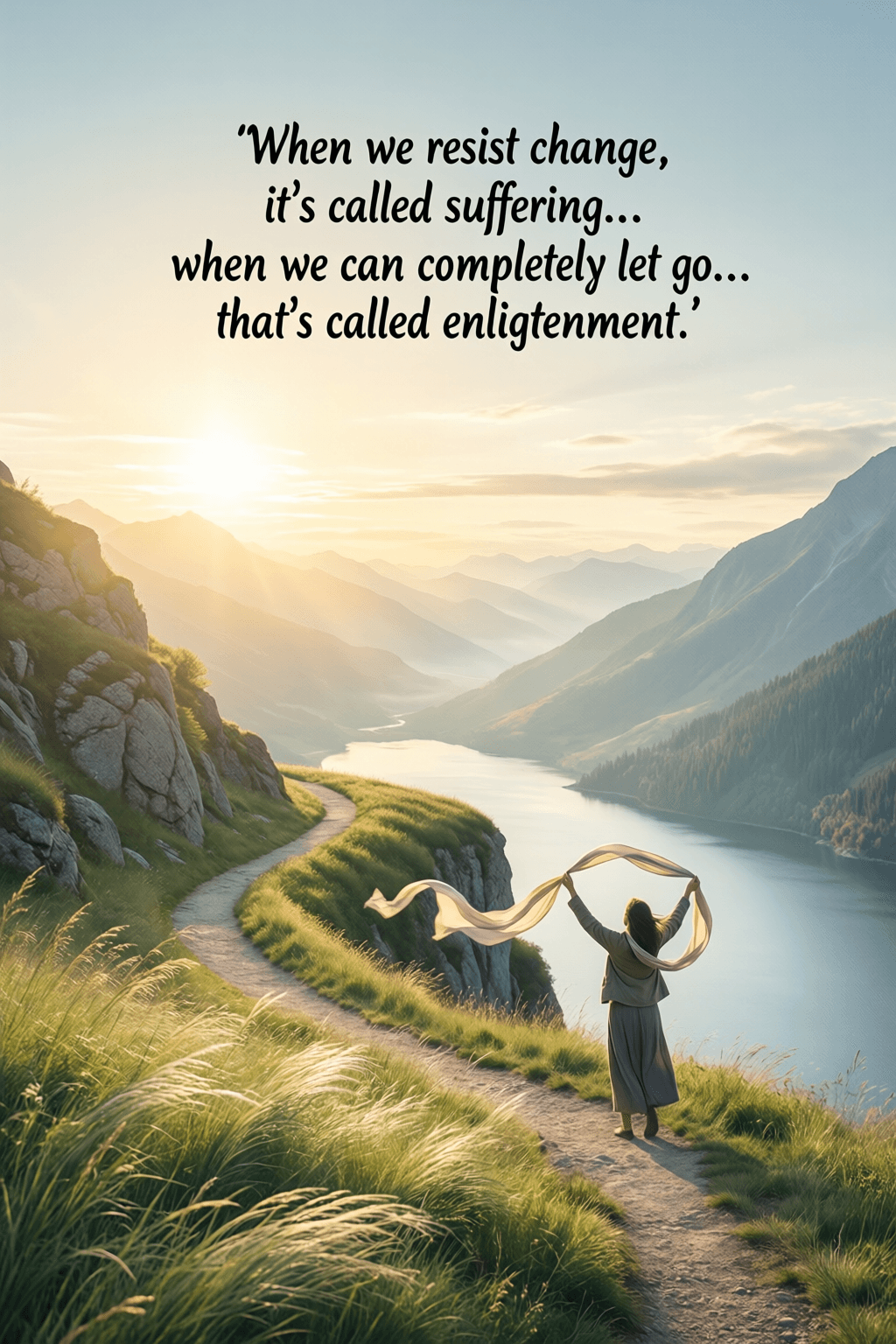
When we resist change, it's called suffering. But when we can completely let go and not struggle against it, that's called enlightenment. — Pema Chödrön
—What lingers after this line?
Resistance as the Root of Suffering
Pema Chödrön’s quote begins with a stark insight: suffering often arises not simply from pain or loss, but from our refusal to accept that life is constantly shifting. We want relationships, identities, and circumstances to remain fixed, and when they do not, the mind tightens in protest. In that sense, suffering is intensified by resistance, because we are fighting both reality and our inability to control it. This idea closely reflects Buddhist teaching, especially the First and Second Noble Truths, which describe suffering and its attachment-based causes. Rather than portraying suffering as punishment, Chödrön frames it as a human reaction to impermanence. Her point is not that change is easy, but that struggling against the unavoidable adds a second layer of pain to the first.
The Nature of Impermanence
From there, the quote naturally leads to the Buddhist principle of impermanence: everything changes, whether we welcome it or not. Seasons turn, bodies age, careers shift, and even our strongest emotions eventually pass. By reminding us of this basic truth, Chödrön invites us to stop treating change as an interruption and begin seeing it as the texture of life itself. This perspective appears throughout Buddhist texts such as the Dhammapada, which repeatedly stresses the fleeting nature of worldly conditions. Likewise, Marcus Aurelius in his Meditations (c. AD 180) observed that all things are in continual transformation. Seen this way, the problem is not change itself, but the expectation that anything should remain permanently ours.
What It Means to Let Go
However, letting go does not mean indifference, passivity, or emotional numbness. Instead, it means releasing the compulsive need to force reality into a shape that comforts us. We can still grieve, care deeply, and take action, yet do so without clinging to the fantasy that we can freeze life in place. In practice, this kind of surrender is active rather than weak. A person losing a job, for example, may first feel fear and disappointment, but genuine letting go begins when they stop asking why this had to happen and start asking what can now be learned or built. Thus, surrender becomes a form of clarity: we stop wasting energy on denial and regain the strength to respond wisely.
Enlightenment as Non-Struggle
Chödrön then uses the word enlightenment not as a mystical prize reserved for saints, but as a state of complete non-struggle with what is. This does not imply liking every event or approving injustice. Rather, it points to a mind so open that it no longer creates extra torment by arguing with reality at every turn. Here her teaching echoes Zen traditions, where awakening often involves seeing directly into the nature of experience without grasping or aversion. Eckhart Tolle’s The Power of Now (1997) similarly popularized the idea that inner peace emerges when we cease psychological resistance to the present moment. In both cases, enlightenment is less about acquiring something new than about dropping the habits that keep us divided against life.
The Courage Hidden in Acceptance
Yet acceptance is often misunderstood as resignation, when in fact it can require extraordinary courage. To accept change is to stand undefended before uncertainty, without the usual armor of denial, blame, or control. That openness feels risky precisely because it asks us to trust ourselves even when the future remains unknown. Many memoirs of illness, grief, and recovery illustrate this truth. Viktor Frankl’s Man’s Search for Meaning (1946), for instance, shows that inner freedom can survive even under extreme conditions when one stops fighting what cannot be altered and focuses on one’s response. In this light, acceptance is not retreat from life but a brave willingness to meet it fully.
A Practical Path for Daily Life
Finally, Chödrön’s insight matters because it transforms ordinary moments, not just dramatic crises. A delayed plan, an unexpected criticism, or a changing relationship can all become opportunities to notice the first impulse of resistance and soften it. Instead of saying, this should not be happening, we can ask, can I be with this as it is, even now? Over time, that small shift changes the emotional atmosphere of life. Mindfulness practices taught by Chödrön in works like When Things Fall Apart (1996) encourage exactly this gentle return to presence. As a result, enlightenment appears less as a distant ideal and more as a daily discipline of loosening our grip, moment by moment, until freedom quietly begins to emerge.
One-minute reflection
What's one small action this suggests?
Related Quotes
6 selectedFind the beauty in imperfection and let it guide you. — Pema Chödrön
Pema Chödrön
This quote encourages us to accept and appreciate flaws rather than striving for unattainable perfection. Imperfection is a natural part of life and holds its own beauty.
Read full interpretation →Impermanence is the only permanent thing in life. Embrace change with open arms. — Thich Nhat Hanh
Thich Nhat Hanh
Thich Nhat Hanh’s timeless message begins with an acknowledgment of life’s ever-shifting landscape. The idea that ‘impermanence is the only permanent thing’ underscores the Buddhist principle that everything is in a stat...
Read full interpretation →The human soul doesn't want to be advised or fixed or saved. It simply wants to be witnessed. Exactly as it is. — Parker J. Palmer
Parker J. Palmer
At its core, Parker J. Palmer’s line shifts attention away from problem-solving and toward presence.
Read full interpretation →A rational person can find peace by cultivating indifference to things outside of their control. — Naval Ravikant
Naval Ravikant
At its heart, Naval Ravikant’s statement echoes a classic Stoic principle: inner peace grows when we stop attaching our well-being to events we cannot govern. Rather than encouraging apathy toward life itself, this kind...
Read full interpretation →Whatever is going to happen will happen, whether we worry or not. — J.K. Rowling
J.K. Rowling
At its core, Rowling’s line reminds us that worry often mistakes itself for control. We rehearse disasters in our minds as if anticipation could alter reality, yet events unfold according to forces far larger than our pr...
Read full interpretation →When you learn how to suffer, you suffer far less. Resilience is not about avoiding the fire; it is about becoming fireproof. — Thich Nhat Hanh
Thich Nhat Hanh
At first glance, Thich Nhat Hanh’s quote appears paradoxical: how could learning to suffer make suffering lighter? Yet his point is that pain intensifies when we resist it, fear it, or treat it as a personal failure.
Read full interpretation →More From Author
More from Pema Chödrön →The only way to move forward is to stop pretending that the past is still happening. — Pema Chödrön
Pema Chödrön’s line begins with a gentle but piercing insight: suffering often persists not only because something painful happened, but because part of us keeps reliving it as if it were still unfolding. In that sense,...
Read full interpretation →The best parts of your life are the ones that happen when absolutely no one is looking. — Pema Chödrön
Pema Chödrön’s quote turns attention away from applause and toward the private texture of living. At first glance, it suggests that life’s richest moments are not always the dramatic ones shared with an audience, but the...
Read full interpretation →Learning is not a sprint toward an end goal; it is a life-long rhythm of shedding what no longer serves you to make room for what does. — Pema Chödrön
At first glance, Pema Chödrön’s reflection challenges one of the most common assumptions about education: that learning is a race with a clear endpoint. Degrees, promotions, and certifications often tempt us to think of...
Read full interpretation →The truth is rarely comfortable, but it is the only thing that will actually set you free. Stop hiding from your reality and start owning your choices. — Pema Chödrön
At its core, Pema Chödrön’s statement argues that freedom does not come from denial, distraction, or carefully managed appearances. Instead, it begins with the willingness to confront what is real, even when that reality...
Read full interpretation →