
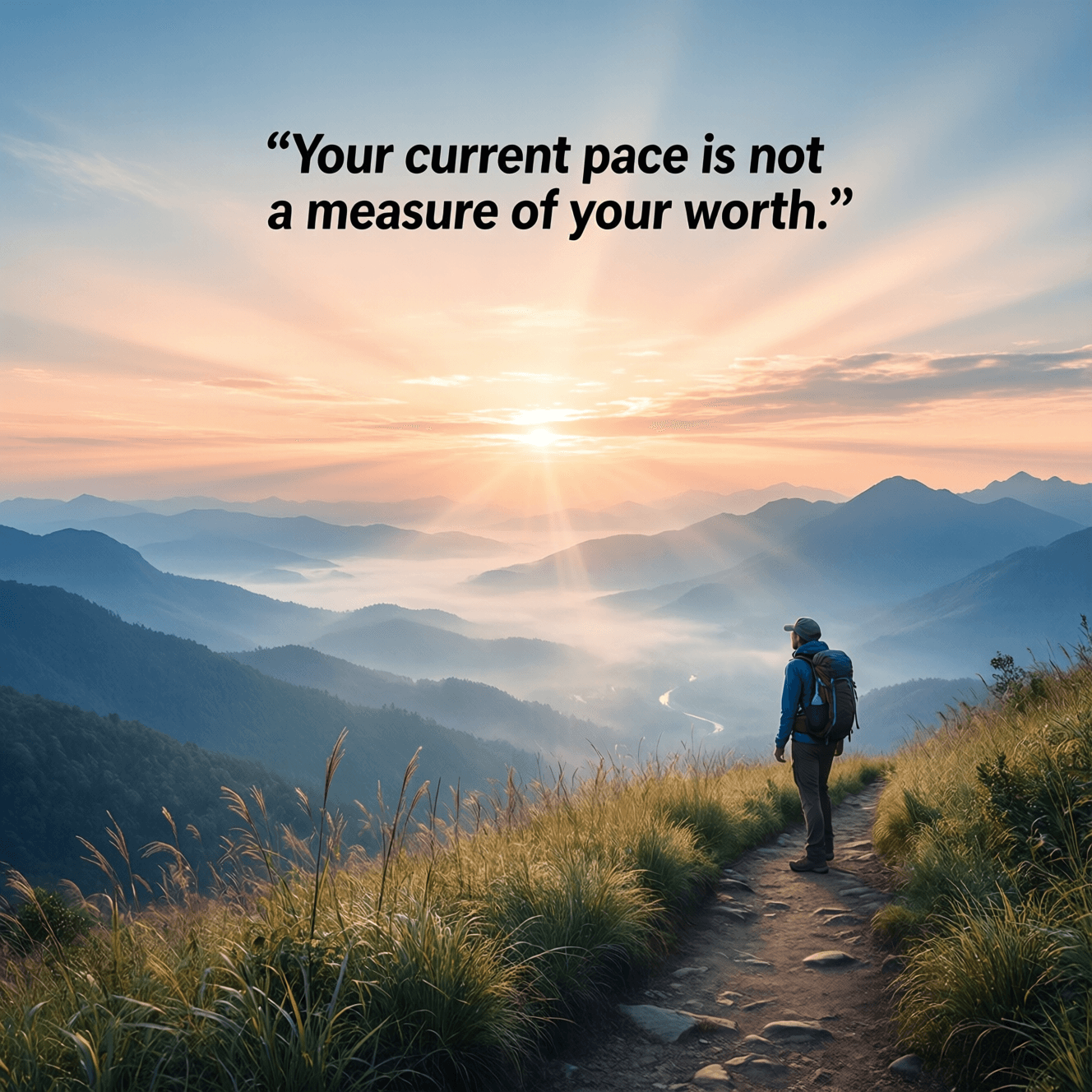
Your current pace is not a measure of your worth. — Unknown
—What lingers after this line?
Decoupling Speed from Value
The quote begins by separating two ideas people often fuse: how fast you’re moving and how valuable you are. In many environments—schools, workplaces, even social media—progress is treated like a scoreboard, which quietly turns time into a moral judgment. Yet pace is simply a description of movement, not a verdict on character. From there, the line invites a shift in self-evaluation: instead of asking, “How quickly am I achieving?” you ask, “What am I learning, building, or healing?” That reframing matters because it treats worth as inherent rather than earned through constant acceleration.
The Trap of Comparison Culture
Once speed is treated as status, comparison becomes the default lens. You notice peers getting promotions, publishing milestones, or posting highlight reels, and your slower season starts to feel like failure. Social psychology has long noted this pull: Leon Festinger’s social comparison theory (1954) describes how people measure themselves against others when objective standards feel unclear. However, comparison usually ignores invisible context—health, resources, caregiving responsibilities, neurodiversity, or sheer luck. Recognizing those unseen variables doesn’t excuse stagnation; it simply restores fairness to the story you tell about yourself.
Seasons of Life and Hidden Work
Even when outward progress stalls, inner progress can be substantial. Some seasons are for laying foundations—therapy, skill-building, grief, recovery, or rebuilding confidence after a setback. Because these efforts don’t always produce immediate, visible results, they are easily mislabeled as “doing nothing,” when they are often the hardest work. In that sense, pace becomes situational rather than personal: a slower tempo may be the appropriate rhythm for the demands of the moment. What looks like delay from the outside can be preparation on the inside.
Rethinking Productivity as a Moral Score
The quote also challenges the modern habit of turning productivity into virtue. When output becomes the measure of goodness, rest starts to feel like laziness and recovery like weakness. Philosophers and critics of industrial modernity have warned about this moralization; for example, Max Weber’s discussion of the Protestant work ethic (1905) describes how labor can become tied to perceived moral standing. By contrast, the quote insists that being human is enough. You can pursue goals and still refuse the idea that falling behind makes you lesser.
Growth That Lasts Often Looks Slow
Sustainable progress is frequently incremental. Skill acquisition research commonly describes learning as non-linear, with plateaus that precede breakthroughs—periods where improvement is happening beneath awareness before it becomes measurable. Athletes know this when training cycles build strength long before performance peaks; musicians know it when technique develops in tedious repetitions that later unlock fluency. So a slower pace can be a sign of depth rather than deficiency. The quote nudges you to value the kind of growth that endures, even if it can’t be rushed.
Practicing Self-Compassion and Recalibration
Finally, the message becomes practical when paired with self-compassion. Kristin Neff’s research on self-compassion (2003) emphasizes treating oneself with the same understanding offered to a friend, especially during difficulty. Instead of using harsh self-talk to speed yourself up, you can use clarity and kindness to choose the next right step. This doesn’t mean abandoning ambition; it means recalibrating metrics. If worth is constant, then pace becomes a flexible strategy—something you adjust to health, purpose, and reality, not something that determines whether you deserve respect.
One-minute reflection
What does this quote ask you to notice today?
Related Quotes
6 selectedYour value is not defined by your visibility. — Unknown
Unknown
The quote draws a clean line between who you are and how often you are seen. It challenges the modern habit of treating attention as evidence of importance, reminding us that value can be intrinsic—rooted in character, s...
Read full interpretation →If your absence doesn't affect them, your presence never mattered. — Unknown
Unknown
The quote frames absence as a revealing experiment: remove yourself, and the reaction—concern, curiosity, indifference—becomes a kind of data. If nothing changes when you’re gone, it suggests your role was never integrat...
Read full interpretation →Rest is a form of resistance; don't let the 'hustle' convince you that your worth is tied to a to-do list. — Unknown
Unknown
The quote opens by flipping a familiar assumption: rest is not a passive lapse in effort but a deliberate stance against pressures that demand constant output. By calling rest “resistance,” it treats downtime as an actio...
Read full interpretation →Your value is not found in your productivity, but in your presence. — Unknown
Unknown
The quote challenges a common modern assumption: that a person’s worth can be measured by output, efficiency, or visible achievements. Instead, it insists that value is inherent and relational—something that exists even...
Read full interpretation →If it costs you your peace, it is too expensive. — Unknown
Unknown
The quote frames peace as a kind of inner currency—finite, valuable, and easily spent. Instead of measuring cost only in money or effort, it asks you to calculate the hidden fees: anxiety, dread, resentment, and the cons...
Read full interpretation →Your worth is not measured by your productivity in a noisy world. — Unknown
Unknown
The quote begins by separating a person’s inherent value from what they produce, pushing back against the quiet assumption that usefulness equals worth. In a culture that praises hustle and visible achievement, it’s easy...
Read full interpretation →More From Author
More from Unknown →The language is the substrate. The architecture is the contract.
The line sets up a deliberate pairing: language lies beneath everything, while architecture governs everything above it. In other words, what you can express determines what you can build, and what you commit to structur...
Read full interpretation →A scroll is not a break; it is a trap disguised as rest. — Unknown
The quote begins by challenging a familiar story we tell ourselves: that a brief scroll is a harmless pause between tasks. On the surface, it looks like recovery—no effort, no decision, no commitment.
Read full interpretation →Don't let your ice cream melt while you're counting someone else's sprinkles. — Unknown
The quote uses ice cream as a simple stand-in for life’s fleeting pleasures: what you have is delicious, but it won’t last forever if you ignore it. Meanwhile, “counting someone else’s sprinkles” captures the habit of mo...
Read full interpretation →If your absence doesn't affect them, your presence never mattered. — Unknown
The quote frames absence as a revealing experiment: remove yourself, and the reaction—concern, curiosity, indifference—becomes a kind of data. If nothing changes when you’re gone, it suggests your role was never integrat...
Read full interpretation →