
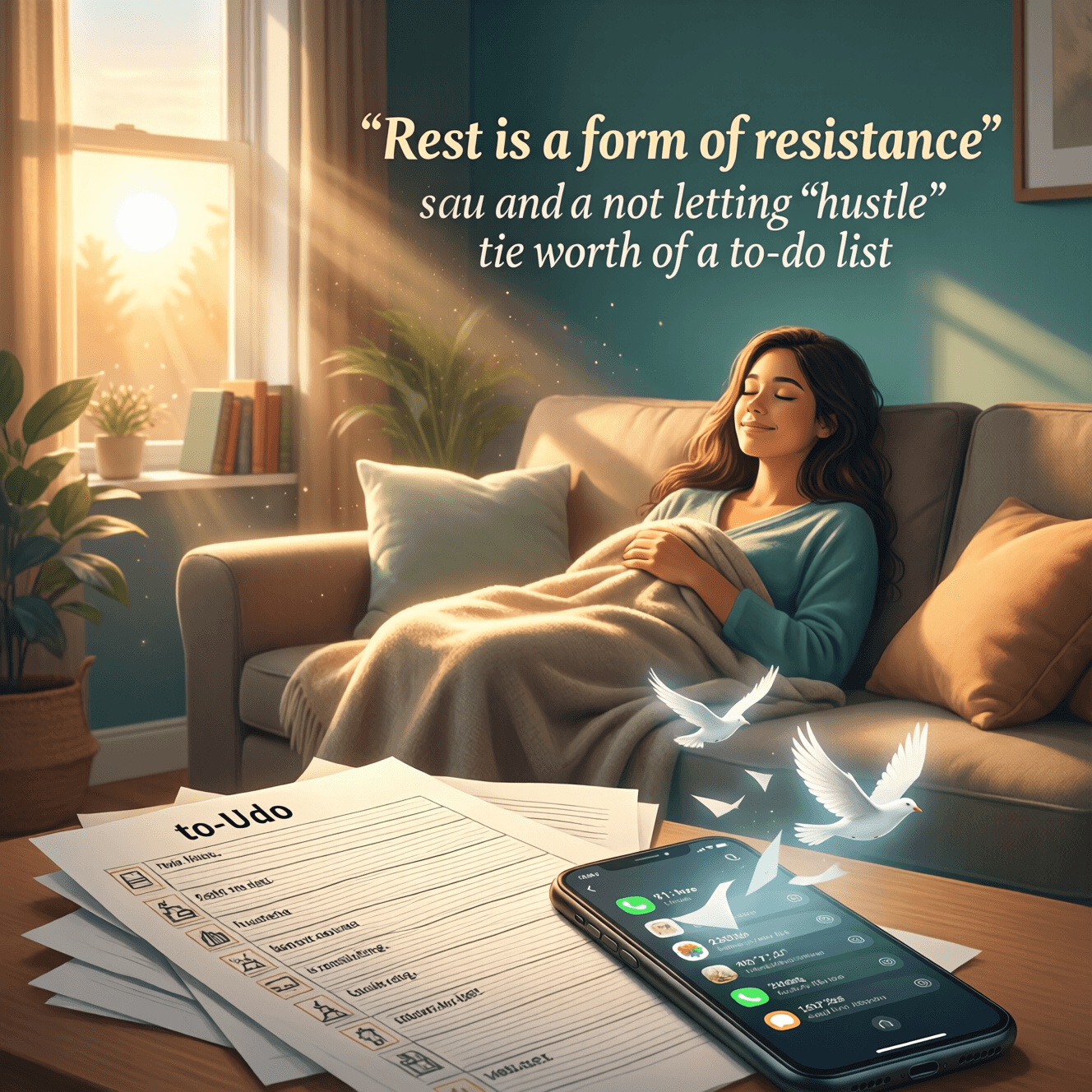
Rest is a form of resistance; don't let the 'hustle' convince you that your worth is tied to a to-do list. — Unknown
—What lingers after this line?
Reframing Rest as an Active Choice
The quote opens by flipping a familiar assumption: rest is not a passive lapse in effort but a deliberate stance against pressures that demand constant output. By calling rest “resistance,” it treats downtime as an action with intent—something chosen, protected, and defended rather than merely taken when everything else is finished. From there, the message hints that exhaustion is often socially engineered. If a culture rewards overwork with praise and visibility, then choosing rest becomes a quiet refusal to participate in that system, a way of asserting control over one’s time and attention.
How Hustle Culture Redefines Human Value
The warning about “the ‘hustle’” points to a worldview where productivity becomes a moral measure. In that mindset, busyness looks like virtue, and stillness can be misread as laziness. The danger is subtle: once productivity is treated as identity, taking breaks feels like falling behind as a person, not merely pausing a task. This is why the quote insists on vigilance—“don’t let” it convince you. The persuasion is constant, arriving through slogans, workplace norms, and even casual questions like “What are you working on now?” until a life begins to look like a performance of usefulness.
The To-Do List as a Trap
A to-do list is supposed to be a tool, but the quote suggests it can become a verdict. When worth is “tied” to tasks, completion offers only temporary relief, because the list regenerates. What begins as organization can slowly turn into a scoreboard where your value rises and falls with how much you checked off today. Seen this way, the list stops serving you and starts defining you. The quote argues for a reversal: tasks should support a meaningful life, not replace it, and productivity should be a strategy you use—not a standard that uses you.
Rest Protects Health, Creativity, and Clarity
Once worth is detached from output, rest can be recognized for what it does: it restores the mind and body so you can think, feel, and choose more clearly. Sleep and downtime are not indulgences tacked onto “real work”; they are prerequisites for sustained attention, emotional regulation, and long-term health. Moreover, rest often enables the very insights hustle culture claims to prize. Many people notice their best ideas arrive on a walk, in the shower, or after a good night’s sleep—moments when the brain can integrate and wander instead of constantly produce.
The Social and Ethical Dimension of Rest
Calling rest “resistance” also implies community impact. When people normalize overwork, they raise expectations for everyone, making rest feel like a privilege rather than a right. By resting openly and unapologetically, a person can help reset norms—signaling that boundaries are legitimate and that care is not something to earn. This idea echoes themes in Tricia Hersey’s *Rest Is Resistance* (2022), which argues that rest confronts systems that profit from burnout and chronic urgency. In that light, resting is not only personal maintenance; it becomes a small political act of refusing extraction.
Practicing Resistance Without Losing Ambition
The quote doesn’t condemn goals; it challenges the equation of goals with identity. A balanced reading allows ambition to remain, but places it inside humane limits. Rest becomes part of the plan rather than evidence that you lack discipline, and success is measured by sustainability as well as achievement. Practically, this can look like setting non-negotiable downtime, refusing “busy” as a badge of honor, and defining worth in broader terms—relationships, integrity, learning, and joy. In the end, the quote urges a simple rebellion: you are already valuable, even when nothing gets checked off.
One-minute reflection
What feeling does this quote bring up for you?
Related Quotes
6 selectedIf your absence doesn't affect them, your presence never mattered. — Unknown
Unknown
The quote frames absence as a revealing experiment: remove yourself, and the reaction—concern, curiosity, indifference—becomes a kind of data. If nothing changes when you’re gone, it suggests your role was never integrat...
Read full interpretation →Rest is a sacred act of defiance against a world that demands your exhaustion. — Unknown
Unknown
The quote begins by naming an atmosphere many people recognize: a culture that quietly equates worth with output and treats fatigue as proof of commitment. In workplaces, schools, and even social media feeds, being busy...
Read full interpretation →Rest is a strategic necessity, not a reward. Your brain needs a software update, not more browser tabs. — Unknown
Unknown
The quote challenges a common habit: treating rest as something you “earn” only after you’ve proved your worth through nonstop output. Instead, it frames rest as a strategic necessity—closer to maintenance than indulgenc...
Read full interpretation →Rest is the new flex. If your only status symbol is a packed calendar, you're not successful; you're just a sentient to-do list in need of a nap. — Unknown
Unknown
The quote flips a familiar social script: instead of admiring exhaustion as proof of importance, it suggests that rest has become the real marker of a well-lived life. In that sense, “rest is the new flex” isn’t about la...
Read full interpretation →Your current pace is not a measure of your worth. — Unknown
Unknown
The quote begins by separating two ideas people often fuse: how fast you’re moving and how valuable you are. In many environments—schools, workplaces, even social media—progress is treated like a scoreboard, which quietl...
Read full interpretation →Rest is a strategy, not a luxury; recovery is the foundation of every great performance. — Unknown
Unknown
The quote overturns a common assumption: that rest is what remains after “real work” is done. Instead, it frames rest as an intentional choice—something planned with the same seriousness as training, studying, or buildin...
Read full interpretation →More From Author
More from Unknown →The language is the substrate. The architecture is the contract.
The line sets up a deliberate pairing: language lies beneath everything, while architecture governs everything above it. In other words, what you can express determines what you can build, and what you commit to structur...
Read full interpretation →A scroll is not a break; it is a trap disguised as rest. — Unknown
The quote begins by challenging a familiar story we tell ourselves: that a brief scroll is a harmless pause between tasks. On the surface, it looks like recovery—no effort, no decision, no commitment.
Read full interpretation →Don't let your ice cream melt while you're counting someone else's sprinkles. — Unknown
The quote uses ice cream as a simple stand-in for life’s fleeting pleasures: what you have is delicious, but it won’t last forever if you ignore it. Meanwhile, “counting someone else’s sprinkles” captures the habit of mo...
Read full interpretation →If your absence doesn't affect them, your presence never mattered. — Unknown
The quote frames absence as a revealing experiment: remove yourself, and the reaction—concern, curiosity, indifference—becomes a kind of data. If nothing changes when you’re gone, it suggests your role was never integrat...
Read full interpretation →