
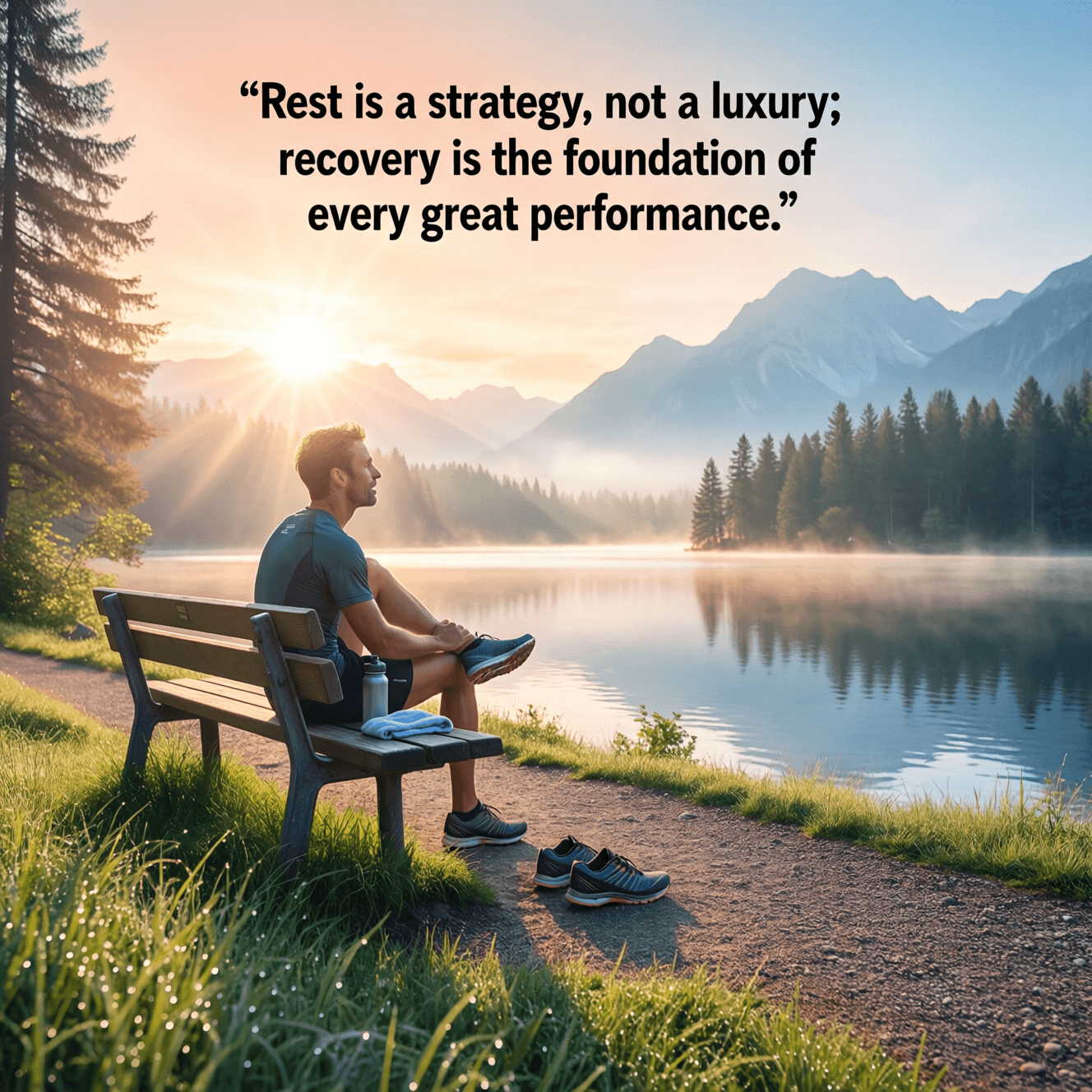
Rest is a strategy, not a luxury; recovery is the foundation of every great performance. — Unknown
—What lingers after this line?
Reframing Rest as Deliberate Tactics
The quote overturns a common assumption: that rest is what remains after “real work” is done. Instead, it frames rest as an intentional choice—something planned with the same seriousness as training, studying, or building. By calling it a strategy rather than a luxury, it implies that high performers don’t wait to collapse; they schedule recovery to protect the quality of what they do. This shift in mindset matters because it treats energy as a finite resource to be managed. Once rest becomes part of the plan, it stops feeling like indulgence and starts functioning like maintenance—quietly preventing the breakdowns that derail long-term progress.
Recovery as the Hidden Half of Work
From there, the quote argues that recovery isn’t merely helpful—it is foundational. In many fields, the visible performance is only the final layer built atop invisible renewal: repaired muscles, restored attention, stabilized mood, and replenished motivation. What looks like “talent” in the spotlight often rests on routines that happen offstage. This is why recovery can be more than downtime; it’s where adaptation occurs. Training provides the stimulus, but the body and mind consolidate gains during rest—an idea echoed in exercise science where improvements arise during recovery periods rather than during the workout itself.
The Physiology of Performance Under Stress
Building on that foundation, rest can be understood as a biological reset. Intense effort activates stress systems—useful in short bursts, costly when sustained. Sleep and restorative breaks help regulate hormones and repair tissue, while also supporting immune function and emotional regulation. Even elite routines reflect this: many top athletes treat sleep as non-negotiable because fatigue quietly erodes speed, coordination, and judgment. In that sense, recovery isn’t passive; it’s active restoration. When the body is under-recovered, the same workload produces less output, higher injury risk, and slower learning—making “more grind” a surprisingly inefficient response.
Mental Recovery and Cognitive Sharpness
Next, the quote applies just as strongly to mental performance. Deep work requires attention, working memory, and self-control—capacities that degrade with sustained strain. Strategic rest, whether a walk, a change of environment, or true time off, helps the brain reset its ability to focus and make sound decisions. A simple example appears in knowledge work: a programmer stuck on a bug late at night may solve it in minutes the next morning after sleep. The improvement isn’t magic; it reflects restored cognitive resources and, often, better consolidation of learning—showing how recovery can directly raise the ceiling on performance.
Sustainability: Avoiding Burnout as a Performance Goal
As the idea broadens, recovery becomes a way to protect longevity. Burnout is rarely caused by effort alone; it often comes from prolonged effort without adequate recovery, compounded by a sense of helplessness or misaligned incentives. When rest is treated as optional, people may achieve short bursts of productivity but struggle to sustain excellence. By contrast, strategic recovery supports consistency—the trait most associated with mastery. The quote’s emphasis on foundations suggests that peak results are less about occasional heroic pushes and more about building a system where high output can be repeated without breaking the person producing it.
Putting Strategic Rest Into Practice
Finally, treating rest as strategy implies planning it with intent. That can mean prioritizing sleep, designing training cycles with deload weeks, taking real weekends, or using micro-breaks during intense cognitive tasks. Even small rituals—like shutting work down at a fixed time or creating a wind-down routine—turn recovery into something dependable rather than accidental. When these choices are made consistently, performance becomes more stable and less fragile. The quote’s core promise is straightforward: greatness is not built only in exertion, but in the structured renewal that makes exertion effective again tomorrow.
One-minute reflection
Where does this idea show up in your life right now?
Related Quotes
6 selectedRest is a strategic necessity, not a reward. Your brain needs a software update, not more browser tabs. — Unknown
Unknown
The quote challenges a common habit: treating rest as something you “earn” only after you’ve proved your worth through nonstop output. Instead, it frames rest as a strategic necessity—closer to maintenance than indulgenc...
Read full interpretation →Rest is the new flex. If your only status symbol is a packed calendar, you're not successful; you're just a sentient to-do list in need of a nap. — Unknown
Unknown
The quote flips a familiar social script: instead of admiring exhaustion as proof of importance, it suggests that rest has become the real marker of a well-lived life. In that sense, “rest is the new flex” isn’t about la...
Read full interpretation →Rest is a form of resistance; don't let the 'hustle' convince you that your worth is tied to a to-do list. — Unknown
Unknown
The quote opens by flipping a familiar assumption: rest is not a passive lapse in effort but a deliberate stance against pressures that demand constant output. By calling rest “resistance,” it treats downtime as an actio...
Read full interpretation →Rest is not the opposite of productivity. It is a vital part of it. Sustainable well-being requires cycles of effort and restoration. — Michelle Pearce
Michelle Pearce
At first glance, Michelle Pearce’s statement challenges a deeply ingrained modern assumption: that productivity and rest are enemies competing for the same limited time. Instead, she reframes rest as a functional partner...
Read full interpretation →Rest is not a reward; it is a prerequisite for a meaningful life.
Unknown
The quote overturns a common moral storyline: work earns rest, and rest is a prize for those who have “done enough.” Instead, it argues that rest comes first—not as indulgence, but as the basic condition that makes a lif...
Read full interpretation →Rest is not a departure from productivity; it is the essential rhythm that makes all movement possible. — Octavia Butler
Octavia Butler
At first glance, Octavia Butler’s statement challenges a culture that equates constant motion with success. Yet her insight reframes rest not as an interruption of meaningful work, but as the hidden condition that allows...
Read full interpretation →More From Author
More from Unknown →The language is the substrate. The architecture is the contract.
The line sets up a deliberate pairing: language lies beneath everything, while architecture governs everything above it. In other words, what you can express determines what you can build, and what you commit to structur...
Read full interpretation →A scroll is not a break; it is a trap disguised as rest. — Unknown
The quote begins by challenging a familiar story we tell ourselves: that a brief scroll is a harmless pause between tasks. On the surface, it looks like recovery—no effort, no decision, no commitment.
Read full interpretation →Don't let your ice cream melt while you're counting someone else's sprinkles. — Unknown
The quote uses ice cream as a simple stand-in for life’s fleeting pleasures: what you have is delicious, but it won’t last forever if you ignore it. Meanwhile, “counting someone else’s sprinkles” captures the habit of mo...
Read full interpretation →If your absence doesn't affect them, your presence never mattered. — Unknown
The quote frames absence as a revealing experiment: remove yourself, and the reaction—concern, curiosity, indifference—becomes a kind of data. If nothing changes when you’re gone, it suggests your role was never integrat...
Read full interpretation →