
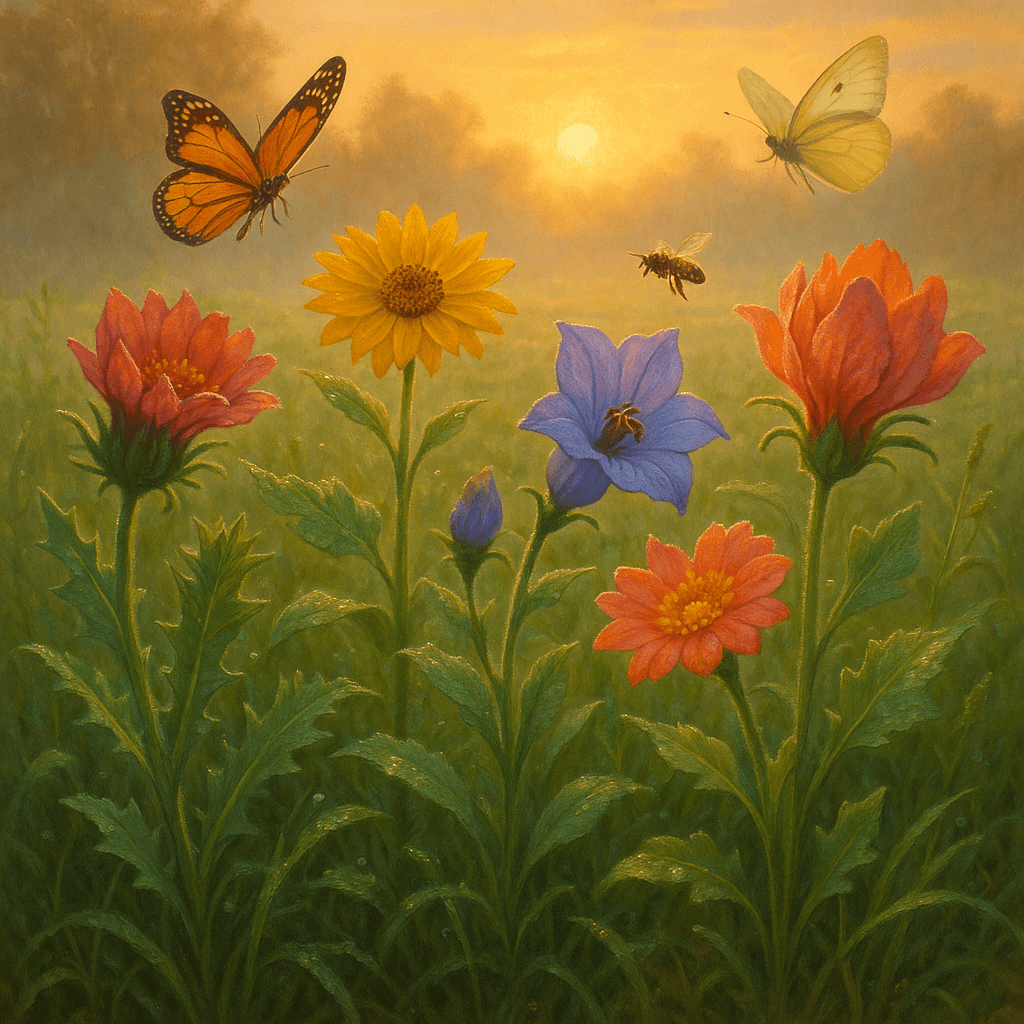
A weed is no more than a flower in disguise. — James Lowell
—What lingers after this line?
Perceptions Shape Value
James Lowell’s statement draws attention to the powerful role perception plays in defining what is considered valuable or undesirable. By asserting that a weed is just a ‘flower in disguise,’ he destabilizes the rigid boundaries society draws between the beautiful and the unwanted. This reframing compels us to question the criteria by which we judge natural growth and, by extension, many aspects of our lives.
Nature’s Bias and Human Attitudes
Moving beyond semantics, our tendency to favor certain plants over others mirrors human biases and cultural preferences. The Victorian craze for manicured gardens led to the vilification of wildflowers, many of which were merely weeds by another name. Dandelions, once cherished for their medicinal properties, became targets of eradication—a shift driven not by botanical facts, but by evolving aesthetic values.
Historical Case Studies of Reappraisal
This theme of reevaluation is not new. For example, the tulip, now celebrated as a symbol of beauty in Dutch culture following ‘tulip mania’ of the 17th century, was once viewed with suspicion when first introduced to Europe. Similarly, milkweed, long cursed by gardeners, has recently gained appreciation for its crucial role in monarch butterfly conservation, illustrating how shifting priorities can transform weeds into cherished flora.
Metaphor for Human Potential
Expanding the metaphor, Lowell’s quote can be interpreted as a reflection on human potential. Just as flowers masquerade as weeds, individuals may be undervalued or misunderstood due to external circumstances or prevailing social judgments. Classic literature, such as Jean Valjean’s journey in Victor Hugo’s *Les Misérables*, showcases transformation from perceived outcast to heroic figure, reinforcing the idea that true worth often lies beneath the surface.
Embracing Diversity and Rethinking Judgment
Ultimately, Lowell’s perspective encourages a broader embrace of diversity, whether in nature or among people. By recognizing the latent beauty and utility in what was once dismissed, society can foster appreciation and innovation. In the modern environmental movement, this mindset shift has inspired rewilding efforts and a renewed celebration of native plants—demonstrating the enduring wisdom behind seeing a flower, even where others see only a weed.
Recommended Reading
As an Amazon Associate, we earn from qualifying purchases.
One-minute reflection
Why might this line matter today, not tomorrow?
Related Quotes
6 selectedA weed is no more than a flower in disguise. — James Lowell
James Lowell
Lowell’s quote urges us to reconsider the arbitrary labels we assign to the natural world. The term 'weed' often carries a negative connotation, suggesting an undesirable or invasive plant.
Read full interpretation →What is behind your eyes holds more power than what is in front of them. — Gary Zukav
Gary Zukav
At its core, Gary Zukav’s quote argues that the mind’s inner landscape—beliefs, memories, expectations, and values—has greater influence than external appearances. What we carry ‘behind our eyes’ determines how we interp...
Read full interpretation →There are things known and there are things unknown, and in between are the doors of perception. — Aldous Huxley
Aldous Huxley
Aldous Huxley’s line divides reality into three striking regions: what we know, what we do not know, and the mysterious passage between them. Rather than treating knowledge and ignorance as fixed opposites, he imagines p...
Read full interpretation →We are not here to copy the reality that is already sold to us, but to use our own lenses to reshape the world we see. — Georgia O'Keeffe
Georgia O'Keeffe
Georgia O’Keeffe’s statement begins with a refusal: we are not here merely to reproduce a ready-made version of reality. In that sense, she challenges the passive habit of accepting what culture, commerce, and convention...
Read full interpretation →It is not activity that disturbs people, but false conceptions of things that drive them mad. — Marcus Aurelius
Marcus Aurelius
At the heart of this saying lies a classic Stoic insight: external events do not automatically shatter our peace; rather, our interpretations give them emotional force. Although the quote is often attributed to Marcus Au...
Read full interpretation →It isn't the things themselves that disturb people, but the judgments that they form about them. — Epictetus
Epictetus
Epictetus distills a central Stoic principle into a single striking claim: external events do not wound us as deeply as our interpretations of them. In the Enchiridion (c.
Read full interpretation →More From Author
More from James Lowell →Creativity is not the finding of a thing, but the making something out of it after it is found. — James Russell Lowell
James Russell Lowell’s line shifts attention away from the romantic myth of the sudden genius who invents from nothing. Instead, he argues that creativity truly begins after the initial encounter—after an idea, object, p...
Read full interpretation →A weed is no more than a flower in disguise. — James Lowell
Lowell’s quote urges us to reconsider the arbitrary labels we assign to the natural world. The term 'weed' often carries a negative connotation, suggesting an undesirable or invasive plant.
Read full interpretation →