
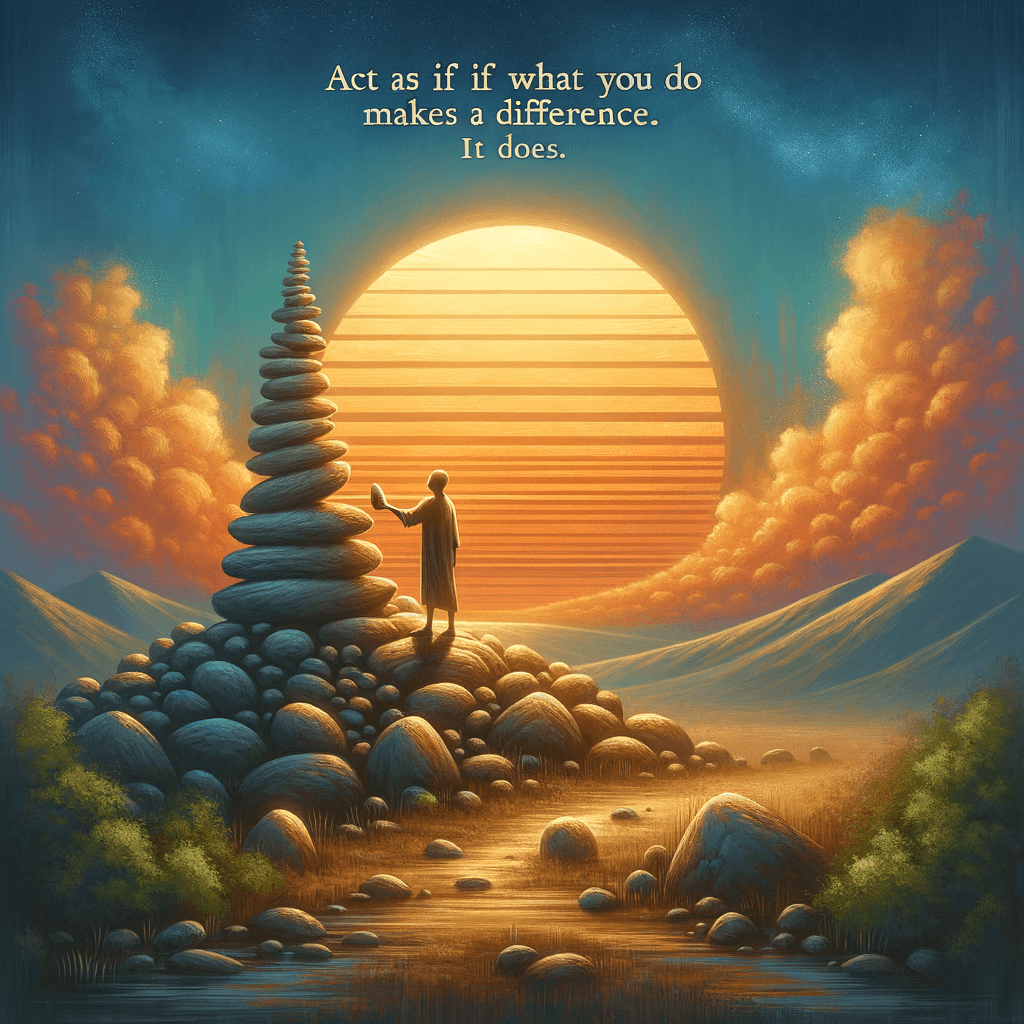
Act as if what you do makes a difference. It does. - William James
—What lingers after this line?
Personal Responsibility
This quote emphasizes the importance of individual actions and encourages people to take responsibility for their behavior. It underscores that every action, no matter how small, can have a significant impact.
Optimism and Positivity
It promotes a positive mindset by urging individuals to believe that their contributions matter. By maintaining this optimistic outlook, people are more likely to be proactive and engaged in making positive changes.
Empowerment
The quote empowers individuals by reinforcing the idea that they have the power to affect change. It encourages them to take initiative and be confident in their ability to make a difference.
Cumulative Impact
It highlights the cumulative effect of individual actions. Small efforts by many people can lead to significant outcomes, which is why it is essential to act with intention and purpose.
Philosophical Context
William James was a philosopher and psychologist in the late 19th and early 20th centuries. His work often focused on pragmatism and the belief that the truth of ideas is determined by their practical effects. This quote reflects his belief in the tangible impact of individual actions.
One-minute reflection
What feeling does this quote bring up for you?
Related Quotes
6 selectedAction may not always bring happiness, but there is no happiness without action. — William James
William James
This quote emphasizes that while taking action does not guarantee happiness, happiness cannot be achieved without taking action. It underlines the importance of being proactive in life.
Read full interpretation →Shine your light and make a positive impact on the world; every small act of kindness creates a ripple of hope. — Unknown.
Unknown
This quote emphasizes the significance of even the smallest acts of kindness. It suggests that each action, no matter how minor, contributes to creating a more compassionate and hopeful world.
Read full interpretation →You cannot command things, but you can command yourself. — Michael D. Pollock
Michael D. Pollock
At first glance, Michael D. Pollock’s line draws a sharp boundary between the outer world and the inner one.
Read full interpretation →A boundary is not a wall; it is a door with a lock that you control. — Annie Wright
Annie Wright
At first glance, Annie Wright’s quote corrects a common misunderstanding: people often treat boundaries as acts of distance or punishment, when in fact they are tools of intentional relationship. A wall shuts everyone ou...
Read full interpretation →When you feel like you are at a dead end, remember that you are at a place where you can choose a different path. — Haemin Sunim
Haemin Sunim
At first glance, a dead end feels like failure, as though movement itself has been denied. Yet Haemin Sunim’s insight gently reverses that impression: what seems like a wall may actually be a point of decision.
Read full interpretation →The boundaries of your life are merely a creation of the self. — Robin Sharma
Robin Sharma
Robin Sharma’s line reframes “boundaries” as something less like a fence in the world and more like a frame in the mind. What we often call limits—who we are, what we can do, what we deserve—can be stories we repeat unti...
Read full interpretation →More From Author
More from William James →No matter how full a reservoir of maxims one may possess, if one has not taken advantage of every concrete opportunity to act, one's character may remain entirely unaffected. — William James
At first glance, William James draws a sharp line between knowing and becoming. A person may store up countless moral sayings, noble principles, and wise resolutions, yet these remain largely ornamental if they never pas...
Read full interpretation →It is our attitude at the beginning of a difficult task which, more than anything else, will affect its successful outcome. — William James
William James argues that the decisive moment in any hard undertaking arrives before the real work is even underway. In this view, success does not begin with talent, resources, or luck, but with the posture of mind we b...
Read full interpretation →Great emergencies and crises show us how much greater our vital resources are than we had supposed. — William James
William James suggests that ordinary life can conceal our deepest capacities. In routine conditions, people often act within familiar limits, assuming those limits define their true strength.
Read full interpretation →We are like islands in the sea, separate on the surface but connected in the deep. — William James
William James’s metaphor begins with a simple visual truth: islands appear isolated when viewed from above. In the same way, human beings often seem self-contained, bounded by private thoughts, personal histories, and in...
Read full interpretation →