
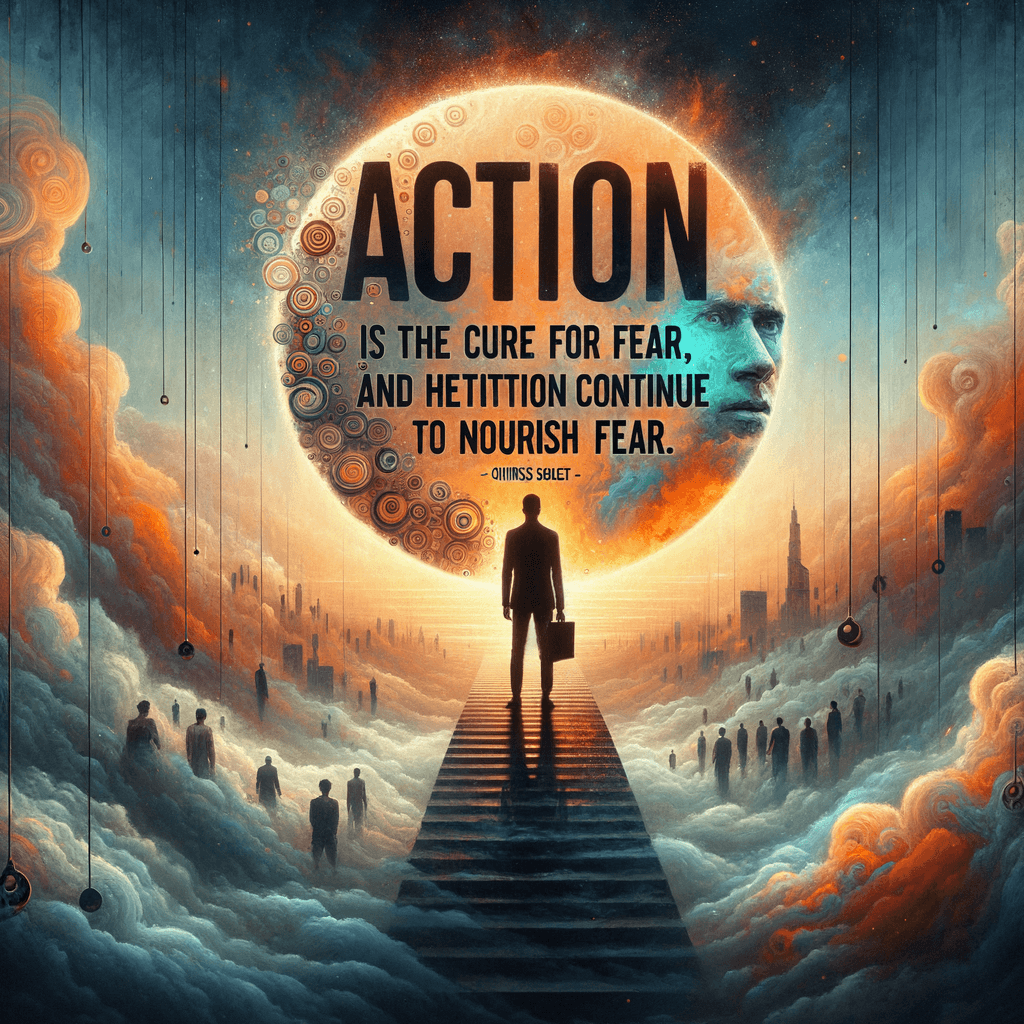
Action is a great remedy for fear, while hesitation and procrastination will continually nourish it. — Dale Carnegie
—What lingers after this line?
Conquering Fear Through Action
This quote highlights that taking action can help overcome fear. By making decisions and taking steps forward, one can confront and reduce the impact of fear.
Dangers of Hesitation
Hesitation and procrastination can exacerbate fear. Delaying actions can allow fear to grow and become more overwhelming, making it harder to address the initial concern.
Psychological Impact
The quote touches on the psychological effects of action versus inaction. Action creates a sense of control and progress, while hesitation can lead to increased anxiety and fear.
Proactivity and Confidence
Taking action boosts confidence and fosters a proactive mindset. Addressing fears head-on builds resilience and a greater sense of self-efficacy.
Dale Carnegie’s Philosophy
Dale Carnegie, a well-known writer and lecturer, emphasized the power of action and decision-making in personal development. His works often focus on practical steps to improve one's life and overcome psychological barriers.
One-minute reflection
Where does this idea show up in your life right now?
Related Quotes
6 selectedInaction breeds doubt and fear. Action breeds confidence and courage. If you want to conquer fear, do not sit home and think about it. Go out and get busy. — Dale Carnegie
Dale Carnegie
This quote emphasizes the importance of taking action rather than being passive. It suggests that engaging in activities and tasks can help overcome feelings of doubt and fear.
Read full interpretation →When I tell my kids I will do something in a minute, what I'm really saying is: Please forget. — Karen Salmansohn
Karen Salmansohn
Karen Salmansohn’s line turns an ordinary parental phrase into a small confession. When a parent says, “in a minute,” the words sound like a promise, but the hidden hope is that the child’s request will quietly vanish.
Read full interpretation →People say nothing is impossible, but I do nothing every day. — A.A. Milne
A. A. Milne
At first glance, A.A. Milne’s line turns a familiar motivational slogan inside out.
Read full interpretation →You don't have to bully yourself out of feeling fear. You just have to move while it's still there. — Annie Wright
Annie Wright
At its core, Annie Wright’s quote challenges the common belief that courage begins only after fear has disappeared. Instead, it reframes fear as something that can accompany action rather than prevent it.
Read full interpretation →The economy can take your money. A crisis can take your opportunities. But fear can take your judgment—and that is the loss most people never recover from. — Epictetus
Epictetus
At first glance, this saying draws a sharp line between what happens to us and what happens within us. Money can vanish in a recession, and opportunities can disappear when markets collapse, yet Epictetus argues that the...
Read full interpretation →Whatever you want to do, do it now. — Michael Landon
Michael Landon
Michael Landon’s line turns a private wish into a public command: if something matters, do it now. At first glance, the statement sounds simple, yet its force lies in how it strips away excuses, postponements, and the fa...
Read full interpretation →More From Author
More from Dale Carnegie →Inaction breeds doubt and fear. Action breeds confidence and courage. If you want to conquer fear, do not sit home and think about it. Go out and get busy. — Dale Carnegie
This quote emphasizes the importance of taking action rather than being passive. It suggests that engaging in activities and tasks can help overcome feelings of doubt and fear.
Read full interpretation →Do the hard jobs first. The easy jobs will take care of themselves. — Dale Carnegie
This quote emphasizes the importance of prioritizing difficult tasks over easier ones. By tackling challenging work first, one can ensure that essential and potentially time-consuming tasks are completed without procrast...
Read full interpretation →Your ability to communicate with others will account for 85% of your success in life. — Dale Carnegie
This quote emphasizes that the ability to effectively communicate with others is a major factor in achieving success. Carnegie suggests that success is not determined solely by individual talent or intelligence, but by o...
Read full interpretation →People rarely succeed unless they have fun in what they are doing. — Dale Carnegie
This quote suggests that people are more likely to achieve success when they derive enjoyment from their work. Passion and enjoyment fuel motivation and drive, leading to better outcomes.
Read full interpretation →