
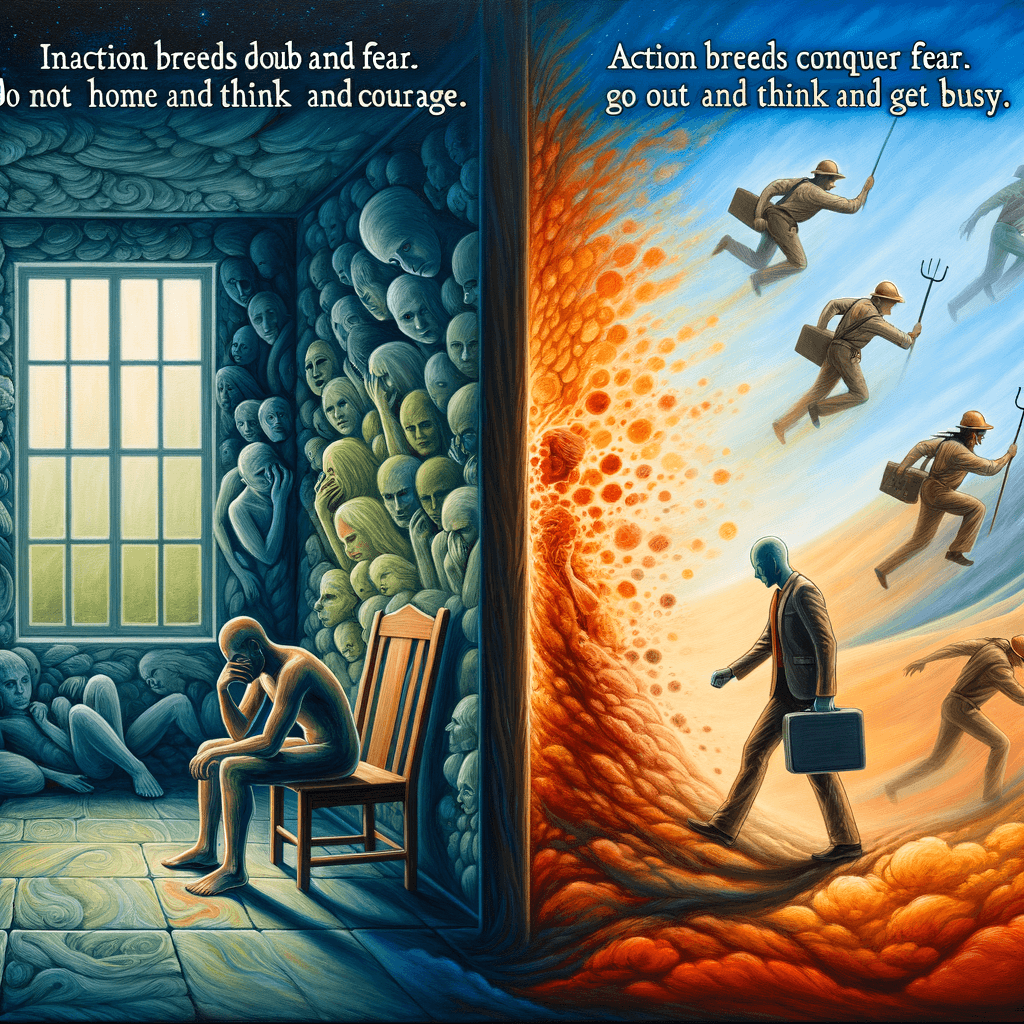
Inaction breeds doubt and fear. Action breeds confidence and courage. If you want to conquer fear, do not sit home and think about it. Go out and get busy. — Dale Carnegie
—What lingers after this line?
Proactive Approach
This quote emphasizes the importance of taking action rather than being passive. It suggests that engaging in activities and tasks can help overcome feelings of doubt and fear.
Psychological Impact of Action
Action leads to a sense of accomplishment and progress, which can boost confidence and cultivate courage. It highlights how engaging in purposeful activity can positively affect one's mental state.
Conquering Fear
Dale Carnegie advises that facing one's fears through proactive steps is more effective than avoiding them. Conquering fear involves confronting it directly with action.
Avoiding Paralysis by Analysis
Focusing too much on thinking and planning without action can lead to overthinking and increased anxiety. Instead, taking even small steps can prevent being overwhelmed by fear and doubt.
Practical Wisdom for Daily Life
The quote offers practical advice for dealing with everyday challenges and fears. It encourages individuals to take initiative and engage in constructive activities to build their self-assurance.
Historical Context
Dale Carnegie, a renowned writer and lecturer on self-improvement and interpersonal skills, lived in the early 20th century. His teachings often focused on the importance of action and positive thinking to achieve personal and professional success.
One-minute reflection
Why might this line matter today, not tomorrow?
Related Quotes
6 selectedAction is a great remedy for fear, while hesitation and procrastination will continually nourish it. — Dale Carnegie
Dale Carnegie
This quote highlights that taking action can help overcome fear. By making decisions and taking steps forward, one can confront and reduce the impact of fear.
Read full interpretation →The way to do a great deal is to keep on doing a little. The way to do nothing at all is to be continually resolving that you will do everything. — C.H. Spurgeon
C.H. Spurgeon
Spurgeon’s statement begins with a practical paradox: great accomplishments are rarely born from dramatic bursts of effort, but from the steady repetition of small acts. By saying that “a great deal” is done by “doing a...
Read full interpretation →To be courageous is to act with the heart. — Molière
Molière
Molière’s line suggests that courage is not merely the absence of fear, but the decision to move despite it. By connecting courage with the heart, he frames bravery as an emotional and moral act rather than a simple disp...
Read full interpretation →The best people possess a feeling for beauty, the courage to take risks, the discipline to tell the truth, the capacity for sacrifice. — Ernest Hemingway
Ernest Hemingway
Hemingway’s line presents goodness not as politeness or success, but as a demanding inner code. The “best people” are those who combine sensitivity, bravery, honesty, and self-denial—qualities that do not always coexist...
Read full interpretation →No matter how full a reservoir of maxims one may possess, if one has not taken advantage of every concrete opportunity to act, one's character may remain entirely unaffected. — William James
William James
At first glance, William James draws a sharp line between knowing and becoming. A person may store up countless moral sayings, noble principles, and wise resolutions, yet these remain largely ornamental if they never pas...
Read full interpretation →If you are not willing to look stupid, nothing great is ever going to happen to you. — Julia Cameron
Julia Cameron
Julia Cameron’s remark begins with a hard truth: many people do not fail because they lack talent, but because they fear embarrassment. In that sense, ‘looking stupid’ becomes shorthand for being seen trying, stumbling,...
Read full interpretation →More From Author
More from Dale Carnegie →Action is a great remedy for fear, while hesitation and procrastination will continually nourish it. — Dale Carnegie
This quote highlights that taking action can help overcome fear. By making decisions and taking steps forward, one can confront and reduce the impact of fear.
Read full interpretation →Do the hard jobs first. The easy jobs will take care of themselves. — Dale Carnegie
This quote emphasizes the importance of prioritizing difficult tasks over easier ones. By tackling challenging work first, one can ensure that essential and potentially time-consuming tasks are completed without procrast...
Read full interpretation →Your ability to communicate with others will account for 85% of your success in life. — Dale Carnegie
This quote emphasizes that the ability to effectively communicate with others is a major factor in achieving success. Carnegie suggests that success is not determined solely by individual talent or intelligence, but by o...
Read full interpretation →People rarely succeed unless they have fun in what they are doing. — Dale Carnegie
This quote suggests that people are more likely to achieve success when they derive enjoyment from their work. Passion and enjoyment fuel motivation and drive, leading to better outcomes.
Read full interpretation →