
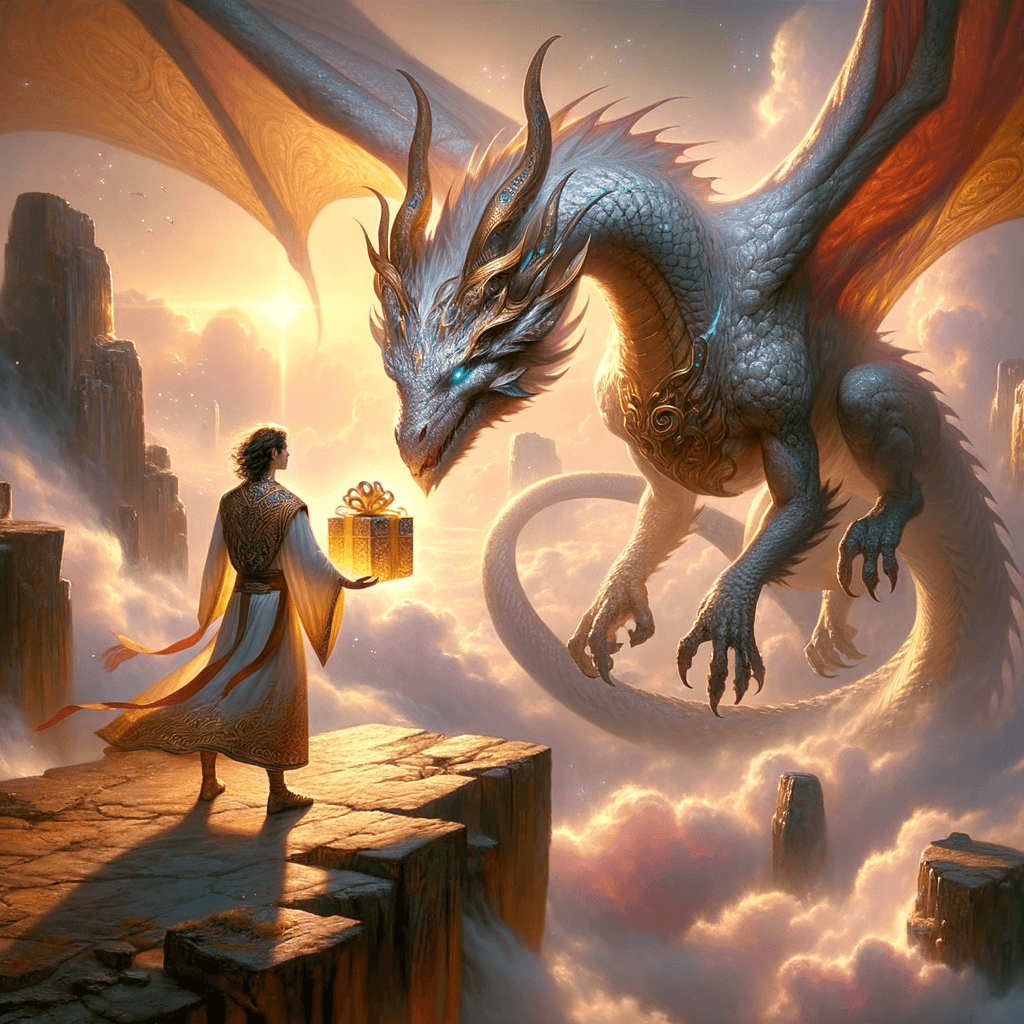
Challenge is a dragon with a gift in its mouth. Tame the dragon and the gift is yours. — Noela Evans
—What lingers after this line?
Challenges as Opportunities
This quote is a metaphor suggesting that every challenge carries within it an opportunity or reward. By facing and overcoming difficulties, one can attain growth, success, or a valuable lesson.
Symbolism of the Dragon
The dragon represents fear, uncertainty, or obstacles that appear intimidating and dangerous. However, it also signifies the potential for great rewards if one has the courage to confront it.
Courage and Resilience
The quote emphasizes the importance of courage and resilience in taming life’s metaphorical dragons. By approaching challenges with determination, one can unlock the hidden 'gift' or benefit they offer.
Growth Through Adversity
Challenges often force individuals to push beyond their limits, leading to personal growth and self-discovery. The process of taming the dragon symbolizes the strength one gains through overcoming adversity.
Philosophical Perspective
Noela Evans refers to a universal truth that life’s greatest gifts often come disguised as challenges. This perspective encourages a mindset shift, viewing difficulties not as hindrances but as opportunities for transformation.
Recommended Reading
As an Amazon Associate, we earn from qualifying purchases.
One-minute reflection
What's one small action this suggests?
Related Quotes
6 selectedDreams are made possible if you have courage. — Nnamdi Azikiwe
Nnamdi Azikiwe
At its core, Nnamdi Azikiwe’s statement argues that dreams do not become real through wishing alone; they require the bravery to be pursued. A dream may begin as imagination, yet without courage it remains suspended in t...
Read full interpretation →We don't develop courage by being happy in our relationships every day. We develop it by surviving difficult times and challenging adversity. — Epicurus
Epicurus
At first glance, Epicurus seems to challenge the common belief that healthy relationships are defined by uninterrupted happiness. Instead, he points to a deeper truth: courage is not formed in comfort, but in the moments...
Read full interpretation →If you are not crashing, you are corroding. Growth requires the courage to be challenged, not just the comfort of being safe. — Jaime Raul Zepeda
Jaime Raul Zepeda
At first glance, Zepeda frames life as a choice between impact and erosion. To be “crashing” suggests collision with difficulty, experimentation, and the visible mess of effort; by contrast, “corroding” evokes a quieter...
Read full interpretation →The comfort zone is the great enemy to creativity; moving beyond it necessitates intuition, which in turn configures new perspectives and conquers fears. — Bruce Lee
Bruce Lee
Bruce Lee begins with a blunt diagnosis: comfort can quietly become the enemy of invention. Familiar routines feel safe because they reduce uncertainty, yet that same predictability often narrows perception and dulls exp...
Read full interpretation →Confidence is not the absence of fear, but the decision that something else is more important. — Ambrose Redmoon
Ambrose Redmoon
At first glance, Ambrose Redmoon’s line overturns a common misconception: confidence is not a serene state in which fear vanishes, but an active decision made in fear’s presence. In that sense, courage and confidence are...
Read full interpretation →The thing is to become a master and in your old age to acquire the courage to do what children did when they knew nothing. — Ernest Hemingway
Ernest Hemingway
Hemingway’s remark turns success into a paradox: true mastery is not merely the accumulation of skill, but the recovery of a fearless freedom usually associated with childhood. At first glance, expertise seems to move us...
Read full interpretation →More From Author
More from Noela Evans →