
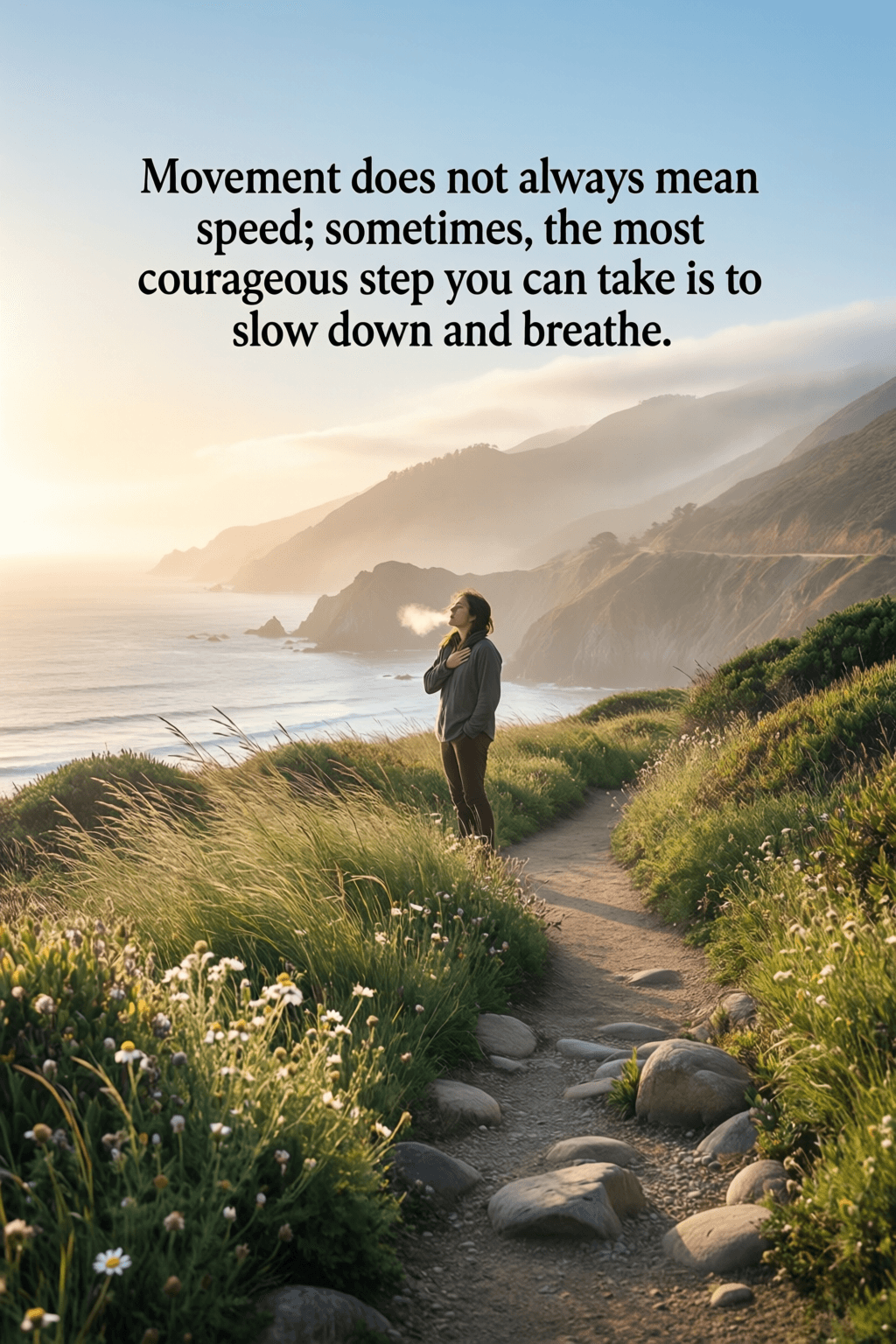
Movement does not always mean speed; sometimes, the most courageous step you can take is to slow down and breathe. — Sarah Ban Breathnach
—What lingers after this line?
Redefining What Movement Means
At first glance, movement is often confused with speed, productivity, or constant visible progress. Sarah Ban Breathnach’s quote gently corrects that assumption by suggesting that motion can also take the form of pause, reflection, and deliberate breathing. In this sense, slowing down is not the opposite of moving forward; rather, it can be a wiser and more sustainable way of doing so. This reframing matters because modern life frequently rewards urgency over clarity. Yet a rushed life can create the illusion of advancement while leaving people emotionally depleted. By contrast, choosing stillness at the right moment becomes an active decision, one that honors the body’s need for rest and the mind’s need for perspective.
Slowness as an Act of Courage
From there, the quote deepens into a moral insight: slowing down is not laziness but bravery. It takes courage to resist cultural pressure that equates worth with busyness. In many settings, people fear that pausing will make them appear weak or unproductive, so they keep pushing even when exhaustion has already blurred their judgment. However, real courage often appears in quieter forms. The person who admits, ‘I need a moment,’ may be showing more strength than the one who never stops. In that way, Breathnach’s words honor restraint as a form of self-respect, reminding us that intentional pause can be a disciplined response to chaos rather than an escape from responsibility.
The Restorative Power of Breath
Naturally, the quote’s focus on breathing gives this insight a physical and immediate dimension. Breath is the body’s simplest reset mechanism, capable of calming stress and restoring attention in a matter of moments. Even brief breathing practices have been linked to reduced anxiety and better emotional regulation; for example, many mindfulness-based programs influenced by Jon Kabat-Zinn’s work in the late 20th century emphasize breath as an anchor to the present. Because breathing is always available, it becomes a democratic tool for resilience. One deep breath before answering a difficult email or entering a tense conversation can interrupt reactivity. Thus, what seems like a small act becomes a quiet turning point, allowing the next step to arise from steadiness rather than panic.
A Counterpoint to Hustle Culture
Seen in a wider social context, the quotation also challenges the ethos of hustle culture. Contemporary ideals often celebrate relentless acceleration, as if a full schedule were proof of significance. Yet writers on simplicity and well-being, including Breathnach in works such as Simple Abundance (1995), have long argued that a life packed with motion can still feel spiritually empty. Consequently, slowing down becomes a form of resistance. It asks whether every demand deserves compliance and whether every opportunity deserves pursuit. By refusing automatic speed, a person begins to reclaim agency over time, attention, and energy. The quote therefore speaks not only to personal wellness but also to the deeper question of how one wants to live.
Presence Before Progress
In practical terms, the wisdom here suggests that presence should come before progress. When people rush from task to task, they may complete more actions while understanding less about why those actions matter. Slowing down creates room to notice feelings, priorities, and patterns that are otherwise drowned out by momentum. This is why many turning points in life begin not with dramatic action but with a pause: a walk after burnout, a breath before a difficult decision, a quiet morning that reveals what has been ignored. In those moments, stillness is not empty. Instead, it gathers scattered experience into insight, making future movement more honest and more aligned.
A Gentler Vision of Strength
Finally, Breathnach offers a gentler definition of strength itself. Strength is often imagined as endurance without complaint, but her words suggest that true strength includes tenderness toward one’s limits. To breathe, to slow down, and to continue thoughtfully is not failure; it is mature, grounded perseverance. As a result, the quote leaves readers with both comfort and instruction. It reassures those who feel behind that not all forward motion is fast, and it encourages them to trust measured steps. In a world addicted to acceleration, that reminder is both humane and radical: sometimes the bravest way forward begins by simply breathing.
Recommended Reading
As an Amazon Associate, we earn from qualifying purchases.
One-minute reflection
What does this quote ask you to notice today?
Related Quotes
6 selectedDreams are made possible if you have courage. — Nnamdi Azikiwe
Nnamdi Azikiwe
At its core, Nnamdi Azikiwe’s statement argues that dreams do not become real through wishing alone; they require the bravery to be pursued. A dream may begin as imagination, yet without courage it remains suspended in t...
Read full interpretation →We don't develop courage by being happy in our relationships every day. We develop it by surviving difficult times and challenging adversity. — Epicurus
Epicurus
At first glance, Epicurus seems to challenge the common belief that healthy relationships are defined by uninterrupted happiness. Instead, he points to a deeper truth: courage is not formed in comfort, but in the moments...
Read full interpretation →If you are not crashing, you are corroding. Growth requires the courage to be challenged, not just the comfort of being safe. — Jaime Raul Zepeda
Jaime Raul Zepeda
At first glance, Zepeda frames life as a choice between impact and erosion. To be “crashing” suggests collision with difficulty, experimentation, and the visible mess of effort; by contrast, “corroding” evokes a quieter...
Read full interpretation →The comfort zone is the great enemy to creativity; moving beyond it necessitates intuition, which in turn configures new perspectives and conquers fears. — Bruce Lee
Bruce Lee
Bruce Lee begins with a blunt diagnosis: comfort can quietly become the enemy of invention. Familiar routines feel safe because they reduce uncertainty, yet that same predictability often narrows perception and dulls exp...
Read full interpretation →Confidence is not the absence of fear, but the decision that something else is more important. — Ambrose Redmoon
Ambrose Redmoon
At first glance, Ambrose Redmoon’s line overturns a common misconception: confidence is not a serene state in which fear vanishes, but an active decision made in fear’s presence. In that sense, courage and confidence are...
Read full interpretation →The thing is to become a master and in your old age to acquire the courage to do what children did when they knew nothing. — Ernest Hemingway
Ernest Hemingway
Hemingway’s remark turns success into a paradox: true mastery is not merely the accumulation of skill, but the recovery of a fearless freedom usually associated with childhood. At first glance, expertise seems to move us...
Read full interpretation →More From Author
More from Sarah Ban Breathnach →Whatever we are waiting for—peace of mind, contentment, grace—it will surely come to us, but only when we are ready to receive it with an open and grateful heart. — Sarah Ban Breathnach
Sarah Ban Breathnach’s quote offers comfort, but it also places gentle responsibility on the reader. Peace of mind, contentment, and grace are not described as prizes seized by force; instead, they arrive when a person b...
Read full interpretation →The world needs dreamers and the world needs doers. But above all, the world needs dreamers who do. — Sarah Ban Breathnach
Sarah Ban Breathnach’s quote begins with a generous recognition: society depends on both visionaries and practical workers. Dreamers imagine what does not yet exist, while doers build, organize, and persist.
Read full interpretation →Let go of comparison and instead focus on becoming the best version of yourself. — Sarah Ban Breathnach
Sarah Ban Breathnach’s quote begins with a quiet but radical instruction: stop using other people as the ruler for your worth. Comparison seems harmless at first, yet it easily turns life into a contest where someone els...
Read full interpretation →Take a leap of faith and begin this wondrous new year by believing. — Sarah Ban Breathnach
This quote encourages individuals to embrace the potential of a new year as an opportunity for change and growth. It highlights the importance of starting fresh with optimism and hope.
Read full interpretation →