
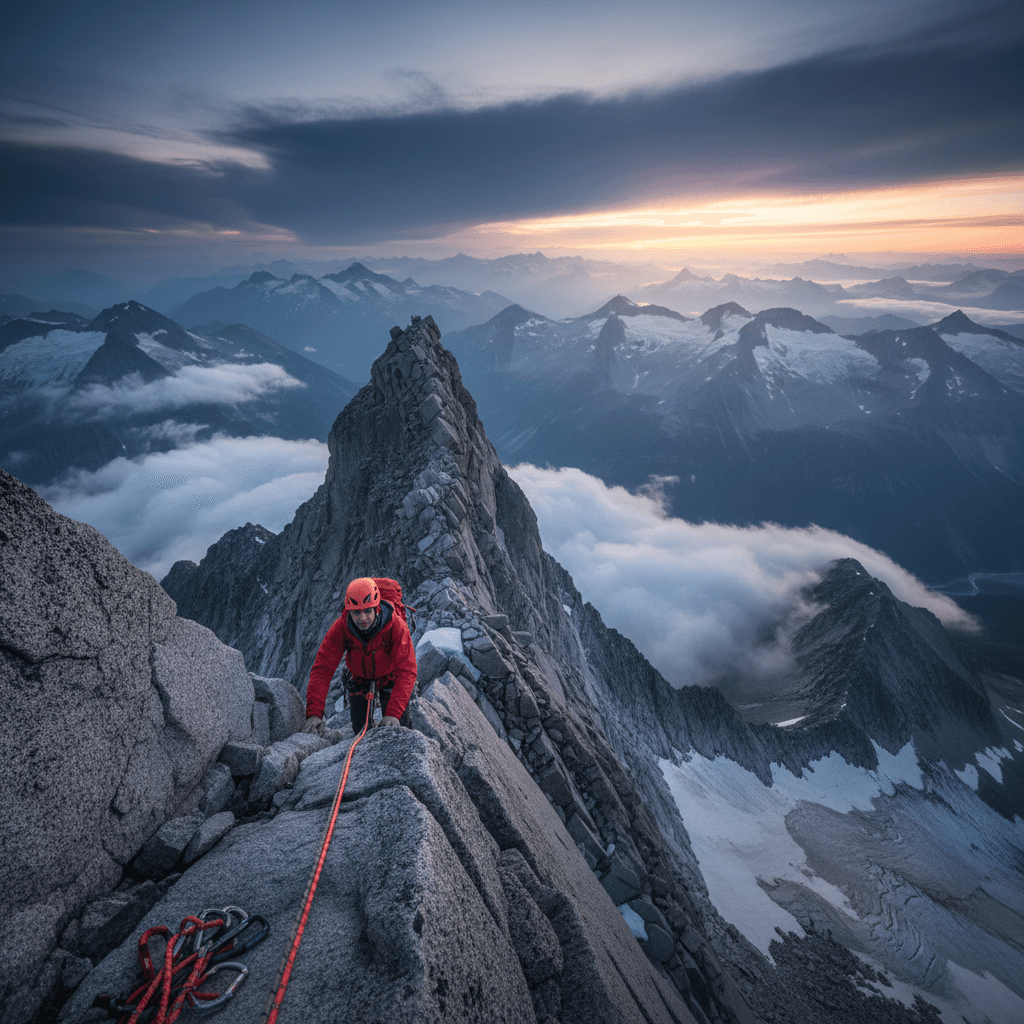
Climb toward what frightens you; the view will widen your courage. — John Muir
—What lingers after this line?
From Vertigo to Vista
Muir’s aphorism reshapes fear from a wall into a slope. To “climb toward what frightens you” is to accept fear as gradient rather than gate, trusting that elevation alters perception. As altitude rises, so does perspective; dangers that seemed absolute from the valley become specific, navigable features from the ridge. Thus the second clause—“the view will widen your courage”—is not mere poetry but a causal claim: vantage breeds valor. By seeing farther, we fear less, not because threats vanish, but because they are set within a larger map. And once the horizon expands, our inner map does too.
Muir’s Lessons in High Places
Historically, Muir did not preach abstractions; he tested them in weather and granite. In The Mountains of California (1894), he climbs a wind-tossed tree to feel the storm from within, converting terror into study and awe. Likewise, in Stickeen (1897), he recounts edging across a glacier’s knife-back with a small dog, where each careful step transformed panic into partnership and skill. These episodes show that moving toward fear—deliberately and attentively—changes its chemistry. What begins as dread becomes data, then discipline, and finally delight. The mountains did not grow smaller; rather, Muir grew larger in their company.
Why Approach Anxiety: The Psychology
Moreover, contemporary psychology explains why ascent works. Exposure therapy, from Wolpe’s foundational work (1958) to Craske’s inhibitory learning model (2014), shows that approaching feared stimuli in manageable doses rewrites expectations; the body learns that alarm need not dictate action. As experiences accrue, self-efficacy rises—Bandura’s classic 1977 insight that mastery experiences build the belief, “I can do this.” With each upward step, prediction errors accumulate in your favor: the feared fall does not occur, or if it does, you recover. Confidence then becomes evidence-based, not wishful, a courage that is wider because it is warranted.
How Perspective Builds Capacity
In turn, the promised view is not strictly scenic; it is cognitive. Fredrickson’s broaden-and-build theory (2001) argues that positive emotions widen our thought–action repertoires, allowing more options and resources to come into play. Reaching a higher standpoint increases not just literal sightlines but mental flexibility; you see alternative routes, safer ledges, better pacing. Paired with cognitive reappraisal (Gross, 1998)—the skill of reframing stressors—the summit view becomes a training ground for composure. Courage widens because the mind, like the panorama, has more room to maneuver.
Courage Is Not Recklessness
Nevertheless, climbing toward fear is not a license for folly. Alpinists codify prudence in practices like turn-around times and route-finding protocols, captured in Mountaineering: The Freedom of the Hills (1960; 9th ed. 2017). Research on heuristic traps in avalanche accidents (McCammon, 2004) warns how familiarity, social proof, and commitment can lure us past good judgment. Thus the art is calibrated approach: break the problem into pitches, carry the right gear, and keep margin. Wise ascent replaces bravado with preparation, so that courage grows alongside competence, not against it.
Everyday Ascents, Everyday Views
Likewise, the mountain is a metaphor for daily trials. If public speaking terrifies you, schedule graded exposures: a rehearsal to your mirror, then a friend, then five colleagues. If a hard conversation looms, script key lines, choose a contained setting, and debrief after. Each small crest yields a wider view—what once felt like a cliff becomes a staircase. Keep a log of predictions versus outcomes to cement lessons; over time, your forecasts become calmer because they are better informed. The terrain of ordinary life rewards the same steady, upward patience.
Making Elevation a Habit
Ultimately, courage widens when ascent becomes practice, not event. Set recurring “edgework” goals—weekly situations just beyond comfort—and pair them with recovery and reflection. Ask after each effort: What did the higher view reveal? Which skills carried me? What margin did I need? In this rhythm, fear remains a compass, not a cage. The horizon keeps receding as you approach, and that is the point: you are training a stance toward difficulty, so that when the next ridge rises, you already know how to climb.
One-minute reflection
What's one small action this suggests?
Related Quotes
6 selectedTo be courageous is to act with the heart. — Molière
Molière
Molière’s line suggests that courage is not merely the absence of fear, but the decision to move despite it. By connecting courage with the heart, he frames bravery as an emotional and moral act rather than a simple disp...
Read full interpretation →The best people possess a feeling for beauty, the courage to take risks, the discipline to tell the truth, the capacity for sacrifice. — Ernest Hemingway
Ernest Hemingway
Hemingway’s line presents goodness not as politeness or success, but as a demanding inner code. The “best people” are those who combine sensitivity, bravery, honesty, and self-denial—qualities that do not always coexist...
Read full interpretation →If you aren't in over your head, how do you know how tall you are? — T. S. Eliot
T. S. Eliot
At first glance, Eliot’s question turns self-knowledge into a matter of pressure rather than comfort. We do not truly learn our limits while standing safely on familiar ground; instead, we discover our height only when c...
Read full interpretation →If you are not willing to look stupid, nothing great is ever going to happen to you. — Julia Cameron
Julia Cameron
Julia Cameron’s remark begins with a hard truth: many people do not fail because they lack talent, but because they fear embarrassment. In that sense, ‘looking stupid’ becomes shorthand for being seen trying, stumbling,...
Read full interpretation →You don't have to bully yourself out of feeling fear. You just have to move while it's still there. — Annie Wright
Annie Wright
At its core, Annie Wright’s quote challenges the common belief that courage begins only after fear has disappeared. Instead, it reframes fear as something that can accompany action rather than prevent it.
Read full interpretation →For what matters in life is not whether we receive a round of applause; what matters is whether we have the courage to venture forth despite the uncertainty of acclaim. — Amor Towles
Amor Towles
At its core, Amor Towles shifts attention away from public approval and toward private resolve. The quote argues that a life’s value is not determined by applause—those visible signs of recognition—but by the willingness...
Read full interpretation →More From Author
More from John Muir →Keep your compass fixed on purpose; storms only reshape the coastline. — John Muir
John Muir’s image begins with a tool meant for orientation: the compass. By urging us to keep it “fixed on purpose,” he implies that purpose is not a mood or a passing preference but a stable reference point that helps u...
Read full interpretation →Stand steady in small acts; they carve the canyon of your legacy. — John Muir
The metaphor is geological before it is moral: water, patient and persistent, sculpts stone. Over millions of years, steady flow incises bedrock, a process that the Grand Canyon dramatizes across 5–6 million years of dow...
Read full interpretation →The mountains are calling and I must go. - John Muir
This quote personifies mountains as having a voice that calls out to the individual, suggesting a magnetic or spiritual pull that nature exerts on those who appreciate it.
Read full interpretation →The clearest way into the Universe is through a forest wilderness. - John Muir
John Muir emphasizes that immersing oneself in nature, specifically a forest wilderness, provides a direct and profound connection to the Universe. This suggests that the natural world offers a clearer understanding and...
Read full interpretation →