
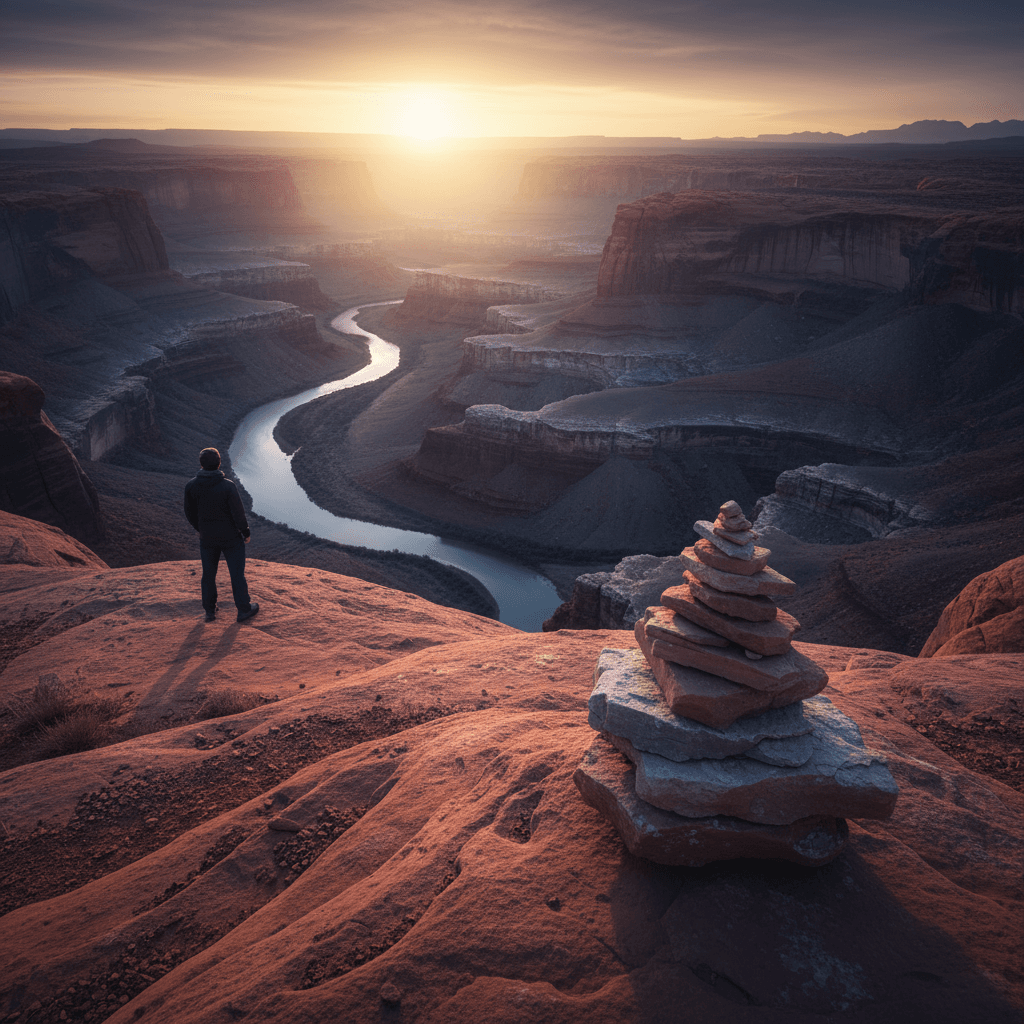
Stand steady in small acts; they carve the canyon of your legacy. — John Muir
—What lingers after this line?
From Trickles to Canyons
The metaphor is geological before it is moral: water, patient and persistent, sculpts stone. Over millions of years, steady flow incises bedrock, a process that the Grand Canyon dramatizes across 5–6 million years of downcutting and lateral erosion (USGS syntheses). Legacy, by analogy, is not blasted into being; it is worn into shape by repeated contact. Thus, the line reframes greatness as sedimentary, layered by small deposits of effort. What looks like sudden grandeur is often the visible cross-section of long, quiet work. In this view, standing steady is not passivity but disciplined continuity, the exact force that turns a trickle into a river and a river into a canyon.
Muir’s Quiet Interventions
Ascribed to naturalist John Muir, the sentiment mirrors his method: modest actions aligned over years. Through essays, letters, and persistent lobbying, Muir helped secure protections for Yosemite and Sequoia in 1890 and then co-founded the Sierra Club in 1892 to keep the pressure steady. Even his celebrated 1903 camping trip with Theodore Roosevelt in Yosemite built on countless prior walks, field notes, and conversations—small acts that accumulated into policy shifts. Rather than a single dramatic stroke, his legacy formed like a canyon wall: stratum by stratum, advocacy layered upon observation, until the landscape of American conservation visibly changed.
Habits as the Engine of Change
Psychology supplies the mechanism beneath the metaphor. Wendy Wood’s research on habit formation shows that repetition in stable contexts automates behavior, reducing the friction of daily follow-through (Good Habits, Bad Habits, 2019). Similarly, BJ Fogg’s Tiny Habits (2019) demonstrates how micro-actions tied to reliable cues compound into meaningful outcomes. When the act is small enough and the stance steady enough, momentum replaces motivation: you do the right thing because it has become what you do. In this light, the canyon of legacy is carved by a river of habits, not a flood of rare inspiration.
Virtue Grows by Repetition
Ethics reaches the same conclusion by another path. Aristotle’s Nicomachean Ethics argues that we become just by doing just acts, brave by doing brave acts; character is a practiced craft, not a proclamation (Book II). Each small decision deposits a layer of the self you are becoming. Over time, those layers harden into disposition—the reliable grain of your choices. Consequently, legacy is not a résumé of peak moments but the canyon cut by daily fidelity. What you repeatedly do—especially when unseen—etches the contours others will later recognize as your character.
Movements Built by Micro-actions
Social change, too, advances by steady increments. Wangari Maathai’s Green Belt Movement began in 1977 with women planting seedlings; decades later, that simple act scaled to tens of millions of trees across Kenya, transforming soils, livelihoods, and civic agency (Maathai, Unbowed, 2006). Likewise, the Montgomery Bus Boycott (1955–56) relied on thousands of daily walks and carpools—ordinary steps repeated until a legal canyon appeared where once there was granite resistance. Such stories reveal a structural truth: when small acts align across people and time, they aggregate into forces capable of reshaping the public landscape.
Designing Your Daily Chisel
Practically, steadiness is engineered, not hoped for. Start by sizing acts to survive bad days; tie them to cues you never miss, like boiling water for coffee or locking the door. Track visible streaks to make progress tangible, and prune friction ruthlessly—lay out tools, pre-decide scripts, batch obstacles. Then, widen the channel gradually: small increases keep the river flowing without flooding the banks. Monthly reflections provide the long view, letting you adjust course while honoring continuity. In this design, discipline feels less like strain and more like current, carrying you where you intend to go.
Reframing Legacy Across Time
Finally, the canyon image reorients our sense of time. Legacy is not a statue erected at the end but a valley forming beneath your feet as you move. Because erosion works invisibly until it doesn’t, patience becomes a strategic virtue; you steward processes you may not live to finish, trusting compounding more than spectacle. In that spirit, to stand steady in small acts is to choose the river over the hammer, endurance over eruption. And in due course, the landscape bears witness: a quiet groove deepens into a passage others can follow.
One-minute reflection
Why might this line matter today, not tomorrow?
Related Quotes
6 selectedAn ant on the move does more than a dozing ox. — Lao Tzu
Lao Tzu
Lao Tzu’s proverb highlights how small, consistent action outweighs idle potential. In Aesop’s fable 'The Tortoise and the Hare,' the slow but steady tortoise ultimately wins the race, demonstrating that perseverance can...
Read full interpretation →A persistent choice reshapes a life more than a single dramatic leap ever could. — Marcus Aurelius
Marcus Aurelius
The line emphasizes a counterintuitive truth: pivotal moments feel transformative, yet it is the quiet, repeated choice that remakes a life. A single vow can ignite hope, but a thousand small fulfillments of that vow res...
Read full interpretation →Keep your compass fixed on purpose; storms only reshape the coastline. — John Muir
John Muir
John Muir’s image begins with a tool meant for orientation: the compass. By urging us to keep it “fixed on purpose,” he implies that purpose is not a mood or a passing preference but a stable reference point that helps u...
Read full interpretation →Climb toward what frightens you; the view will widen your courage. — John Muir
John Muir
Muir’s aphorism reshapes fear from a wall into a slope. To “climb toward what frightens you” is to accept fear as gradient rather than gate, trusting that elevation alters perception.
Read full interpretation →The mountains are calling and I must go. - John Muir
John Muir
This quote personifies mountains as having a voice that calls out to the individual, suggesting a magnetic or spiritual pull that nature exerts on those who appreciate it.
Read full interpretation →The clearest way into the Universe is through a forest wilderness. - John Muir
John Muir
John Muir emphasizes that immersing oneself in nature, specifically a forest wilderness, provides a direct and profound connection to the Universe. This suggests that the natural world offers a clearer understanding and...
Read full interpretation →More From Author
More from John Muir →Keep your compass fixed on purpose; storms only reshape the coastline. — John Muir
John Muir’s image begins with a tool meant for orientation: the compass. By urging us to keep it “fixed on purpose,” he implies that purpose is not a mood or a passing preference but a stable reference point that helps u...
Read full interpretation →Climb toward what frightens you; the view will widen your courage. — John Muir
Muir’s aphorism reshapes fear from a wall into a slope. To “climb toward what frightens you” is to accept fear as gradient rather than gate, trusting that elevation alters perception.
Read full interpretation →The mountains are calling and I must go. - John Muir
This quote personifies mountains as having a voice that calls out to the individual, suggesting a magnetic or spiritual pull that nature exerts on those who appreciate it.
Read full interpretation →The clearest way into the Universe is through a forest wilderness. - John Muir
John Muir emphasizes that immersing oneself in nature, specifically a forest wilderness, provides a direct and profound connection to the Universe. This suggests that the natural world offers a clearer understanding and...
Read full interpretation →