
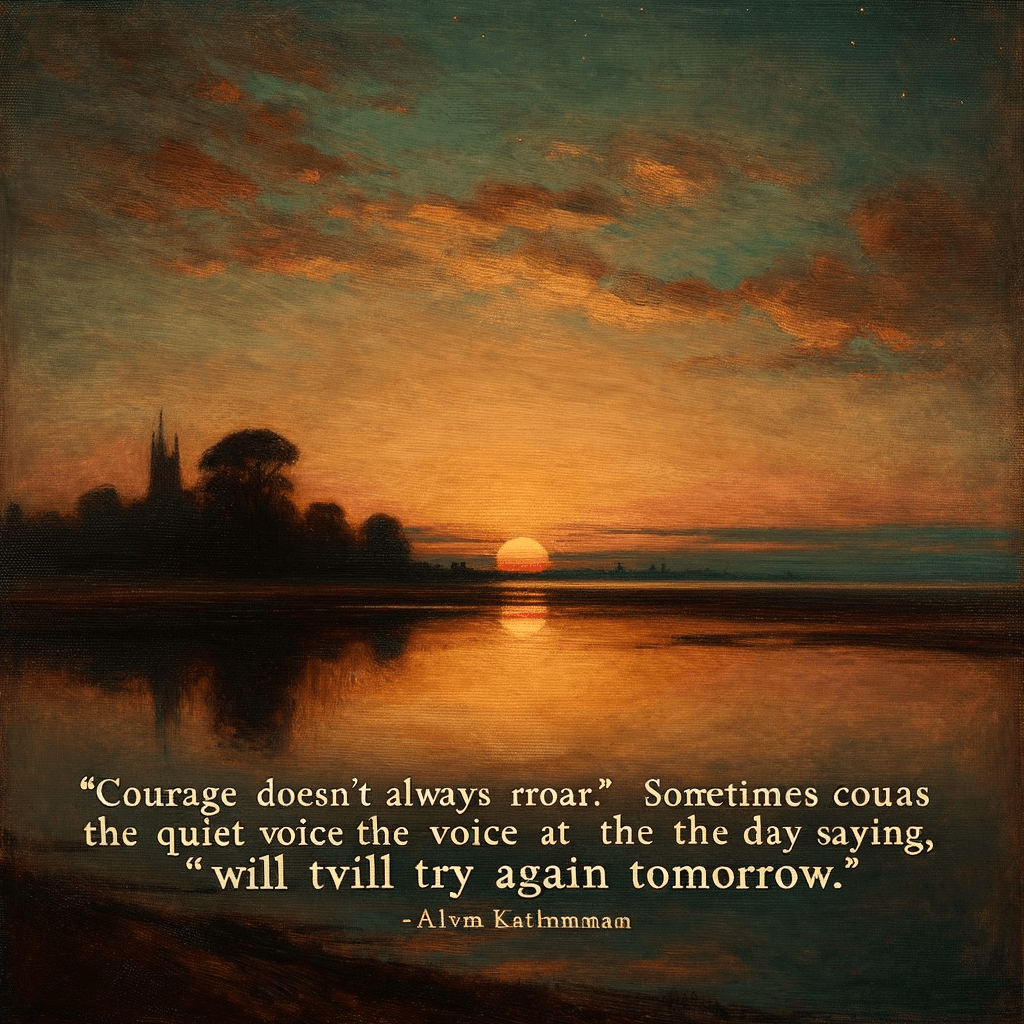
Courage doesn't always roar, sometimes it's the quiet voice at the end of the day saying: 'I will try again tomorrow.'
—What lingers after this line?
Everyday Bravery
This quote suggests that courage is not always about grand, bold actions. Sometimes, it is embodied in small, quiet acts of resilience and determination.
Perseverance
Perseverance is highlighted here as a form of courage. The willingness to face another day and try again despite failures or challenges requires significant inner strength.
Self-Compassion
The quote encourages self-compassion and understanding. It acknowledges that it’s okay to struggle and that giving oneself permission to try again tomorrow is a courageous act.
Mental Strength
Mental strength is portrayed as an essential aspect of courage. The quiet voice signifies one’s inner dialogue that keeps pushing forward even when the external world might not recognize the effort.
Resilience in Adversity
This emphasizes the idea that courage can be found in the resilience shown during tough times. It’s about the ability to continue, even when things are difficult and success is uncertain.
One-minute reflection
What feeling does this quote bring up for you?
Related Quotes
6 selectedYou don't need to feel brave to act bravely. The feeling follows the action, not the other way around. — Unknown
Unknown
The quote challenges a common assumption: that bravery is a feeling you must summon before you can do brave things. Instead, it argues that courageous action can come first, even while fear is still present.
Read full interpretation →If we are facing in the right direction, all we have to do is keep walking. — Thích Nhất Hạnh
Thich Nhat Hanh
Thích Nhất Hạnh’s words begin with a simple but profound premise: progress depends first on direction, not speed. If a person is turned toward compassion, clarity, healing, or truth, then each modest step becomes meaning...
Read full interpretation →Do the best one can. Do it over again. Then still improve, even if ever so slightly, those retouches. — Marguerite Yourcenar
Marguerite Yourcenar
Yourcenar’s words begin with a simple demand: do the best one can. Yet she immediately refuses to let effort become an excuse for stopping.
Read full interpretation →To be courageous is to act with the heart. — Molière
Molière
Molière’s line suggests that courage is not merely the absence of fear, but the decision to move despite it. By connecting courage with the heart, he frames bravery as an emotional and moral act rather than a simple disp...
Read full interpretation →The best people possess a feeling for beauty, the courage to take risks, the discipline to tell the truth, the capacity for sacrifice. — Ernest Hemingway
Ernest Hemingway
Hemingway’s line presents goodness not as politeness or success, but as a demanding inner code. The “best people” are those who combine sensitivity, bravery, honesty, and self-denial—qualities that do not always coexist...
Read full interpretation →A good-enough novel violently written now is better than a perfect novel meticulously written never. — Elizabeth Gilbert
Elizabeth Gilbert
Elizabeth Gilbert’s line immediately shifts the argument from artistic purity to artistic existence. A “good-enough” novel, even one “violently written,” has entered the world and can move, provoke, or comfort someone; b...
Read full interpretation →More From Author
More from Unknown →The language is the substrate. The architecture is the contract.
The line sets up a deliberate pairing: language lies beneath everything, while architecture governs everything above it. In other words, what you can express determines what you can build, and what you commit to structur...
Read full interpretation →A scroll is not a break; it is a trap disguised as rest. — Unknown
The quote begins by challenging a familiar story we tell ourselves: that a brief scroll is a harmless pause between tasks. On the surface, it looks like recovery—no effort, no decision, no commitment.
Read full interpretation →Don't let your ice cream melt while you're counting someone else's sprinkles. — Unknown
The quote uses ice cream as a simple stand-in for life’s fleeting pleasures: what you have is delicious, but it won’t last forever if you ignore it. Meanwhile, “counting someone else’s sprinkles” captures the habit of mo...
Read full interpretation →If your absence doesn't affect them, your presence never mattered. — Unknown
The quote frames absence as a revealing experiment: remove yourself, and the reaction—concern, curiosity, indifference—becomes a kind of data. If nothing changes when you’re gone, it suggests your role was never integrat...
Read full interpretation →