
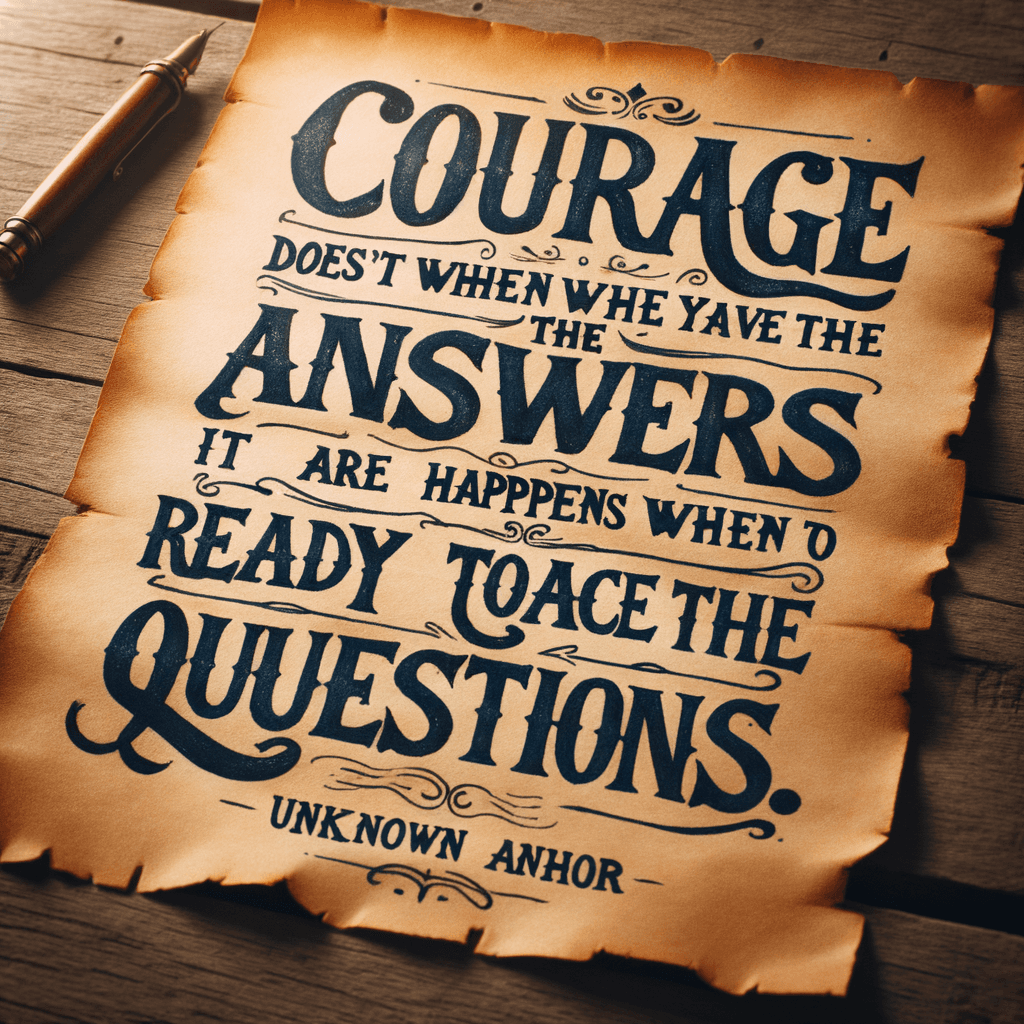
Courage doesn't happen when you have all the answers; it happens when you are ready to face the questions. — Shannon L. Alder
—What lingers after this line?
Definition of Courage
This quote redefines courage as not merely the possession of answers or knowledge, but the willingness to confront uncertainty and the unknown.
Facing Challenges
It emphasizes that true bravery emerges in situations where questions abound, highlighting the importance of resilience in the face of difficulties.
Embracing Vulnerability
The act of preparing to face questions underscores a level of vulnerability, implying that acknowledging uncertainty is a strength rather than a weakness.
Personal Growth
This statement also implies that personal growth often occurs when we challenge ourselves to seek answers rather than retreating into comfort zones.
Philosophical Perspective
Shannon L. Alder's writing often explores human behavior and psychology, encouraging readers to embrace life's complexities and uncertainties as part of the human experience.
One-minute reflection
What feeling does this quote bring up for you?
Related Quotes
6 selectedTo be courageous is to act with the heart. — Molière
Molière
Molière’s line suggests that courage is not merely the absence of fear, but the decision to move despite it. By connecting courage with the heart, he frames bravery as an emotional and moral act rather than a simple disp...
Read full interpretation →The best people possess a feeling for beauty, the courage to take risks, the discipline to tell the truth, the capacity for sacrifice. — Ernest Hemingway
Ernest Hemingway
Hemingway’s line presents goodness not as politeness or success, but as a demanding inner code. The “best people” are those who combine sensitivity, bravery, honesty, and self-denial—qualities that do not always coexist...
Read full interpretation →You will never be able to experience everything. So, please, do poetical justice to your soul and simply experience yourself. — Albert Camus
Albert Camus
Camus begins from a humbling truth: no person can live every possible life, see every landscape, or test every path. Because existence is finite, the dream of total experience becomes a source of restlessness rather than...
Read full interpretation →You cannot express something you have not first discovered. — Carl Jung
Carl Jung
At its core, Jung’s remark suggests that authentic expression begins not with performance but with discovery. A person cannot meaningfully speak, create, or reveal what has never been encountered within the self.
Read full interpretation →If you are not willing to look stupid, nothing great is ever going to happen to you. — Julia Cameron
Julia Cameron
Julia Cameron’s remark begins with a hard truth: many people do not fail because they lack talent, but because they fear embarrassment. In that sense, ‘looking stupid’ becomes shorthand for being seen trying, stumbling,...
Read full interpretation →You don't have to bully yourself out of feeling fear. You just have to move while it's still there. — Annie Wright
Annie Wright
At its core, Annie Wright’s quote challenges the common belief that courage begins only after fear has disappeared. Instead, it reframes fear as something that can accompany action rather than prevent it.
Read full interpretation →More From Author
More from Shannon L. Alder →Most misunderstandings in the world could be avoided if people would simply take the time and energy to ask, 'What else could this mean?' — Shannon L. Alder
Shannon L. Alder’s line turns misunderstanding into a preventable habit rather than an unavoidable fate.
Read full interpretation →Confidence is knowing who you are and not changing it a bit because someone's version of your reality is not their reality. — Shannon L. Alder
At its core, Shannon L. Alder’s quote defines confidence not as loudness or display, but as a steady knowledge of one’s own identity.
Read full interpretation →Every woman that finally figured out her worth has picked up her suitcases of pride and boarded a flight to freedom. — Shannon L. Alder
Shannon L. Alder’s line begins with a turning point: “finally figured out her worth.” That word “finally” implies a journey through doubt, dismissal, or conditioning before self-value becomes undeniable.
Read full interpretation →Carve your name on hearts, not tombstones. A legacy is etched into the minds of others and the stories they share about you. — Shannon L. Alder
This quote suggests that the most meaningful legacies are created through the positive impact and love we have shared with others, rather than through physical monuments or memorials.
Read full interpretation →