
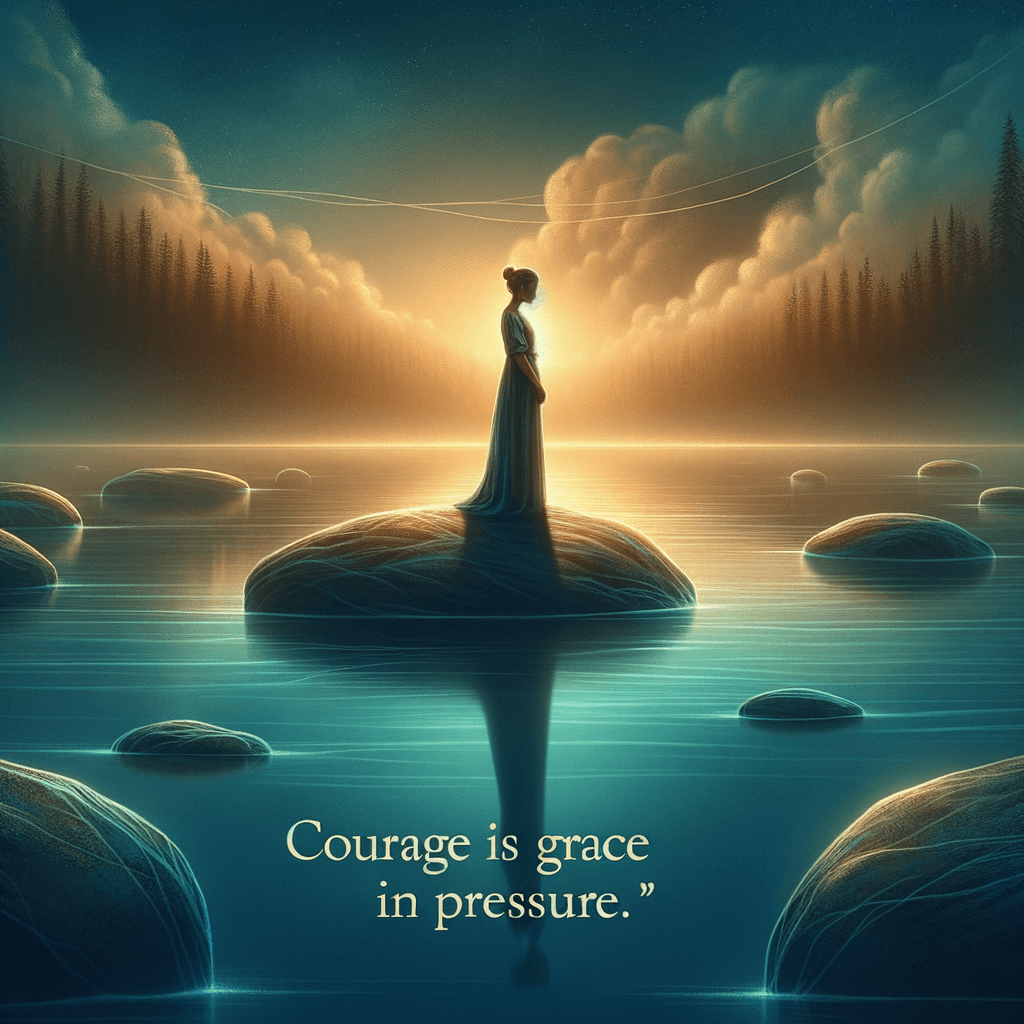
Courage is grace under pressure. — Ernest Hemingway
—What lingers after this line?
Definition of Courage
This quote encapsulates the idea that true courage is not just the absence of fear, but rather the ability to remain composed and dignified in challenging situations.
Resilience in Adversity
Hemingway's words suggest that grace under pressure signifies resilience. It highlights the importance of maintaining one's inner strength and grace when faced with difficulties.
Emotional Control
The quote implies that courage involves emotional control. It encourages individuals to manage their feelings and reactions even when situations become overwhelming.
Heroism and Character
Courage is often associated with heroism. Hemingway implies that true heros exemplify grace under pressure, showcasing their strength of character during tough times.
Hemingway's Background
Ernest Hemingway was known for his stoic style and themes surrounding war and human endurance. This quote reflects his experiences and insights gained from his life, including his time as a war correspondent.
One-minute reflection
Where does this idea show up in your life right now?
Related Quotes
6 selectedThe best people possess a feeling for beauty, the courage to take risks, the discipline to tell the truth, the capacity for sacrifice. — Ernest Hemingway
Ernest Hemingway
Hemingway’s line presents goodness not as politeness or success, but as a demanding inner code. The “best people” are those who combine sensitivity, bravery, honesty, and self-denial—qualities that do not always coexist...
Read full interpretation →The thing is to become a master and in your old age to acquire the courage to do what children did when they knew nothing. — Ernest Hemingway
Ernest Hemingway
Hemingway’s remark turns success into a paradox: true mastery is not merely the accumulation of skill, but the recovery of a fearless freedom usually associated with childhood. At first glance, expertise seems to move us...
Read full interpretation →To be courageous is to act with the heart. — Molière
Molière
Molière’s line suggests that courage is not merely the absence of fear, but the decision to move despite it. By connecting courage with the heart, he frames bravery as an emotional and moral act rather than a simple disp...
Read full interpretation →If you are not willing to look stupid, nothing great is ever going to happen to you. — Julia Cameron
Julia Cameron
Julia Cameron’s remark begins with a hard truth: many people do not fail because they lack talent, but because they fear embarrassment. In that sense, ‘looking stupid’ becomes shorthand for being seen trying, stumbling,...
Read full interpretation →You don't have to bully yourself out of feeling fear. You just have to move while it's still there. — Annie Wright
Annie Wright
At its core, Annie Wright’s quote challenges the common belief that courage begins only after fear has disappeared. Instead, it reframes fear as something that can accompany action rather than prevent it.
Read full interpretation →For what matters in life is not whether we receive a round of applause; what matters is whether we have the courage to venture forth despite the uncertainty of acclaim. — Amor Towles
Amor Towles
At its core, Amor Towles shifts attention away from public approval and toward private resolve. The quote argues that a life’s value is not determined by applause—those visible signs of recognition—but by the willingness...
Read full interpretation →More From Author
More from Ernest Hemingway →The best people possess a feeling for beauty, the courage to take risks, the discipline to tell the truth, the capacity for sacrifice. — Ernest Hemingway
Hemingway’s line presents goodness not as politeness or success, but as a demanding inner code. The “best people” are those who combine sensitivity, bravery, honesty, and self-denial—qualities that do not always coexist...
Read full interpretation →Confidence is silent. Insecurities are loud. — Unknown (Wait—skip/replace with: True nobility is being superior to your former self. — Ernest Hemingway)
At its core, Hemingway’s line redefines nobility as an inward achievement rather than a social rank. Instead of measuring worth by wealth, pedigree, or dominance over others, it points to a quieter standard: becoming bet...
Read full interpretation →If you can find someone who you can hold and close your eyes to the world with, then you're lucky. Even if it only lasts for a minute or a day. — Ernest Hemingway
At its heart, Hemingway’s line defines luck not as wealth or permanence, but as the discovery of a person who briefly makes the world fall away. To hold someone and close your eyes suggests more than romance; it evokes t...
Read full interpretation →The thing is to become a master and in your old age to acquire the courage to do what children did when they knew nothing. — Ernest Hemingway
Hemingway’s remark turns success into a paradox: true mastery is not merely the accumulation of skill, but the recovery of a fearless freedom usually associated with childhood. At first glance, expertise seems to move us...
Read full interpretation →