
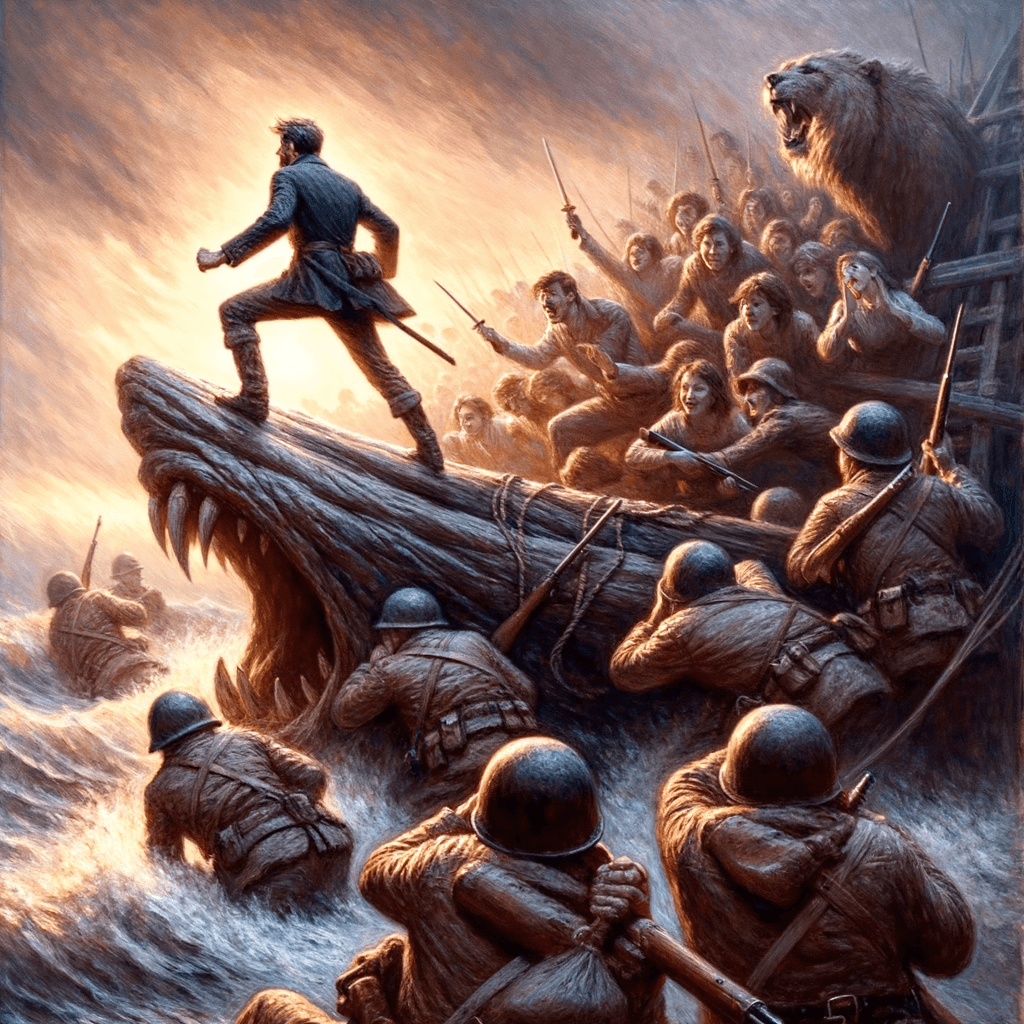
Courage is not the absence of fear, but rather the assessment that something else is more important than fear. — Franklin D. Roosevelt
—What lingers after this line?
Definition of Courage
This quote redefines courage, presenting it not as a lack of fear, but as the recognition of a higher priority that outweighs fear itself. It shifts the focus from fearlessness to determination in the face of fear.
Fear as a Natural Emotion
Roosevelt acknowledges fear as a normal human emotion, indicating that experiencing fear is not a weakness or a failure; instead, it is a common part of the human experience when facing challenges.
Prioritization of Values
The quote hints at the idea that bravery involves making choices based on values. When something is considered more important than the fear one feels, it becomes a motivating force for action.
Leadership and Decision-Making
Roosevelt's perspective on courage is particularly relevant in leadership contexts, where tough decisions must often be made despite fear. Effective leaders prioritize the greater good over their own apprehensions.
Historical Context
As a prominent figure during challenging times, including the Great Depression and World War II, Franklin D. Roosevelt's thoughts on courage reflect his leadership and resilience, serving as inspiration to a nation facing adversity.
One-minute reflection
Why might this line matter today, not tomorrow?
Related Quotes
6 selectedConfidence is not the absence of fear, but the decision that something else is more important. — Ambrose Redmoon
Ambrose Redmoon
At first glance, Ambrose Redmoon’s line overturns a common misconception: confidence is not a serene state in which fear vanishes, but an active decision made in fear’s presence. In that sense, courage and confidence are...
Read full interpretation →Courage is less about fearlessness than training the mind to act with clarity and conviction. — Ranjay Gulati
Ranjay Gulati
Ranjay Gulati’s line begins by overturning a common myth: that courage belongs to people who simply don’t feel afraid. Instead, he frames fear as normal—and even expected—while locating courage in what happens next.
Read full interpretation →To be courageous is to act with the heart. — Molière
Molière
Molière’s line suggests that courage is not merely the absence of fear, but the decision to move despite it. By connecting courage with the heart, he frames bravery as an emotional and moral act rather than a simple disp...
Read full interpretation →The best people possess a feeling for beauty, the courage to take risks, the discipline to tell the truth, the capacity for sacrifice. — Ernest Hemingway
Ernest Hemingway
Hemingway’s line presents goodness not as politeness or success, but as a demanding inner code. The “best people” are those who combine sensitivity, bravery, honesty, and self-denial—qualities that do not always coexist...
Read full interpretation →If you are not willing to look stupid, nothing great is ever going to happen to you. — Julia Cameron
Julia Cameron
Julia Cameron’s remark begins with a hard truth: many people do not fail because they lack talent, but because they fear embarrassment. In that sense, ‘looking stupid’ becomes shorthand for being seen trying, stumbling,...
Read full interpretation →You don't have to bully yourself out of feeling fear. You just have to move while it's still there. — Annie Wright
Annie Wright
At its core, Annie Wright’s quote challenges the common belief that courage begins only after fear has disappeared. Instead, it reframes fear as something that can accompany action rather than prevent it.
Read full interpretation →More From Author
More from Franklin D. Roosevelt →It is common sense to take a method and try it. If it fails, admit it frankly and try another. But above all, try something. — Franklin D. Roosevelt
Franklin D. Roosevelt’s statement champions a practical mindset: when circumstances are difficult, waiting for flawless answers is often more dangerous than acting on an imperfect plan.
Read full interpretation →The only limit to our realization of tomorrow will be our doubts of today. - Franklin D. Roosevelt
This quote suggests that doubt is a significant barrier to achieving future goals. It emphasizes how our own uncertainties and lack of confidence can prevent us from realizing our full potential.
Read full interpretation →The only limit to our realization of tomorrow is our doubts of today. - Franklin D. Roosevelt
This quote suggests that our doubts can significantly hinder our potential and progress. If we let our uncertainties dominate, they become the primary obstacles to achieving our future goals.
Read full interpretation →To reach a port we must set sail — sail, not tie at anchor — sail, not drift. — Franklin D. Roosevelt
This quote emphasizes the importance of taking action and initiative in achieving goals. Merely staying in one place or waiting for things to happen will not lead to progress.
Read full interpretation →