
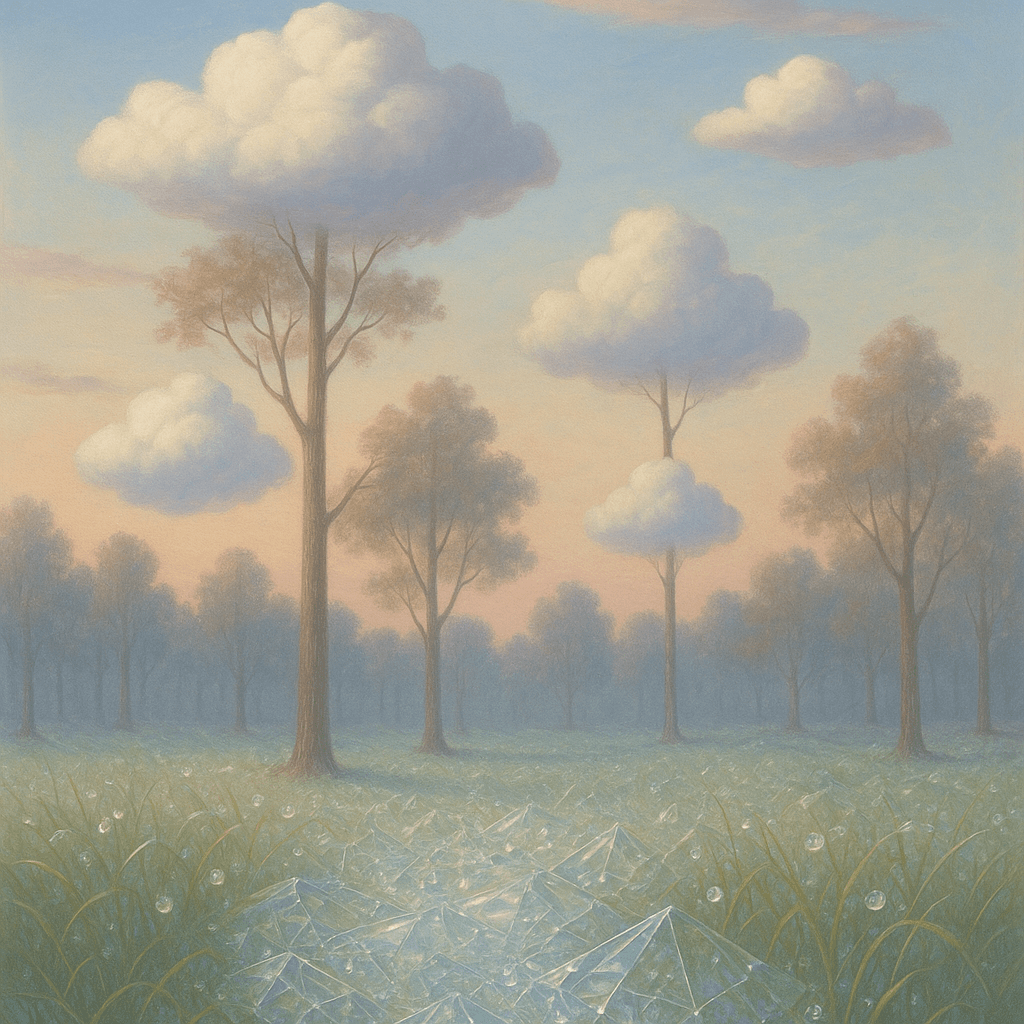
Dare to be naïve. — René Magritte
—What lingers after this line?
Redefining Naïveté in a Complex World
René Magritte’s call to “dare to be naïve” stands in deliberate contrast to common perceptions of naïveté as ignorance or gullibility. Rather than denoting foolishness, here naïveté becomes an act of conscious openness—a decision to approach the world without the armor of skepticism or cynicism. In a society that often equates maturity with skepticism, Magritte invites us to revisit the power of innocent curiosity.
Surrealism and the Wisdom of Simplicity
This perspective aligns seamlessly with Surrealist ideals. Surrealists, led by André Breton in the early twentieth century, championed the unfiltered logic of dreams and the subconscious. Magritte’s own artworks—such as "The Son of Man" (1964)—captured innocence and ambiguity, blurring boundaries between reality and illusion and urging viewers to see familiar objects with fresh, childlike wonder. Thus, naïveté is recast from weakness to artistic strength.
Creativity Through Unconditioned Perception
Continuing this thread, authentic creativity often springs from seeing the world unencumbered by preconceived notions. Pablo Picasso once stated, “It took me four years to paint like Raphael, but a lifetime to paint like a child.” Like Magritte, Picasso recognized that creativity flourishes when we temporarily suspend adult assumptions, welcoming the surprises that lie within raw perception.
Naïveté as Resistance to Conformity
Moreover, to adopt naïveté is to resist the pressures of social conformity. In education and culture, we are often urged to suppress odd or unorthodox ideas in favor of conventional thinking. Yet, as demonstrated in works like Antoine de Saint-Exupéry’s 'The Little Prince' (1943), the ability to think simply can uncover truths overlooked by jaded perspectives, suggesting naïveté is a stance of courage and authenticity.
Living with Openness in Everyday Life
Finally, Magritte’s exhortation serves not merely as artistic advice but as an everyday philosophy. By embracing naïve openness, we allow ourselves to engage fully with novel experiences and new people—and to continually question what we assume to be true. In doing so, we cultivate both resilience and wonder, discovering that, as Magritte implies, the most original insights often await those willing to be ‘naïve’ in their vision.
One-minute reflection
What does this quote ask you to notice today?
Related Quotes
6 selectedGo slightly out of your depth. When you don't feel that your feet are quite touching the bottom, you're just about in the right place to do something exciting. — David Bowie
David Bowie
David Bowie’s advice hinges on a counterintuitive claim: the sensation of being slightly unsteady is not a warning light but a compass. When your “feet” no longer touch the bottom, you’ve left the reassuring shallows of...
Read full interpretation →Write the sentence that frightens you; creation often starts from trembling hands. — Haruki Murakami
Haruki Murakami
Murakami’s line treats fear not as a stop sign but as a directional tool: the sentence that frightens you is likely pointing toward what matters most. When a thought feels dangerous to articulate, it often touches someth...
Read full interpretation →Challenge the ordinary rhythm; new melodies often begin with a single note out of tune. — Haruki Murakami
Haruki Murakami
Murakami’s line treats “ordinary rhythm” as both comfort and constraint. Rhythm is what makes daily life predictable—habits, expectations, and the invisible rules of what sounds “right.” Yet he hints that when we never i...
Read full interpretation →In creation, as in life, it is better to fail aimlessly than to succeed wrongly. — John Ruskin
John Ruskin
John Ruskin, a leading Victorian thinker, points us toward a deeper truth about creation and living: success, if achieved for the wrong reasons or by following an unworthy path, is far less valuable than a genuine attemp...
Read full interpretation →Risk a new rhythm; dance before the music is certain. — Frida Kahlo
Frida Kahlo
Kahlo’s line proposes a reversal: instead of waiting for the perfect beat, generate it by moving. Certainty, like a metronome, feels safe, yet creativity rarely arrives with a fully scored arrangement.
Read full interpretation →Creativity takes courage. — Henri Matisse
Henri Matisse
This quote highlights that being creative often involves exposing one's inner thoughts and feelings, which requires a significant amount of courage as it makes one vulnerable to criticism and judgment.
Read full interpretation →More From Author
More from René Magritte →