
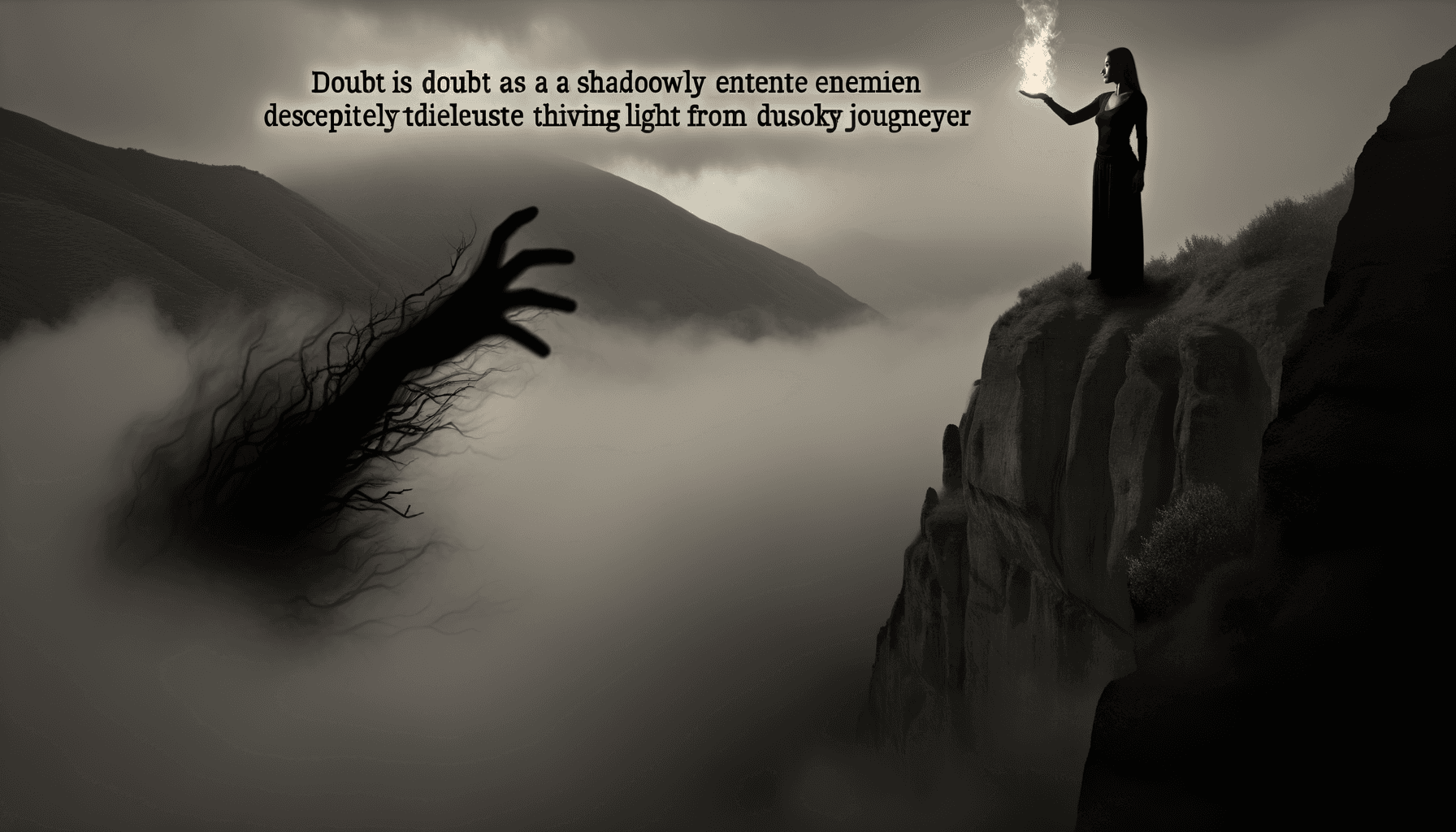
Doubt is a thief that boldly steals courage. — Kahlil Gibran
—What lingers after this line?
The Paralyzing Effect of Doubt
This quote suggests that doubt can prevent individuals from taking action or pursuing their goals. It undermines confidence and weakens determination, much like a thief that robs a person of their bravery.
The Link Between Doubt and Fear
Doubt often leads to fear, causing hesitation and uncertainty. When someone doubts themselves, they may become too afraid to take risks or face challenges, which ultimately stifles growth and progress.
The Importance of Self-Belief
Gibran's quote highlights the necessity of self-belief in overcoming obstacles. When people trust their instincts and abilities, they can combat doubt and hold onto their courage, allowing them to move forward with confidence.
Doubt as an Internal Battle
Rather than being an external force, doubt is an internal struggle that individuals must confront. Overcoming doubt requires self-awareness and resilience to push past uncertainty and maintain courage in challenging situations.
Philosophical Perspective
Kahlil Gibran, a Lebanese-American poet and philosopher, often explored themes of inner strength, human potential, and emotional depth in his writings. This quote aligns with his broader perspective on personal growth and overcoming inner struggles.
One-minute reflection
Where does this idea show up in your life right now?
Related Quotes
6 selectedPlant words of kindness; harvest a field of courage. — Kahlil Gibran
Kahlil Gibran
Kahlil Gibran’s image of planting words of kindness treats language as a living seed rather than a fleeting sound. Every remark, encouragement, or gentle reply enters the hidden soil of another person’s inner life, where...
Read full interpretation →The best people possess a feeling for beauty, the courage to take risks, the discipline to tell the truth, the capacity for sacrifice. — Ernest Hemingway
Ernest Hemingway
Hemingway’s line presents goodness not as politeness or success, but as a demanding inner code. The “best people” are those who combine sensitivity, bravery, honesty, and self-denial—qualities that do not always coexist...
Read full interpretation →If you are not willing to look stupid, nothing great is ever going to happen to you. — Julia Cameron
Julia Cameron
Julia Cameron’s remark begins with a hard truth: many people do not fail because they lack talent, but because they fear embarrassment. In that sense, ‘looking stupid’ becomes shorthand for being seen trying, stumbling,...
Read full interpretation →You don't have to bully yourself out of feeling fear. You just have to move while it's still there. — Annie Wright
Annie Wright
At its core, Annie Wright’s quote challenges the common belief that courage begins only after fear has disappeared. Instead, it reframes fear as something that can accompany action rather than prevent it.
Read full interpretation →For what matters in life is not whether we receive a round of applause; what matters is whether we have the courage to venture forth despite the uncertainty of acclaim. — Amor Towles
Amor Towles
At its core, Amor Towles shifts attention away from public approval and toward private resolve. The quote argues that a life’s value is not determined by applause—those visible signs of recognition—but by the willingness...
Read full interpretation →Confidence doesn't mean being fearless. It means creating, even when your hands shake. — Lisa Golightly
Lisa Golightly
At first glance, Lisa Golightly’s quote overturns a common myth: that confident people move through life without fear. Instead, she presents confidence as action taken in spite of fear, not in the absence of it.
Read full interpretation →More From Author
More from Kahlil Gibran →Your home is your larger body. It grows in the sun and sleeps in the stillness of the night. — Kahlil Gibran
At first glance, Gibran transforms the idea of home from a mere structure into something intimate and organic: “your larger body.” In this image, a dwelling is not separate from the person who inhabits it, but an outward...
Read full interpretation →March on. Do not tarry. To go forward is to move toward perfection. — Kahlil Gibran
Gibran’s opening imperative—“March on. Do not tarry.”—sets a tone of disciplined urgency.
Read full interpretation →There must be spaces in your togetherness, and let the winds of the heavens dance between you. — Kahlil Gibran
Gibran’s line opens with a gentle paradox: he speaks to people who are already “together,” yet insists that togetherness is healthiest when it includes room. Rather than portraying love as fusion, he frames it as a relat...
Read full interpretation →Our anxiety does not come from thinking about the future, but from wanting to control it. — Kahlil Gibran
Kahlil Gibran reframes anxiety as something more specific than mere anticipation. The future itself—uncertain, unfolding, and not yet real—doesn’t automatically distress us; rather, distress appears when we demand certai...
Read full interpretation →