
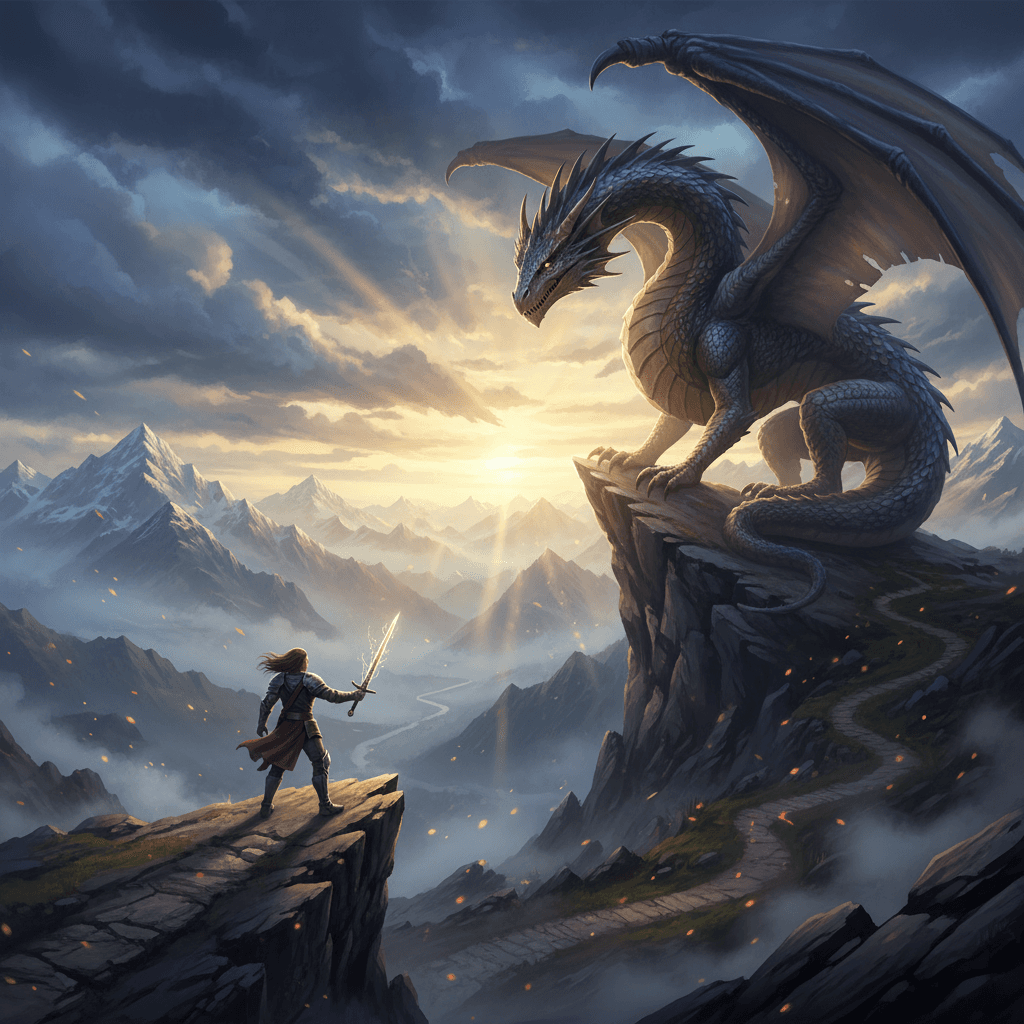
Fairy tales are more than true; not because they tell us that dragons exist, but because they tell us that dragons can be beaten. — Neil Gaiman
—What lingers after this line?
From Fear to Agency
Gaiman’s line reframes the function of frightening stories: they are not inventories of monsters but manuals for courage. By insisting that dragons can be beaten, the aphorism turns imagination into rehearsal, converting dread into a blueprint for action. This is why such tales endure; they grant us a stance toward adversity rather than a catalog of threats. In other words, the promise is not safety but agency—the learned posture that fear is a signal to prepare, not a command to surrender. With that premise in place, we can trace how this insight travels through literature, psychology, and lived experience.
The Chesterton–Gaiman Lineage
Historically, the thought comes through G. K. Chesterton’s essay “The Red Angel” in Tremendous Trifles (1909), where he argues that fairy tales do not invent terror for children; they teach that the bogey can be killed. Neil Gaiman popularized the phrasing as the epigraph to Coraline (2002), sharpening the emphasis on victory. This lineage matters because it shows the idea’s evolution from Edwardian moral reflection to contemporary storytelling, all the while preserving its core: stories do more than mirror life—they model ways to meet it. From here, the developmental stakes become clear.
How Children Practice Courage
Developmental psychology suggests that symbolic danger is training ground for real resilience. Bruno Bettelheim’s The Uses of Enchantment (1976) argues that fairy tales allow children to externalize inner conflicts and master them in miniature. Likewise, affect labeling research shows that naming fear reduces its grip; Lieberman et al. (Psychological Science, 2007) found that putting feelings into words can calm the amygdala. Thus, when a child hears about a dragon and a clever hero, the narrative supplies safe exposure plus language for dread—two ingredients for bravery. Building on that, mythic structure gives a step-by-step map for facing the unknown.
Mythic Blueprints for Resistance
Joseph Campbell’s The Hero with a Thousand Faces (1949) describes a recurring path: call to adventure, ordeal, and return with the boon. Dragon stories slot neatly into this arc, from St. George’s lance to Tolkien’s Smaug in The Hobbit (1937), where the monster embodies greed as much as fire. By personifying chaos in a dragon, tales make the unwieldy specific and therefore tackleable. Moreover, the hero’s tools—wit, allies, timely humility—double as habits. Having mapped the myth, psychology shows how these maps work on the mind.
Externalizing Problems to Shrink Them
Narrative therapy formalizes the fairy-tale trick: separate the person from the problem so it can be contested. Michael White and David Epston’s Narrative Means to Therapeutic Ends (1990) teaches clients to speak of anxiety or addiction as an antagonist—much like a dragon—so strategies can be devised against it. Cognitive reappraisal in CBT adds another lever, reframing catastrophe as challenge. In combination, story structures transform paralysis into planning: once the foe has a name, one can recruit allies, gather tools, and set small quests. With that mental kit, victories are not only imagined; they are pursued.
Modern Dragons and Real-World Victories
History supplies proof that some dragons fall. Smallpox was eradicated in 1980 through global cooperation; polio cases have dropped by over 99% since 1988 (WHO/GPEI). Social dragons, too, have been challenged—consider the end of apartheid in 1994 or Malala Yousafzai’s defiance of Taliban violence en route to education advocacy (Nobel Peace Prize, 2014). Such outcomes are neither easy nor guaranteed, yet they confirm the tale’s thesis: formidable foes can be forced to yield by courage, craft, and community. Still, wise stories also teach discernment about which battles to fight, and how.
Courage With Nuance, Not Naïveté
Fairy tales rarely promise costless triumphs. Beowulf’s last dragon is slain at the price of the hero’s life, while modern retellings like How to Train Your Dragon (2010) recast the “monster” as misunderstood, suggesting that some conflicts yield to empathy, not swords. Maurice Sendak’s Where the Wild Things Are (1963) models another path: integrating unruly feelings rather than annihilating them. Thus, the moral widens—slaying is one tool among many; wisdom lies in choosing the right response. With that nuance in mind, the final move is ours to make.
Telling New Stories of Victory
Because narratives rehearse futures, families, teachers, and leaders can craft tales that dignify fear while spotlighting tactics—mutual aid in disasters, collective action on climate, ethical technology that serves the vulnerable. As Rebecca Solnit argues in Hope in the Dark (2004), hope is not a mood but a discipline of seeing openings. When we tell and retell stories where dragons yield—by treaty, cure, or tenacity—we train our imaginations to notice leverage and our hands to seize it. In that sense, fairy tales are more than true: they are instructions for tomorrow.
Recommended Reading
As an Amazon Associate, we earn from qualifying purchases.
One-minute reflection
What does this quote ask you to notice today?
Related Quotes
6 selectedThe thing is to become a master and in your old age to acquire the courage to do what children did when they knew nothing. — Ernest Hemingway
Ernest Hemingway
Hemingway’s remark turns success into a paradox: true mastery is not merely the accumulation of skill, but the recovery of a fearless freedom usually associated with childhood. At first glance, expertise seems to move us...
Read full interpretation →Confidence doesn't mean being fearless. Confidence is knowing you are capable of handling the fear. — Amy Poehler
Amy Poehler
At first glance, people often imagine confidence as a polished kind of fearlessness, as though brave individuals simply do not tremble. Amy Poehler’s quote overturns that myth by suggesting that confidence begins not wit...
Read full interpretation →It takes a lot of courage to show your dreams to someone else. — Erma Bombeck
Erma Bombeck
Erma Bombeck’s insight begins with a simple truth: dreams feel precious because they expose what we most deeply want. To share them is not merely to state a goal, but to reveal hope, insecurity, and the possibility of fa...
Read full interpretation →You do not have to be fearless to be brave. You only need to be present enough to take the next deliberate action. — Pema Chödrön
Pema Chödrön
At first glance, Pema Chödrön’s quote gently overturns a common misconception: that bravery belongs only to people untouched by fear. Instead, she presents courage as something far more accessible.
Read full interpretation →The most radical act of courage is to be truly seen, to step out from behind our carefully curated walls and offer our authentic selves to the world. — Glennon Doyle
Glennon Doyle
Glennon Doyle’s quote reframes courage not as conquest or spectacle, but as the quiet, risky decision to be known. At its core, it suggests that the bravest act is not hiding our flaws behind polished identities, but all...
Read full interpretation →If you want the truth, you must be brave enough to hear it. — Margaret Heffernan
Margaret Heffernan
At first glance, Margaret Heffernan’s remark sounds like a simple call for honesty, yet it reaches further than that. She suggests that truth is not merely something we uncover through intelligence or investigation; rath...
Read full interpretation →More From Author
More from Neil Gaiman →This is how you do it: you sit down at the keyboard and put one word after another until it's done. It's that easy and that hard. — Neil Gaiman
Neil Gaiman’s line begins with almost disarming plainness: writing means sitting down and placing one word after another until the work is finished. At first glance, the instruction sounds mechanical, even obvious.
Read full interpretation →Forge a habit of beginning; momentum will do the rest. — Neil Gaiman
Neil Gaiman’s line reads like a lever: pry open the door with a small beginning, and the room of progress lights itself. The first move shrinks anxiety and clarifies the next step, transforming a vague intention into a c...
Read full interpretation →Sometimes you wake up. Sometimes the fall kills you. And sometimes, when you fall, you fly. — Neil Gaiman
Neil Gaiman situates the sentence in The Sandman: Fear of Falling (Vertigo, 1993; collected in Fables & Reflections), where a blocked playwright wrestles with failure. In a dream, the prospect of falling holds three outc...
Read full interpretation →The world always seems brighter when you've just made something that wasn't there before. — Neil Gaiman
Neil Gaiman’s quote underscores a universal truth: bringing something new into existence can dramatically alter our perception of reality. The act of creating—whether crafting a story, painting, or invention—ignites a se...
Read full interpretation →