
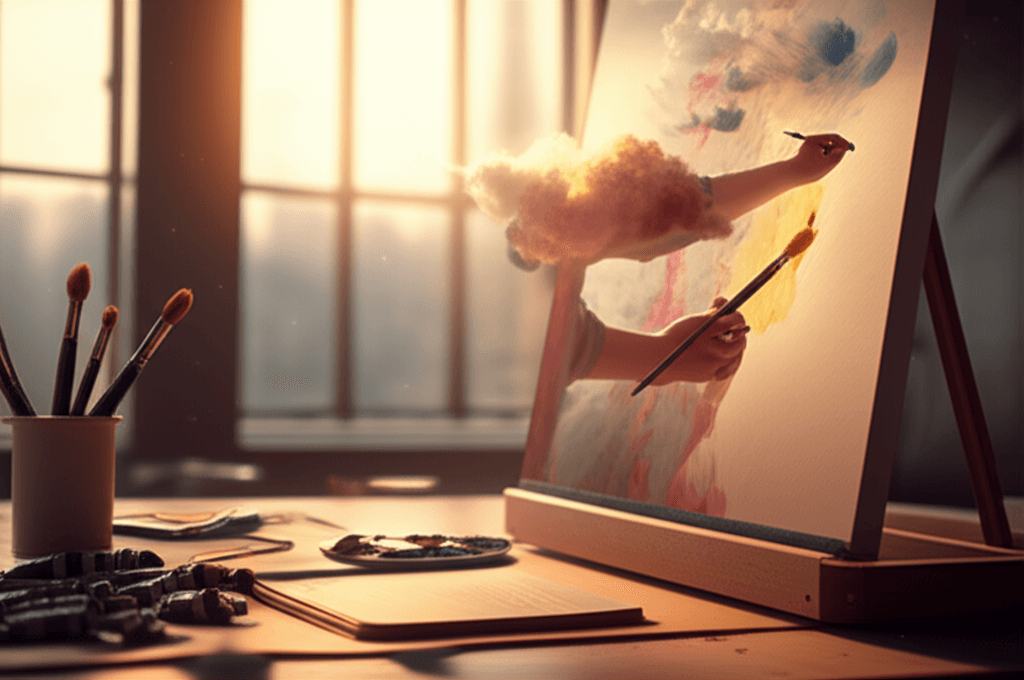
Make good art. — Neil Gaiman
—What lingers after this line?
The Imperative and Its Origin
At its simplest, Gaiman compresses an ethos into three words. In his 2012 University of the Arts (Philadelphia) commencement address, he repeats the refrain—“When things get tough, this is what you should do: Make good art”—after a comic litany of disasters, from broken legs to “your cat exploded.” The mantra reframes crisis as creative fuel, inviting graduates to convert fear, grief, or confusion into making. Rather than a slogan, it acts as a compass: move your hands, make the thing, and let the doing steady you.
Redefining “Good” as Authenticity, Not Perfection
From there, “good” refuses to mean flawless. Gaiman insists the one thing you have that nobody else has is you—your voice, your story (UArts, 2012). Good, then, is honest, particular, and yours; it emerges through drafts, not miracles. As Anne Lamott notes in Bird by Bird (1994), “shitty first drafts” are the doorway to clarity. By privileging sincerity over polish at the outset, you give craft something true to refine.
Alchemizing Setbacks into Work
Moreover, adversity becomes raw material. Frida Kahlo’s The Broken Column (1944) shows how physical pain can be translated into form without self-pity, while Steven Pressfield’s The War of Art (2002) names the inner friction as “Resistance.” Gaiman’s refrain channels both insights: name the wound, confront the inertia, then transmute them into pages, pigments, or pixels. In doing so, setbacks stop being endpoints and become engines.
Craft, Deadlines, and the Freelancer’s Triangle
Next comes the unglamorous part: professionalism. Gaiman jokes that clients keep freelancers who are good, on time, and pleasant—pick two and you’ll probably keep working (UArts, 2012). The quip hides a discipline: finish, deliver, and collaborate. Deadlines create containers for excellence, much as poetic forms do for verse. When you ship regularly, quality compounds; iteration teaches faster than aspiration.
Finding Flow Through Playful Discipline
Consequently, sustained making opens the door to flow. Mihaly Csikszentmihalyi’s Flow (1990) describes the absorbing state where challenge and skill meet; practice is what gets you there. Playfulness accelerates this, as Austin Kleon argues in Steal Like an Artist (2012): remixing influences with curiosity yields surprising originality. By oscillating between deliberate practice and exploratory play, you make work that feels alive—and thus, good.
Art’s Responsibility to Others
Finally, the point is not self-expression alone but connection. Toni Morrison’s Nobel Lecture (1993) contends that language can oppress or free; art chooses the latter when it gives others words, images, and courage. Gaiman ends similarly: break rules, make interesting mistakes, and leave the world more interesting for your being here (UArts, 2012). Making good art, then, is a civic act—private effort with public consequence.
One-minute reflection
Why might this line matter today, not tomorrow?
Related Quotes
6 selectedWhen you are in the middle of a creative block, remember that the work is not the point; the point is the practice of showing up. — Twyla Tharp
Twyla Tharp
Twyla Tharp’s quote shifts attention away from the finished product and toward the habit that makes creation possible in the first place. In the middle of a creative block, it is easy to believe that nothing matters unle...
Read full interpretation →Make your hands busy with making—words, gardens, music—and life answers back. — Pablo Neruda
Pablo Neruda
Neruda’s line frames creativity less as self-expression and more as initiation: when you keep your hands busy making, you open a channel through which the world can respond. The emphasis on “hands” matters, because it gr...
Read full interpretation →Turn thought into practice; let your pages become pathways — Virginia Woolf
Virginia Woolf
Virginia Woolf’s line, “Turn thought into practice; let your pages become pathways,” urges us to treat ideas not as fragile abstractions but as beginnings of action. Thought, in this view, is a seed that withers if it re...
Read full interpretation →Let imagination pull the ropes of practice — Paulo Coelho
Paulo Coelho
Paulo Coelho’s image of imagination pulling the ropes of practice suggests that what we repeatedly do is quietly choreographed by what we dare to envision. Instead of treating imagination as a childish escape, he casts i...
Read full interpretation →Keep your hands busy with creation, and fear will learn to sit quietly — Langston Hughes
Langston Hughes
Langston Hughes suggests that what we do with our hands can transform what happens in our minds. By urging us to "keep your hands busy with creation," he reframes courage not as a feeling we must wait for, but as a pract...
Read full interpretation →Find one bright thing to create each day; it trains the soul to notice light. — Helen Keller
Helen Keller
Helen Keller’s line proposes a practice: create one bright thing each day so the soul learns to see light. This is less about mood than muscle—an intentional repetition that reshapes perception.
Read full interpretation →More From Author
More from Neil Gaiman →This is how you do it: you sit down at the keyboard and put one word after another until it's done. It's that easy and that hard. — Neil Gaiman
Neil Gaiman’s line begins with almost disarming plainness: writing means sitting down and placing one word after another until the work is finished. At first glance, the instruction sounds mechanical, even obvious.
Read full interpretation →Forge a habit of beginning; momentum will do the rest. — Neil Gaiman
Neil Gaiman’s line reads like a lever: pry open the door with a small beginning, and the room of progress lights itself. The first move shrinks anxiety and clarifies the next step, transforming a vague intention into a c...
Read full interpretation →Sometimes you wake up. Sometimes the fall kills you. And sometimes, when you fall, you fly. — Neil Gaiman
Neil Gaiman situates the sentence in The Sandman: Fear of Falling (Vertigo, 1993; collected in Fables & Reflections), where a blocked playwright wrestles with failure. In a dream, the prospect of falling holds three outc...
Read full interpretation →The world always seems brighter when you've just made something that wasn't there before. — Neil Gaiman
Neil Gaiman’s quote underscores a universal truth: bringing something new into existence can dramatically alter our perception of reality. The act of creating—whether crafting a story, painting, or invention—ignites a se...
Read full interpretation →