
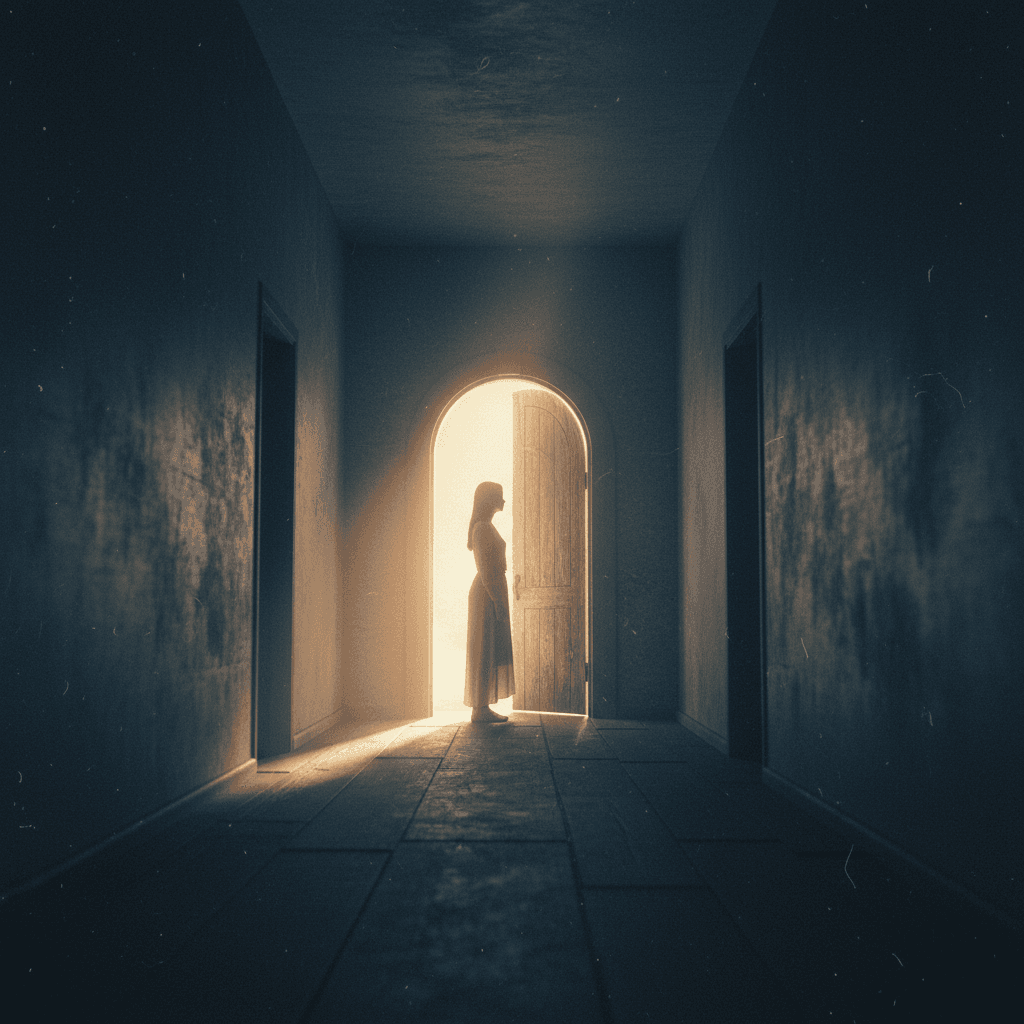
Find the quiet courage to open one more door — Viktor Frankl
—What lingers after this line?
A Single Step in the Dark
Viktor Frankl’s invitation to “find the quiet courage to open one more door” condenses his life’s philosophy into a single, gentle imperative. Instead of demanding heroic acts, he points to a small, almost ordinary gesture: turning the handle on the next door when we would rather sit down in the hallway. This door can be a new treatment after many medical failures, a difficult conversation long avoided, or simply getting out of bed on a heavy morning. By framing courage as quiet, Frankl frees it from spectacle; the bravest acts may be seen by no one at all.
Frankl’s Witness to Human Resilience
To grasp the weight of this image, it helps to recall Frankl’s experience as a Holocaust survivor and psychiatrist, recounted in *Man’s Search for Meaning* (1946). In concentration camps, the “next door” could mean enduring one more roll call in the freezing cold or offering a crust of bread to someone weaker. These were not grand gestures with guaranteed outcomes, yet they embodied a stubborn insistence on meaning. Thus, when Frankl speaks of opening one more door, he draws from situations where despair seemed rational and hope, almost absurd—yet people still chose to move forward by the smallest possible increment.
Meaning Hidden Behind the Next Threshold
From Frankl’s logotherapy perspective, meaning is not invented but discovered, often just beyond our current field of vision. The metaphor of the door implies that significance may lie on the other side of uncertainty, visible only after we cross the threshold. A job loss, for instance, may become the entrance to a vocation once imagined impossible; a painful breakup can open into deeper self-knowledge and truer connection. By urging us toward “one more” door, Frankl suggests that life’s purposes are rarely exhausted. Even when a hallway of closed doors stretches behind us, the possibility of new meaning still waits ahead.
The Power of Incremental Bravery
Moreover, the phrase “one more” counters the paralysis that comes from imagining we must change everything at once. Psychological research on behavior change, such as James Prochaska and Carlo DiClemente’s stages-of-change model (1983), shows that lasting transformation usually emerges through small, repeated steps. Frankl’s wording mirrors this: we are not asked to open every door, only the next one. This incremental framing makes courage accessible; it transforms an overwhelming future into a manageable present action. In practice, this might mean writing a single paragraph of a daunting thesis or making one phone call toward reconciliation.
Quiet Courage Versus Loud Heroics
Frankl’s emphasis on quiet courage also challenges cultural ideals that equate bravery with noise, visibility, and victory. Many people feel disqualified from seeing themselves as brave because their struggles are private—living with chronic illness, grieving in silence, or caring for a family member day after day. Yet, when courage is understood as the willingness to open one more door despite fear or fatigue, these hidden battles become sites of profound heroism. The applause may never come, but the moral weight of the act remains, dignifying lives that might otherwise seem mundane or futile.
Choosing to Try Again, Without Guarantees
Finally, opening one more door is an act of faith without certainty. Frankl never promised that each new room will be bright or easy; some doors lead to fresh disappointment or further struggle. However, the refusal to stop knocking embodies what he called the “defiant power of the human spirit.” Instead of measuring life by immediate success, we begin to value our capacity to respond—again and again—to what confronts us. In that response lies freedom: the freedom to choose our stance even when circumstances do not change. Thus, the quiet courage Frankl describes becomes not just a temporary effort, but a way of living: one more breath, one more attempt, one more door.
One-minute reflection
What's one small action this suggests?
Related Quotes
6 selectedWrite tomorrow's answer with today's brave pen. — Viktor Frankl
Viktor Frankl
Viktor Frankl’s line—“Write tomorrow's answer with today's brave pen”—compresses two moments into one responsibility. The “answer” belongs to tomorrow, yet the tool that creates it is in our hand now.
Read full interpretation →When fear tightens its grip, stretch your hands toward what you want. — Viktor Frankl
Viktor Frankl
Fear tightens by narrowing our field of view, pulling attention toward threats and away from possibilities. In that constriction, our instincts often default to avoidance—delay, distraction, or retreat—which briefly soot...
Read full interpretation →If we are facing in the right direction, all we have to do is keep walking. — Thích Nhất Hạnh
Thich Nhat Hanh
Thích Nhất Hạnh’s words begin with a simple but profound premise: progress depends first on direction, not speed. If a person is turned toward compassion, clarity, healing, or truth, then each modest step becomes meaning...
Read full interpretation →Do the best one can. Do it over again. Then still improve, even if ever so slightly, those retouches. — Marguerite Yourcenar
Marguerite Yourcenar
Yourcenar’s words begin with a simple demand: do the best one can. Yet she immediately refuses to let effort become an excuse for stopping.
Read full interpretation →To be courageous is to act with the heart. — Molière
Molière
Molière’s line suggests that courage is not merely the absence of fear, but the decision to move despite it. By connecting courage with the heart, he frames bravery as an emotional and moral act rather than a simple disp...
Read full interpretation →The best people possess a feeling for beauty, the courage to take risks, the discipline to tell the truth, the capacity for sacrifice. — Ernest Hemingway
Ernest Hemingway
Hemingway’s line presents goodness not as politeness or success, but as a demanding inner code. The “best people” are those who combine sensitivity, bravery, honesty, and self-denial—qualities that do not always coexist...
Read full interpretation →More From Author
More from Viktor Frankl →You are not responsible for your first thought, but you are responsible for your second thought. — Viktor Frankl
At its core, the quotation distinguishes between what arises automatically and what we deliberately endorse. A first thought may be reflexive, inherited, fearful, angry, or conditioned by habit; it appears before moral j...
Read full interpretation →The meaning of life differs from man to man, from day to day and from hour to hour. — Viktor Frankl
Frankl’s sentence immediately resists the idea that life has one universal, static answer. Instead, he frames meaning as something that changes with the individual and even with the passing of time—so what matters most t...
Read full interpretation →Each man is questioned by life; and he can only answer to life by answering for his own life. — Viktor Frankl
Frankl reverses a common assumption: instead of treating life like a puzzle we interrogate for meaning, he frames life as the one doing the asking. In this view, daily events—work demands, relationship conflicts, illness...
Read full interpretation →Meaning is not something you find; it is something you build. Stop waiting for a sign and start laying the bricks of your own purpose. — Viktor Frankl
Frankl’s line overturns a familiar hope—that life’s purpose is hidden somewhere, waiting to be uncovered like a buried artifact. Instead, he frames meaning as something made, assembled through choices and commitments ove...
Read full interpretation →