
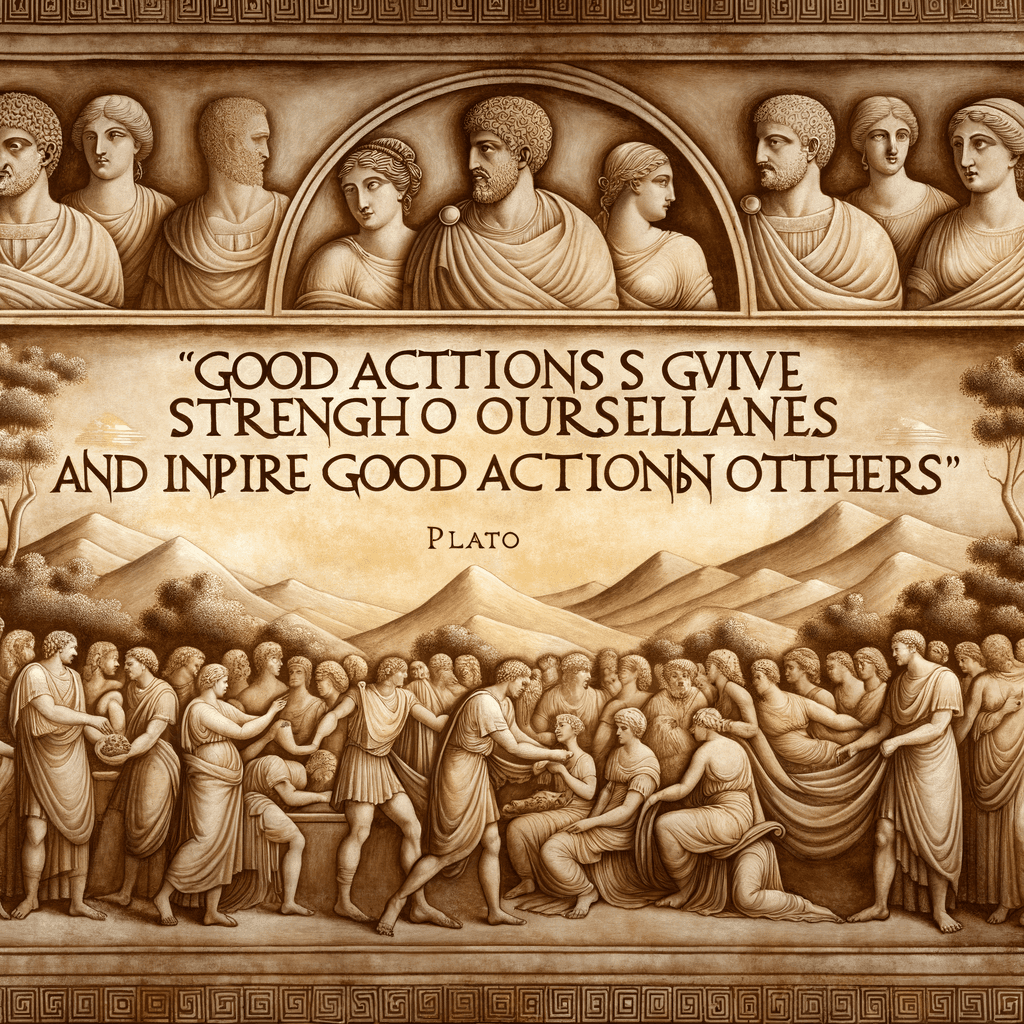
Good actions give strength to ourselves and inspire good actions in others. — Plato
—What lingers after this line?
Empowerment Through Virtue
This quote highlights the idea that performing good deeds enhances one's own moral character and personal strength, reinforcing the notion that virtuous actions contribute to self-improvement.
Ripple Effect of Kindness
Plato suggests that good actions can create a positive ripple effect in society, where one person's good deed can encourage and inspire others to follow suit, thereby fostering a community of goodwill.
Role of Example in Leadership
The quote emphasizes the importance of leading by example. Those in positions of influence can create an environment that nurtures ethical behavior and inspires others to act in kind.
Moral Responsibility
By suggesting that good actions inspire others, Plato conveys a sense of moral responsibility; individuals are not only accountable for their actions but also for how those actions can affect others' behaviors.
Philosophical Context
As a philosopher in ancient Greece, Plato believed in the significance of moral virtues and ethics. His works often delved into the nature of good and the impact of individual behavior on society, reflecting the ideals of virtue ethics.
One-minute reflection
What feeling does this quote bring up for you?
Related Quotes
6 selectedAct in the well-being of others and you will find your own. — Dalai Lama, Tibet.
Dalai Lama, Tibet.
This quote emphasizes the importance of acting selflessly and prioritizing the well-being of others. It suggests that true fulfillment and happiness come from helping those around us.
Read full interpretation →The things that you do for yourself are gone when you are gone, but the things that you do for others remain as your legacy. — Kalu K. Ndukwe Kalu
Kalu K. Ndukwe Kalu
At its heart, Kalu K. Ndukwe Kalu’s quote redirects attention from personal gain to shared impact.
Read full interpretation →The most important aspect of gratitude is that it spurs action—that it compels us to go outside ourselves to express our gratitude in a way that makes a difference in someone else's life. — Rebecca Solnit
Rebecca Solnit
Rebecca Solnit shifts gratitude away from being a private sentiment and turns it into a moral impulse. In her view, thankfulness matters most not when it remains an inward glow, but when it pushes us outward toward other...
Read full interpretation →One of the deep secrets of life is that all that is really worth the doing is what we do for others. — Lewis Carroll
Lewis Carroll
Lewis Carroll’s line turns attention away from achievement for its own sake and toward a quieter measure of value: whether our actions help someone beyond ourselves. At first glance, this may sound like simple moral advi...
Read full interpretation →The only thing to do with good advice is to pass it on. It is never of any use to oneself. — Oscar Wilde
Oscar Wilde
Oscar Wilde’s line turns a familiar moral expectation on its head: instead of treating advice as a tool for self-improvement, he treats it as a social commodity best circulated outward. The joke lands because it exposes...
Read full interpretation →Measure success by the lives you lift, not the titles you earn — Kahlil Gibran
Kahlil Gibran
Gibran’s line shifts the measure of achievement away from what can be printed on a business card and toward what can be felt in other people’s lives. Titles are visible, quickly understood, and easy to compare, which is...
Read full interpretation →More From Author
More from Plato →A grateful mind is a great mind which eventually attracts to itself great things. — Plato
At first glance, Plato’s saying links two qualities we often separate: thankfulness and greatness. Rather than treating gratitude as mere politeness, the quote presents it as a sign of mental and moral enlargement.
Read full interpretation →Everything that is beautiful and noble is the result of long labor and struggle. — Plato
At first glance, Plato’s statement presents beauty and nobility not as accidents of luck, but as achievements earned through endurance. What is truly admirable, he suggests, does not simply appear fully formed; rather, i...
Read full interpretation →Time is the moving image of eternity. - Plato
This quote suggests that time is an ever-changing representation of something eternal and unchanging. It implies that while time flows and changes, eternity remains constant.
Read full interpretation →What we seek is what we are. — Plato
This quote suggests that our desires and aspirations are a reflection of our true selves. What we seek in life often reveals our values, beliefs, and inner identity.
Read full interpretation →