
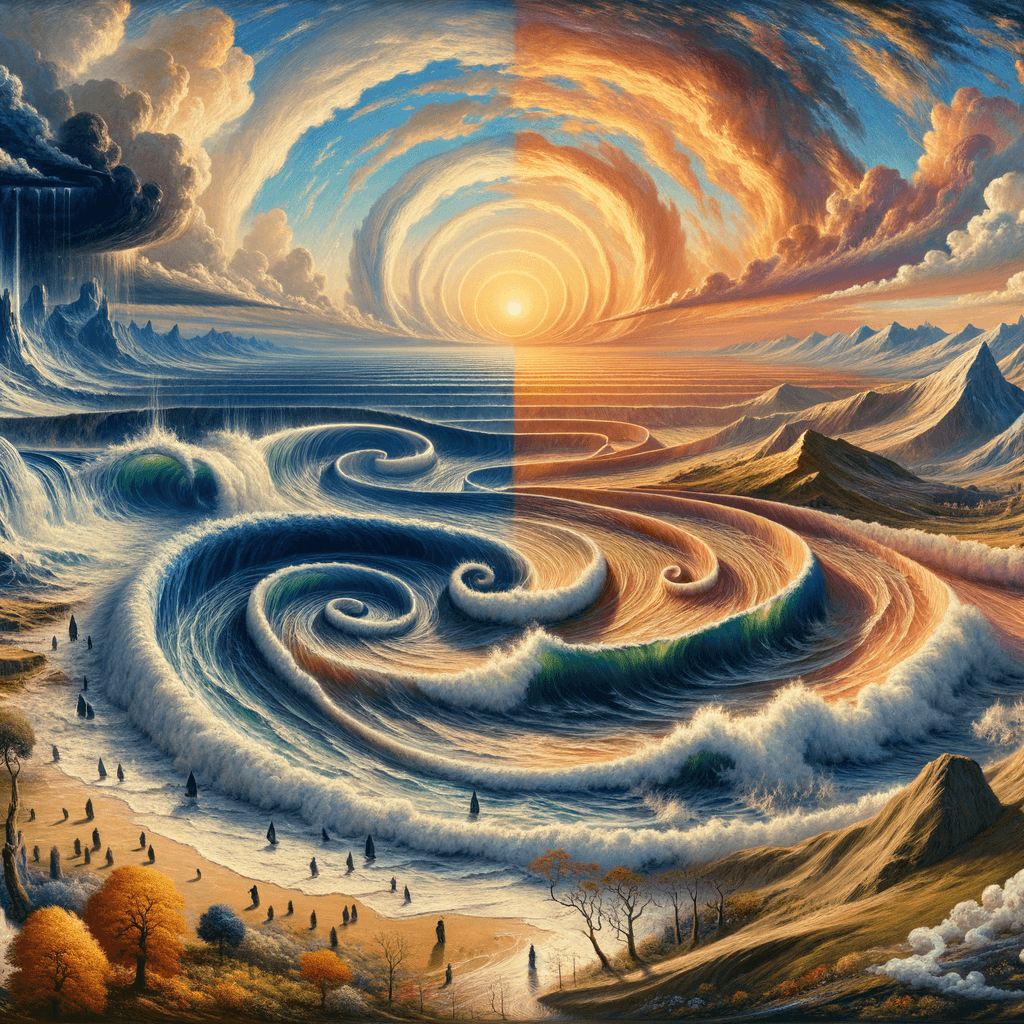
Time is the moving image of eternity. - Plato
—What lingers after this line?
Philosophical Perspective on Time
This quote suggests that time is an ever-changing representation of something eternal and unchanging. It implies that while time flows and changes, eternity remains constant.
Connection Between Time and Eternity
Plato is drawing a relationship between the temporal world we live in and the concept of eternity. Time can be seen as a limited, perceptible version of the infinite and eternal.
Impermanence and Permanence
The quote illustrates the contrast between the temporary nature of our existence in time and the permanent, unchanging nature of eternity.
Philosophical Idealism
Plato's quote reflects his broader philosophical views, notably his theory of forms, where the material world is an imperfect reflection of higher, immutable truths.
Reflection on Human Perception
This statement also encourages reflection on how humans perceive the world around them. It suggests that our understanding of time is just a glimpse or image of a deeper, eternal reality.
Historical Context
Plato, a classical Greek philosopher, lived during the 4th century BCE. His works laid the foundations of Western philosophy and touched upon numerous aspects of metaphysics, ethics, and epistemology.
One-minute reflection
What feeling does this quote bring up for you?
Related Quotes
6 selectedThe soul is partly in time and partly in eternity. We might remember the part that resides in eternity when we feel despair over the part that is in life. — Thomas Moore
Thomas Moore
Thomas Moore’s reflection begins with a striking duality: the soul belongs both to the changing world of time and to the changeless dimension of eternity. On one hand, we live through deadlines, aging, grief, and uncerta...
Read full interpretation →The stars are the street lights of eternity. - Unknown
Unknown
This quote uses vivid imagery by comparing stars to street lights, creating a visual metaphor. It suggests that just as street lights illuminate our paths at night, stars illuminate the vast expanse of eternity.
Read full interpretation →To see a world in a grain of sand and a heaven in a wild flower, hold infinity in the palm of your hand and eternity in an hour. - William Blake
William Blake
This quote suggests that vast and profound insights can be found in the smallest and most ordinary things if one has the perception and imagination to see them. It encourages finding magic and significance in everyday ob...
Read full interpretation →The day which we fear as our last is but the birthday of eternity. — Lucius Annaeus Seneca
Lucius Annaeus Seneca
Seneca, a Stoic philosopher, views death not as an end but as a transition. The day we die is, in fact, the beginning of an eternal existence — a concept that ties death to a greater cosmic or spiritual continuation.
Read full interpretation →Forever is composed of nows. — Emily Dickinson
Emily Dickinson
Emily Dickinson’s aphorism compresses a vast idea into a few words: eternity is not a distant horizon but a continuous fabric woven from present instants. By declaring that forever is “composed of nows,” she reframes tim...
Read full interpretation →A grateful mind is a great mind which eventually attracts to itself great things. — Plato
Plato
At first glance, Plato’s saying links two qualities we often separate: thankfulness and greatness. Rather than treating gratitude as mere politeness, the quote presents it as a sign of mental and moral enlargement.
Read full interpretation →More From Author
More from Plato →A grateful mind is a great mind which eventually attracts to itself great things. — Plato
At first glance, Plato’s saying links two qualities we often separate: thankfulness and greatness. Rather than treating gratitude as mere politeness, the quote presents it as a sign of mental and moral enlargement.
Read full interpretation →Everything that is beautiful and noble is the result of long labor and struggle. — Plato
At first glance, Plato’s statement presents beauty and nobility not as accidents of luck, but as achievements earned through endurance. What is truly admirable, he suggests, does not simply appear fully formed; rather, i...
Read full interpretation →Good actions give strength to ourselves and inspire good actions in others. — Plato
This quote highlights the idea that performing good deeds enhances one's own moral character and personal strength, reinforcing the notion that virtuous actions contribute to self-improvement.
Read full interpretation →What we seek is what we are. — Plato
This quote suggests that our desires and aspirations are a reflection of our true selves. What we seek in life often reveals our values, beliefs, and inner identity.
Read full interpretation →