
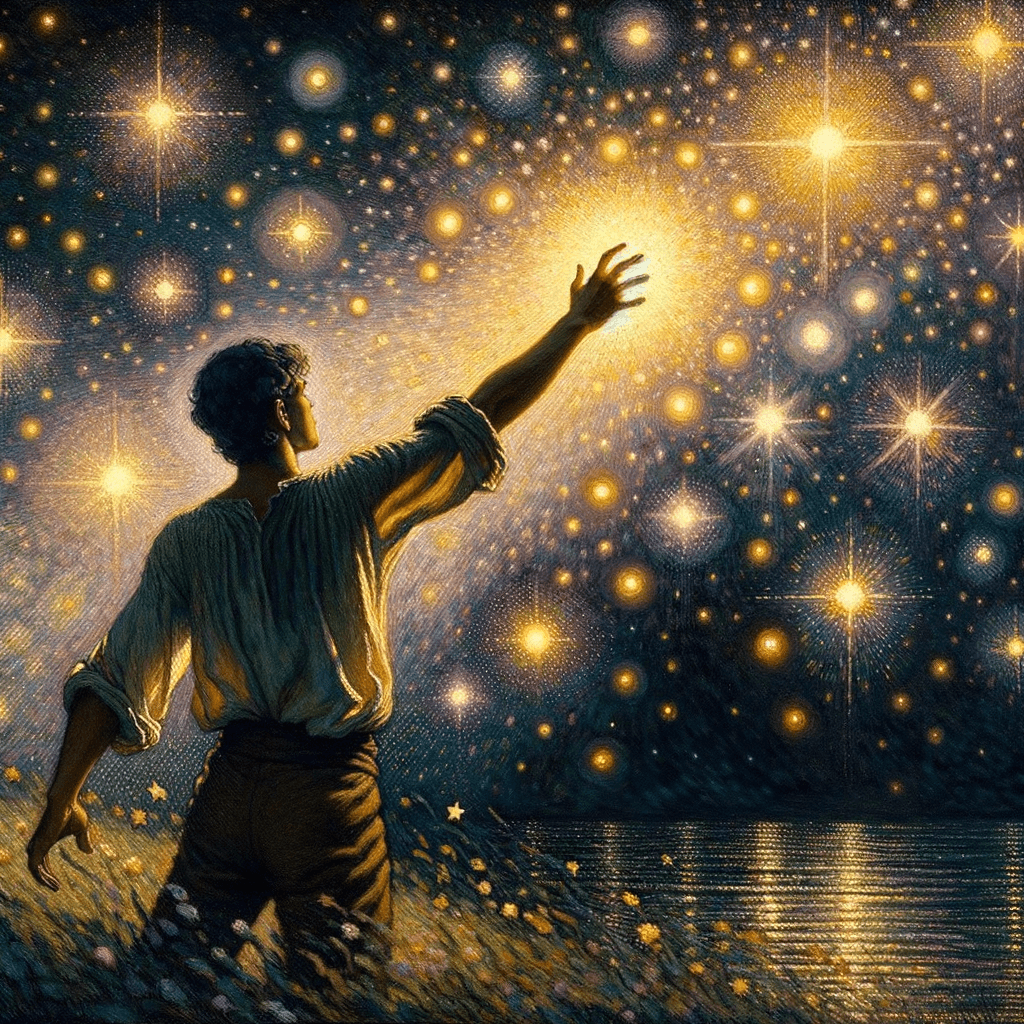
It is not in the stars to hold our destiny but in ourselves. — William Shakespeare
—What lingers after this line?
Personal Responsibility
This quote emphasizes the importance of taking responsibility for one's own life and choices. It suggests that individuals have the power to shape their destinies through their actions and decisions.
Self-Determination
Shakespeare's words highlight the concept of self-determination, arguing against the idea that our futures are predetermined by external forces such as fate or astrology.
Empowerment
The quote serves as a reminder that empowerment comes from within. It encourages individuals to recognize their own agency and capacity to influence their future.
Rejection of Fatalism
By stating that our destiny is not in the stars, the quote invites a rejection of fatalism – the belief that all events are predetermined and inevitable. Instead, it advocates for an active approach to life.
Literary Context
William Shakespeare, a renowned English playwright and poet of the late 16th and early 17th centuries, often explored themes of human agency, ambition, and the complexities of fate in his works.
One-minute reflection
What's one small action this suggests?
Related Quotes
6 selectedBe the master of your fate, the captain of your soul. — William Ernest Henley
William Ernest Henley
This quote emphasizes the importance of taking control of one's own life. It encourages individuals to be proactive and assertive in shaping their destiny, rather than passively allowing external circumstances to dictate...
Read full interpretation →You cannot command things, but you can command yourself. — Michael D. Pollock
Michael D. Pollock
At first glance, Michael D. Pollock’s line draws a sharp boundary between the outer world and the inner one.
Read full interpretation →A boundary is not a wall; it is a door with a lock that you control. — Annie Wright
Annie Wright
At first glance, Annie Wright’s quote corrects a common misunderstanding: people often treat boundaries as acts of distance or punishment, when in fact they are tools of intentional relationship. A wall shuts everyone ou...
Read full interpretation →When you feel like you are at a dead end, remember that you are at a place where you can choose a different path. — Haemin Sunim
Haemin Sunim
At first glance, a dead end feels like failure, as though movement itself has been denied. Yet Haemin Sunim’s insight gently reverses that impression: what seems like a wall may actually be a point of decision.
Read full interpretation →The boundaries of your life are merely a creation of the self. — Robin Sharma
Robin Sharma
Robin Sharma’s line reframes “boundaries” as something less like a fence in the world and more like a frame in the mind. What we often call limits—who we are, what we can do, what we deserve—can be stories we repeat unti...
Read full interpretation →You are the author of your own story. You don't need permission to begin. — Ctrl+Alt+Write
Ctrl+Alt+Write
The quote opens with a bracing premise: your life is not merely something that happens to you, but something you shape. By calling you “the author,” it reframes identity from a fixed description into an ongoing draft—rev...
Read full interpretation →More From Author
More from William Shakespeare →Talk less than you know; have more than you show. — William Shakespeare
At first glance, Shakespeare’s line praises restraint: speak with care, and let your words carry only what is necessary. “Talk less than you know” suggests that wisdom is not proven by constant display, but by the abilit...
Read full interpretation →Screw your courage to the sticking-place. — William Shakespeare
At its core, Shakespeare’s line is a vivid call to steady oneself before decisive action. In Macbeth (c.
Read full interpretation →You do not have to announce your progress to the world. Let your growth be private, your silence be your strength, and your results be your only witness. — William Shakespeare
At its core, this saying praises the discipline of developing without constant display. Instead of broadcasting every ambition, setback, or small victory, it suggests that real growth often happens best in protected spac...
Read full interpretation →We know what we are, but know not what we may be. — William Shakespeare
Shakespeare’s line captures a striking human tension: we feel certain about who we are now, yet remain unable to fully imagine who we might become. At first glance, the statement sounds simple, but it opens a profound ga...
Read full interpretation →