
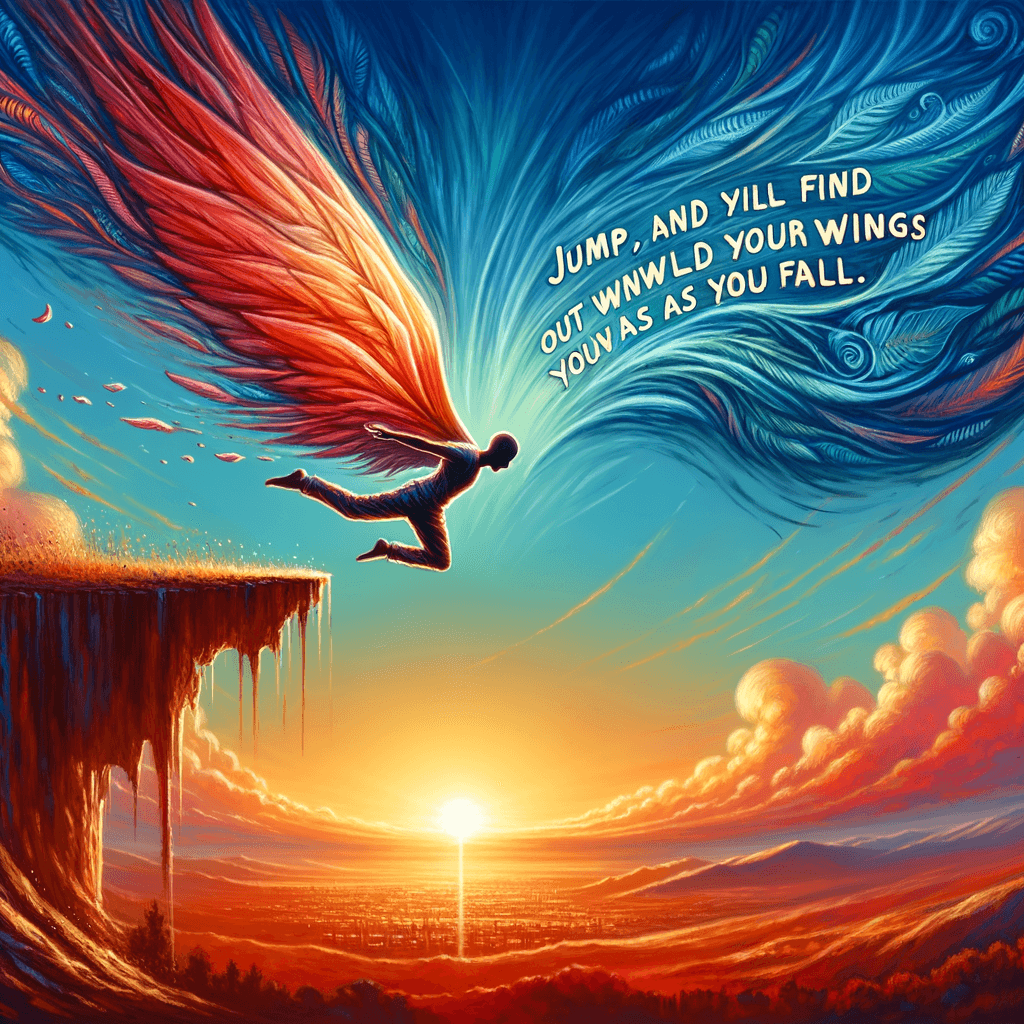
Jump, and you will find out how to unfold your wings as you fall. — Ray Bradbury
—What lingers after this line?
Courage and Risk-Taking
This quote encourages taking bold actions even when the outcome is uncertain. It suggests that true growth and discovery often require a leap of faith.
Self-Discovery
The act of jumping metaphorically represents embracing the unknown. As you navigate unforeseen challenges, you learn about your capabilities and resilience.
Overcoming Fear
It emphasizes that facing fears head-on can lead to unexpected strengths and solutions. Allowing yourself to take risks can ultimately result in personal development and success.
Adaptability and Learning
The idea of unfolding wings while falling highlights the importance of adaptability. It suggests that you will develop the skills and knowledge you need as you encounter challenges.
Creative Thinking
Ray Bradbury, known for his imaginative literary work, often explored themes of creativity and exploration. This quote reflects his belief in the power of thinking outside the box and taking creative risks.
Philosophical Perspective
On a deeper level, the quote could be seen as a metaphor for life’s journey itself. It suggests that life’s challenges are an integral part of discovering one's true potential and abilities.
One-minute reflection
Why might this line matter today, not tomorrow?
Related Quotes
6 selectedLearning to love yourself is like learning to walk – essential, life-changing, and the only way to stand tall. — Vironika Tugaleva
Vironika Tugaleva
Vironika Tugaleva’s comparison begins with a simple but powerful truth: self-love is not a luxury, but a basic human necessity. Just as walking allows a child to move through the world with growing independence, learning...
Read full interpretation →The most gifted members of the human species are at their creative best when they cannot have their way, and must compensate for what they miss by realizing and cultivating their capacities. — Bryant H. McGill
Bryant H. McGill
Bryant H. McGill’s observation begins with a striking reversal: gifted people may not reach their highest potential when everything comes easily, but when something blocks their path.
Read full interpretation →A mind grows by staying with difficulty long enough for the experience to change it. — Mary Catherine Bateson
Mary Catherine Bateson
Mary Catherine Bateson’s observation begins with a quiet but demanding truth: the mind does not grow merely by encountering difficulty, but by remaining with it. Challenge becomes transformative only when we resist the u...
Read full interpretation →Consistency is a superpower. — Ryan Holiday
Ryan Holiday
Ryan Holiday’s line begins with a deceptively simple idea: greatness is rarely built through dramatic gestures. More often, it emerges from repeated actions that seem ordinary in isolation but become extraordinary over t...
Read full interpretation →Confidence is silent. Insecurities are loud. — Unknown (Wait—skip/replace with: True nobility is being superior to your former self. — Ernest Hemingway)
Ernest Hemingway
At its core, Hemingway’s line redefines nobility as an inward achievement rather than a social rank. Instead of measuring worth by wealth, pedigree, or dominance over others, it points to a quieter standard: becoming bet...
Read full interpretation →You are under no obligation to be consistent with the person you were yesterday. — James McCrae
James McCrae
At its core, James McCrae’s line challenges the quiet pressure to remain legible to others. Many people feel bound to opinions, habits, or identities simply because they once claimed them, as though consistency were a mo...
Read full interpretation →More From Author
More from Ray Bradbury →Don't think. Thinking is the enemy of creativity. It's self-conscious, and anything self-conscious is lousy. — Ray Bradbury
At first glance, Ray Bradbury’s line sounds almost rebellious: “Don’t think. Thinking is the enemy of creativity.” Yet his target is not intelligence itself, but the paralyzing kind of self-awareness that makes an artist...
Read full interpretation →Life should be touched, not strangled. You've got to relax, let it happen at times, and at others move forward with it. — Ray Bradbury
Ray Bradbury’s line begins with a vivid contrast: life can be touched, or it can be strangled. In that image, he warns against trying to control every outcome so tightly that experience itself loses its vitality.
Read full interpretation →Creativity is a continual surprise. — Ray Bradbury
Ray Bradbury’s remark distills creativity into a living process rather than a finished product. By calling it a “continual surprise,” he suggests that invention is not merely planned output but an ongoing encounter with...
Read full interpretation →Life is trying things to see if they work. — Ray Bradbury
This quote emphasizes that life involves experimenting with different ideas, methods, or paths to discover what succeeds.
Read full interpretation →