
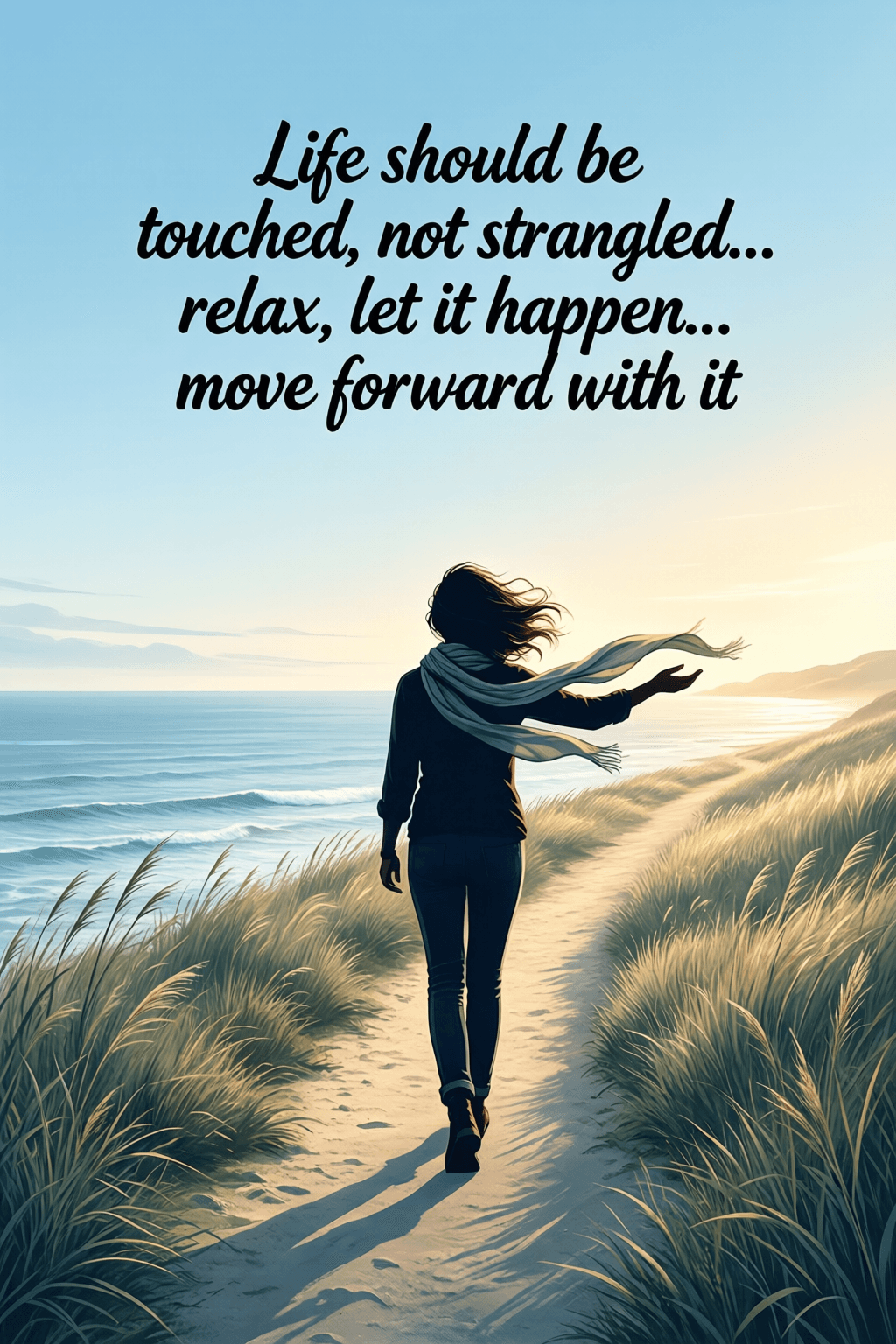
Life should be touched, not strangled. You've got to relax, let it happen at times, and at others move forward with it. — Ray Bradbury
—What lingers after this line?
The Meaning of a Gentle Grip
Ray Bradbury’s line begins with a vivid contrast: life can be touched, or it can be strangled. In that image, he warns against trying to control every outcome so tightly that experience itself loses its vitality. To touch life is to engage with it attentively and lovingly, while strangling it suggests fear, rigidity, and the desperate need to force certainty where none exists. From the start, then, Bradbury frames wisdom as a matter of posture rather than power. We do not master life by clutching harder; instead, we learn to meet it with sensitivity. That idea echoes the reflective spirit of his essays and fiction, where wonder often flourishes only when people stop trying to dominate the unknown.
Why Control Can Become Destructive
Seen this way, the quote also exposes a common human mistake: believing that constant pressure produces better living. Yet excessive control often shrinks the very possibilities we hope to secure. A parent who scripts every step of a child’s future, for example, may protect them from risk while also suffocating curiosity and independence. In this sense, Bradbury’s metaphor aligns with ancient insights. The Tao Te Ching, traditionally attributed to Laozi (c. 4th century BC), repeatedly praises flexibility over force, suggesting that what is soft can outlast what is rigid. Bradbury brings that timeless lesson into everyday life, reminding us that strangling experience usually leaves us with anxiety, not meaning.
The Discipline of Letting Things Happen
However, Bradbury does not recommend passivity. When he says we must ‘relax, let it happen at times,’ he points to a disciplined openness, not resignation. Some moments require patience: grief must unfold, creativity must incubate, and love often deepens in ways that cannot be scheduled. Trying to rush these processes can make them more elusive. Writers frequently describe this paradox. In Anne Lamott’s Bird by Bird (1994), she notes that clarity often arrives after one stops demanding perfection from the first attempt. Likewise, anyone who has struggled to fall asleep knows that the harder one tries, the less likely sleep becomes. Bradbury’s advice recognizes that certain goods emerge only when invited, not coerced.
Knowing When to Move With Life
Still, the quote turns in its second half: ‘and at others move forward with it.’ That shift is crucial, because a light touch is not the same as drifting aimlessly. Bradbury suggests that wisdom lies in discerning when life calls for surrender and when it calls for action. There are times to wait for the current, and times to swim with intention. This balance appears in Viktor Frankl’s Man’s Search for Meaning (1946), where he distinguishes between what cannot be changed and the freedom to respond meaningfully. In ordinary terms, one cannot force an opportunity to appear, but one can prepare, decide, and act when it does. Thus Bradbury’s philosophy is dynamic: relax when forcing will harm, advance when motion becomes possible.
Creativity, Freedom, and Trust
Bradbury’s words also carry the sensibility of an artist. In Zen in the Art of Writing (1990), he repeatedly celebrates spontaneity, play, and emotional honesty in creative work. For him, imagination thrives when the mind is alert but not overmanaged. A story, like life, can die under too much supervision before it has the chance to breathe. More broadly, this applies beyond art. Friendships grow through shared time rather than strategic manipulation, and meaningful careers often develop through a mix of effort and serendipity. Therefore, to ‘touch’ life is to trust that not everything valuable can be engineered. Some of the best things arrive when we make room for them.
A Practical Philosophy for Daily Living
Ultimately, Bradbury offers a practical rule for living: hold experience with care, not panic. Relaxation and forward motion are not opposites here but partners. We loosen our grip enough to notice what is unfolding, and then we step toward it when the moment is right. That rhythm protects us from both paralysis and domination. In daily life, this might mean listening instead of immediately fixing, pausing before forcing a decision, or acting decisively once a path becomes clear. Bradbury’s sentence endures because it captures a mature form of courage: not the need to command life at every second, but the grace to meet it responsively. By doing so, we do not lose life’s richness—we finally allow it to live.
One-minute reflection
What's one small action this suggests?
Related Quotes
6 selectedWisdom is knowing when to have rest, when to have activity, and how much of each to have. — Etty Hillesum
Etty Hillesum
Etty Hillesum’s insight begins with a simple but demanding idea: wisdom is not merely knowing what is good, but knowing when it is good. Rest and activity are both necessary, yet either can become harmful when taken at t...
Read full interpretation →Be fast when it makes sense to be fast, and be slow when slowness is called for. — Carl Honoré
Carl Honoré
Carl Honoré’s line begins with a practical admission: speed is not the enemy. There are moments when urgency, efficiency, and quick response are exactly what life requires.
Read full interpretation →We are wired to hold on. To people, jobs, plans, beliefs — even when they don't serve us anymore. You're allowed to leave. Not because you gave up. But because you finally decided to move forward. — Nary
Nary
Nary’s quote begins with a compassionate truth: human beings are deeply wired to cling. We attach ourselves to people, work, routines, ambitions, and beliefs because they give us identity and predictability.
Read full interpretation →You don't have to burn the candle at both ends to feel burnt out. Being burnt out isn't a motivational issue, it's a pacing issue. — Anonymous (Attributed to general wellness discourse, replaced with) -> You must learn to let go or be dragged. — Zen Proverb (Wait, rule: no proverbs) -> You must learn to let go or be dragged. — A.A. Milne
A. A. Milne
At its core, the line attributed here to A.A. Milne presents letting go not as surrender, but as wisdom.
Read full interpretation →I am learning to love the sound of my feet walking away from things not meant for me. — A.G.
A.G.
At first glance, A.G.’s line transforms an ordinary sound—one’s own footsteps—into a symbol of inner change. To love that sound is to find beauty not in being chosen, but in choosing oneself.
Read full interpretation →The only way to move forward is to stop pretending that the past is still happening. — Pema Chödrön
Pema Chödrön
Pema Chödrön’s line begins with a gentle but piercing insight: suffering often persists not only because something painful happened, but because part of us keeps reliving it as if it were still unfolding. In that sense,...
Read full interpretation →More From Author
More from Ray Bradbury →Don't think. Thinking is the enemy of creativity. It's self-conscious, and anything self-conscious is lousy. — Ray Bradbury
At first glance, Ray Bradbury’s line sounds almost rebellious: “Don’t think. Thinking is the enemy of creativity.” Yet his target is not intelligence itself, but the paralyzing kind of self-awareness that makes an artist...
Read full interpretation →Creativity is a continual surprise. — Ray Bradbury
Ray Bradbury’s remark distills creativity into a living process rather than a finished product. By calling it a “continual surprise,” he suggests that invention is not merely planned output but an ongoing encounter with...
Read full interpretation →Jump, and you will find out how to unfold your wings as you fall. — Ray Bradbury
This quote encourages taking bold actions even when the outcome is uncertain. It suggests that true growth and discovery often require a leap of faith.
Read full interpretation →Life is trying things to see if they work. — Ray Bradbury
This quote emphasizes that life involves experimenting with different ideas, methods, or paths to discover what succeeds.
Read full interpretation →