
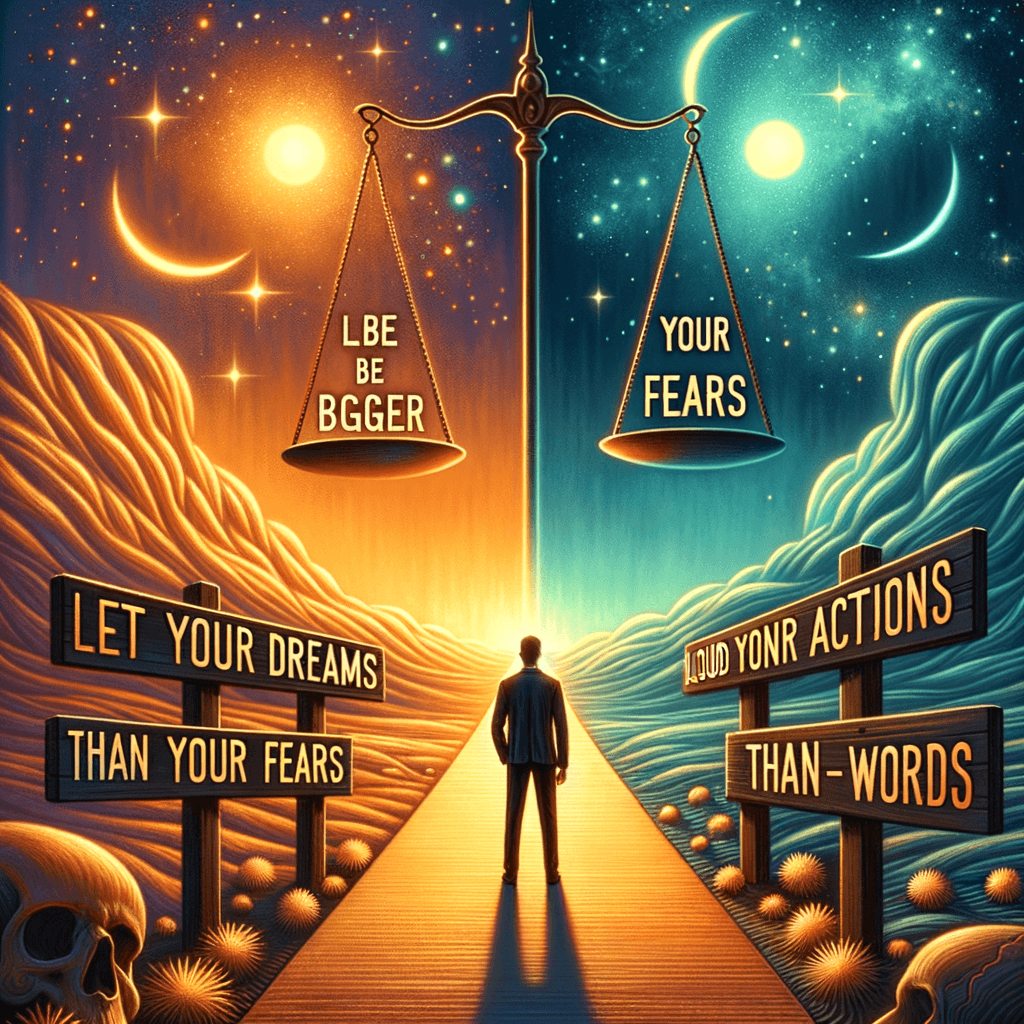
Let your dreams be bigger than your fears and your actions louder than your words. — J.J. Watt, United States.
—What lingers after this line?
Dreams vs. Fears
This quote emphasizes the importance of allowing one's aspirations to outweigh their fears. It encourages individuals to pursue their dreams bravely and not let fear hold them back.
Taking Action
The quote urges the importance of actions over mere words. It stresses that one's commitments and ambitions should be demonstrated through tangible actions rather than just spoken intentions or promises.
Motivation and Empowerment
By encouraging people to dream big and act decisively, the quote serves as a motivational call to empower individuals to strive for greatness, pushing past their comfort zones and into ambition.
Contrast Between Words and Actions
This phrase highlights the common discrepancy between what people say and what they actually do, suggesting that authenticity in achieving goals comes from concrete efforts rather than verbal affirmations.
Influence of J.J. Watt
J.J. Watt is known not only as a prominent American football player but also as a public figure involved in various charitable endeavors. His words reflect a mindset of perseverance and determination that motivates both athletes and the broader public.
One-minute reflection
Where does this idea show up in your life right now?
Related Quotes
6 selectedThe best people possess a feeling for beauty, the courage to take risks, the discipline to tell the truth, the capacity for sacrifice. — Ernest Hemingway
Ernest Hemingway
Hemingway’s line presents goodness not as politeness or success, but as a demanding inner code. The “best people” are those who combine sensitivity, bravery, honesty, and self-denial—qualities that do not always coexist...
Read full interpretation →If you are not failing from time to time, you are not aiming high enough. — Soichiro Honda
Soichiro Honda
At its core, Soichiro Honda’s remark reframes failure from a mark of inadequacy into proof of aspiration. If every attempt succeeds smoothly, the goal may be too safe, too familiar, or too small to stretch one’s abilitie...
Read full interpretation →If you are not willing to look stupid, nothing great is ever going to happen to you. — Julia Cameron
Julia Cameron
Julia Cameron’s remark begins with a hard truth: many people do not fail because they lack talent, but because they fear embarrassment. In that sense, ‘looking stupid’ becomes shorthand for being seen trying, stumbling,...
Read full interpretation →You don't have to bully yourself out of feeling fear. You just have to move while it's still there. — Annie Wright
Annie Wright
At its core, Annie Wright’s quote challenges the common belief that courage begins only after fear has disappeared. Instead, it reframes fear as something that can accompany action rather than prevent it.
Read full interpretation →For what matters in life is not whether we receive a round of applause; what matters is whether we have the courage to venture forth despite the uncertainty of acclaim. — Amor Towles
Amor Towles
At its core, Amor Towles shifts attention away from public approval and toward private resolve. The quote argues that a life’s value is not determined by applause—those visible signs of recognition—but by the willingness...
Read full interpretation →Confidence doesn't mean being fearless. It means creating, even when your hands shake. — Lisa Golightly
Lisa Golightly
At first glance, Lisa Golightly’s quote overturns a common myth: that confident people move through life without fear. Instead, she presents confidence as action taken in spite of fear, not in the absence of it.
Read full interpretation →More From Author
More from J.J. Watt, United States. →