
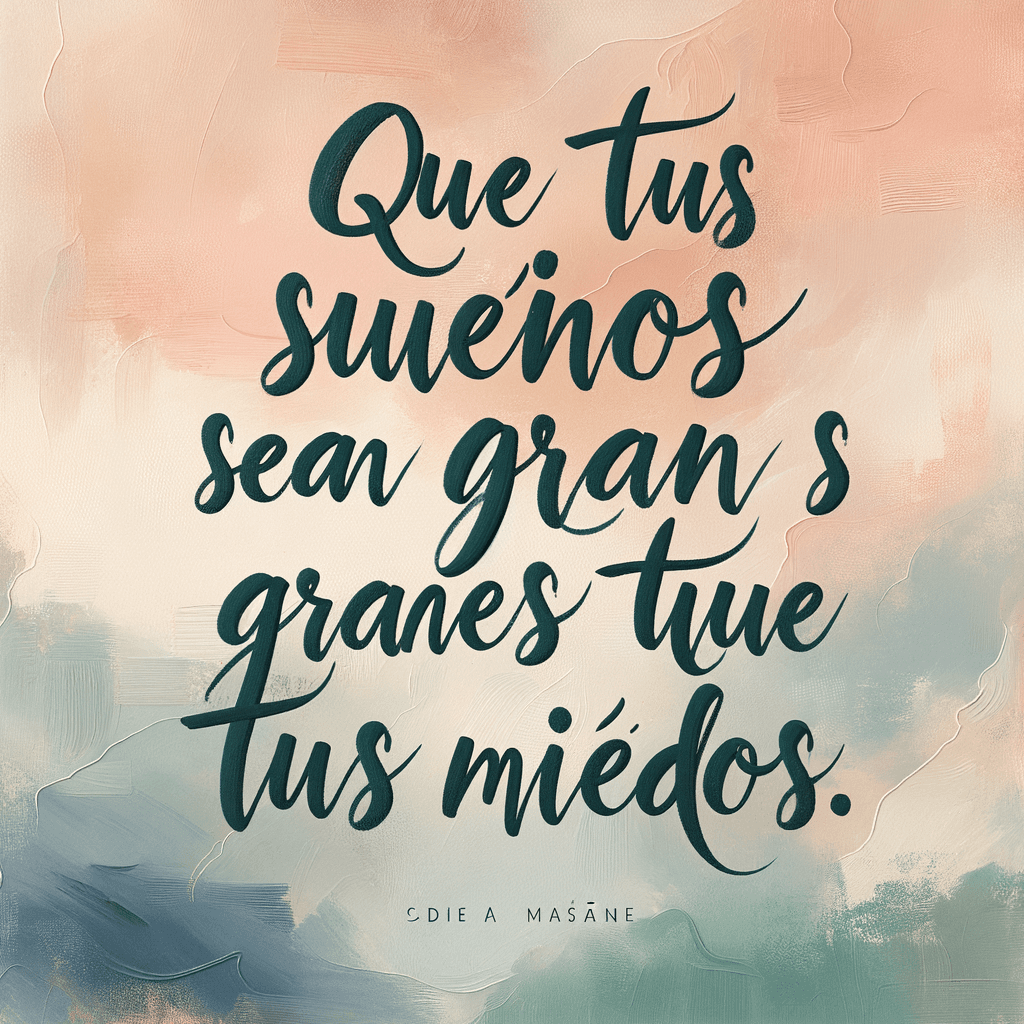
May your dreams be bigger than your fears.
—What lingers after this line?
Courage and Ambition
This quote encourages individuals to pursue their dreams with courage, suggesting that their aspirations should outweigh any fears holding them back. It promotes the idea of bravery in the face of challenges.
Positive Mindset
It emphasizes the importance of maintaining a positive and optimistic mindset. Focusing on dreams and goals rather than fears can lead to greater achievements and personal growth.
Overcoming Obstacles
By wishing for one's dreams to be bigger than their fears, the quote highlights the need to overcome obstacles and not let fear dictate one's actions or hinder progress.
Motivation and Inspiration
The quote serves as a motivational and inspirational message, encouraging people to strive for what they truly desire and not to be discouraged by the fear of failure or the unknown.
Personal Growth
It underscores the concept that personal growth and fulfillment come from chasing dreams and stepping out of one's comfort zone, rather than succumbing to fear.
One-minute reflection
Where does this idea show up in your life right now?
Related Quotes
6 selectedYou don't need to feel brave to act bravely. The feeling follows the action, not the other way around. — Unknown
Unknown
The quote challenges a common assumption: that bravery is a feeling you must summon before you can do brave things. Instead, it argues that courageous action can come first, even while fear is still present.
Read full interpretation →Dreams are made possible if you have courage. — Nnamdi Azikiwe
Nnamdi Azikiwe
At its core, Nnamdi Azikiwe’s statement argues that dreams do not become real through wishing alone; they require the bravery to be pursued. A dream may begin as imagination, yet without courage it remains suspended in t...
Read full interpretation →It takes a lot of courage to show your dreams to someone else. — Erma Bombeck
Erma Bombeck
Erma Bombeck’s insight begins with a simple truth: dreams feel precious because they expose what we most deeply want. To share them is not merely to state a goal, but to reveal hope, insecurity, and the possibility of fa...
Read full interpretation →To be courageous is to act with the heart. — Molière
Molière
Molière’s line suggests that courage is not merely the absence of fear, but the decision to move despite it. By connecting courage with the heart, he frames bravery as an emotional and moral act rather than a simple disp...
Read full interpretation →The best people possess a feeling for beauty, the courage to take risks, the discipline to tell the truth, the capacity for sacrifice. — Ernest Hemingway
Ernest Hemingway
Hemingway’s line presents goodness not as politeness or success, but as a demanding inner code. The “best people” are those who combine sensitivity, bravery, honesty, and self-denial—qualities that do not always coexist...
Read full interpretation →If you are not willing to look stupid, nothing great is ever going to happen to you. — Julia Cameron
Julia Cameron
Julia Cameron’s remark begins with a hard truth: many people do not fail because they lack talent, but because they fear embarrassment. In that sense, ‘looking stupid’ becomes shorthand for being seen trying, stumbling,...
Read full interpretation →More From Author
More from Unknown →The language is the substrate. The architecture is the contract.
The line sets up a deliberate pairing: language lies beneath everything, while architecture governs everything above it. In other words, what you can express determines what you can build, and what you commit to structur...
Read full interpretation →A scroll is not a break; it is a trap disguised as rest. — Unknown
The quote begins by challenging a familiar story we tell ourselves: that a brief scroll is a harmless pause between tasks. On the surface, it looks like recovery—no effort, no decision, no commitment.
Read full interpretation →Don't let your ice cream melt while you're counting someone else's sprinkles. — Unknown
The quote uses ice cream as a simple stand-in for life’s fleeting pleasures: what you have is delicious, but it won’t last forever if you ignore it. Meanwhile, “counting someone else’s sprinkles” captures the habit of mo...
Read full interpretation →If your absence doesn't affect them, your presence never mattered. — Unknown
The quote frames absence as a revealing experiment: remove yourself, and the reaction—concern, curiosity, indifference—becomes a kind of data. If nothing changes when you’re gone, it suggests your role was never integrat...
Read full interpretation →