
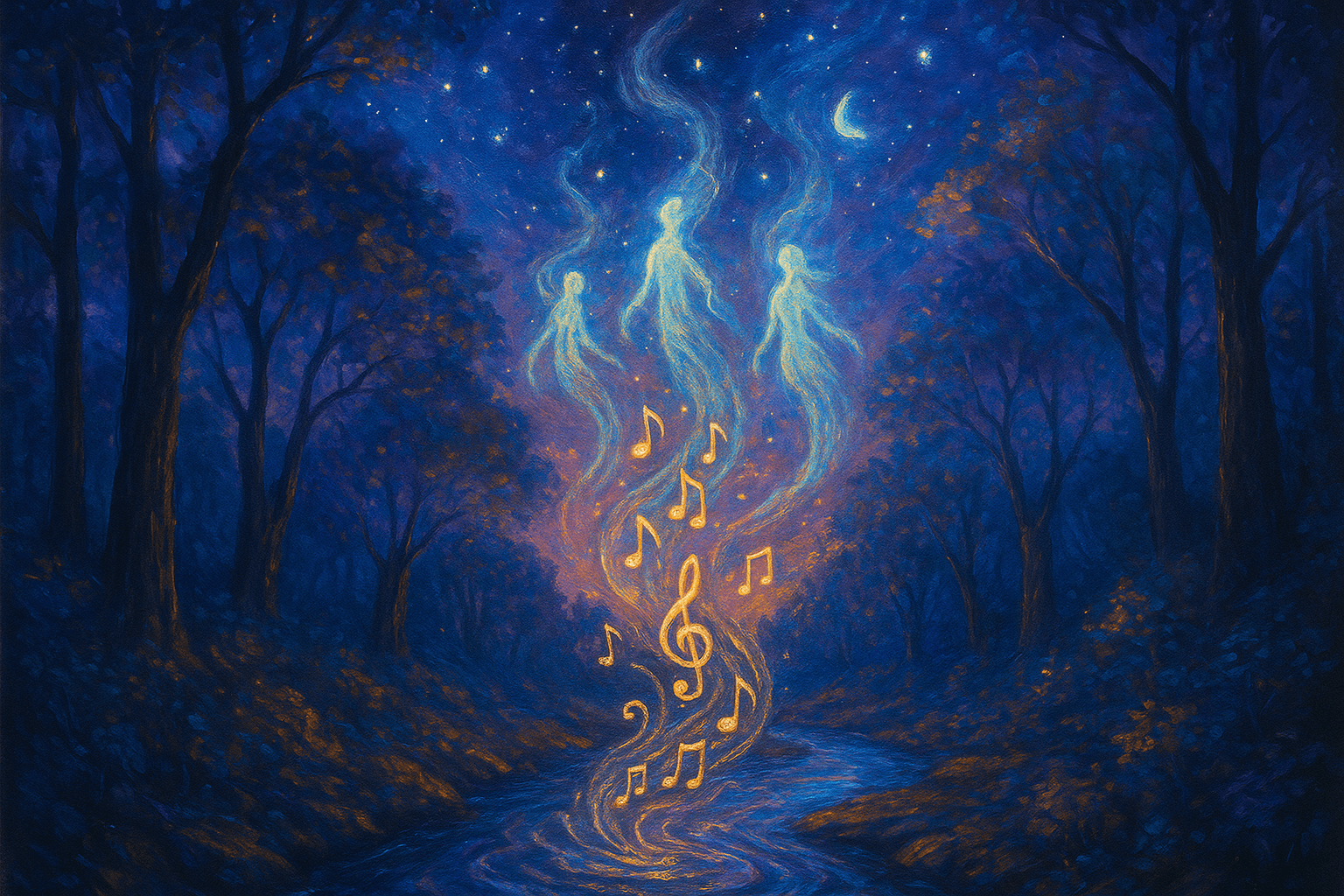
Music is the mediator between the spiritual and the sensual life. — Ludwig van Beethoven
—What lingers after this line?
Beethoven’s Profound Insight
To begin, Beethoven’s declaration that ‘music is the mediator between the spiritual and the sensual life’ encapsulates a belief that music uniquely connects realms often perceived as separate. Beethoven, a composer whose own life was marked by both inner torment and creative ecstasy, viewed music as a force that harmonizes our deepest interior experiences with the tangible sensations of the world. His approach underscores music’s dual nature, capable of evoking transcendent truths while also grounding us in the immediacy of sensation.
The Role of Music in Spiritual Experience
Building on this insight, music has long played a crucial role in spiritual traditions. From Gregorian chants resonating through medieval cathedrals to the devotional ragas of Indian classical music, cultures worldwide have used sound to foster a sense of connection with the sacred. These practices illustrate how music acts as a universal language, lifting listeners beyond the mundane and offering glimpses of the divine—a sentiment echoed in Beethoven’s own sacred compositions, such as the 'Missa Solemnis.'
Engaging the Senses Through Melody and Rhythm
While music reaches towards the spiritual, it is also undeniably sensual. The experience of rhythm vibrating in the chest, the pleasure of harmonies, and the thrill of a swelling crescendo all speak to our physical selves. Neuroscientific research affirms that listening to music stimulates the brain’s reward centers, much like food, touch, or affection. Thus, music doesn’t shy away from the body; it embraces the sensual just as deeply as it nods to the sublime.
Historical Perspectives on Music’s Mediating Power
Historically, philosophers like Plato and Schopenhauer also recognized music's unique role as a mediator. In Plato’s 'Republic' (c. 375 BC), music educates the soul, shaping both character and morals. Centuries later, Schopenhauer suggested that music gives us direct insight into the ‘will’ behind existence, bypassing mere intellect. Beethoven’s conviction echoes and synthesizes these earlier perspectives, suggesting that music alone can entwine the rational, spiritual, and sensual aspects of our lives.
Music as a Pathway to Wholeness
Ultimately, recognizing music as a bridge encourages us to seek wholeness rather than division within ourselves. When we listen to or create music, we participate in an interplay between spirit and flesh—an integrative act that can heal, inspire, and connect. Whether during moments of quiet contemplation or raucous celebration, music offers us a pathway to unity, fulfilling Beethoven’s vision of a world in which the spiritual and the sensual coexist in harmonious dialogue.
One-minute reflection
What's one small action this suggests?
Related Quotes
6 selectedMusic is the mediator between the spiritual and the sensual life. — Ludwig van Beethoven
Ludwig van Beethoven
Beethoven’s assertion situates music uniquely between the intangible world of spirit and the tangible experiences of the senses. Rather than viewing art as mere entertainment or abstract philosophy, Beethoven elevates mu...
Read full interpretation →Just as a candle cannot burn without fire, men cannot live without a spiritual life. — Buddha
Buddha
This quote illustrates the idea that just as a candle requires fire to produce light, human beings need a spiritual aspect in their lives to truly thrive and find purpose.
Read full interpretation →Spirituality does not come from religion. It comes from our soul. — Sadhguru
Sadhguru
This quote draws a distinction between spirituality and organized religion. While religion often encompasses rituals, doctrines, and communal practices, Sadhguru suggests that true spirituality is a deeply personal and i...
Read full interpretation →We are not human beings having a spiritual experience; we are spiritual beings having a human experience. — Pierre Teilhard de Chardin
Pierre Teilhard de Chardin
This quote suggests that our essence is inherently spiritual, and our human existence is a temporary journey. It shifts the focus from viewing life as purely physical to considering a deeper, spiritual dimension.
Read full interpretation →True religion is real living; living with all one's soul, with all one's goodness and righteousness. — Albert Einstein
Albert Einstein
Einstein defines true religion not as blind adherence to rituals or doctrine, but as a way of life that is deeply authentic, moral, and soulfully engaged.
Read full interpretation →Don’t gain the world and lose your soul; wisdom is better than silver or gold. — Bob Marley
Bob Marley
Bob Marley's quote warns against the dangers of prioritizing material success over one's moral or spiritual well-being. This echoes themes in the Christian New Testament: 'What good will it be for someone to gain the who...
Read full interpretation →More From Author
More from Ludwig van Beethoven →I will seize fate by the throat; it shall never wholly overcome me. — Ludwig van Beethoven
Beethoven’s line reads like a personal manifesto: fate may exist, but it will not be allowed the final word. By picturing himself gripping fate “by the throat,” he turns an abstract force into an opponent that can be con...
Read full interpretation →To sing a wrong note is insignificant; to sing without passion is inconceivable. — Ludwig van Beethoven
Beethoven’s assertion prioritizes emotion over technical perfection in music. For him, conveying deep feeling is the essence of performance: a missed note is trivial next to the absence of passion.
Read full interpretation →Turn obstacles into instruments; compose a better life. — Ludwig van Beethoven
Beethoven’s charge to turn obstacles into instruments recasts adversity as raw material for mastery. The metaphor is musical yet practical: an impediment is not merely endured; it becomes a tool that shapes tone, timing,...
Read full interpretation →Music is the mediator between the spiritual and the sensual life. — Ludwig van Beethoven
Beethoven’s assertion situates music uniquely between the intangible world of spirit and the tangible experiences of the senses. Rather than viewing art as mere entertainment or abstract philosophy, Beethoven elevates mu...
Read full interpretation →