
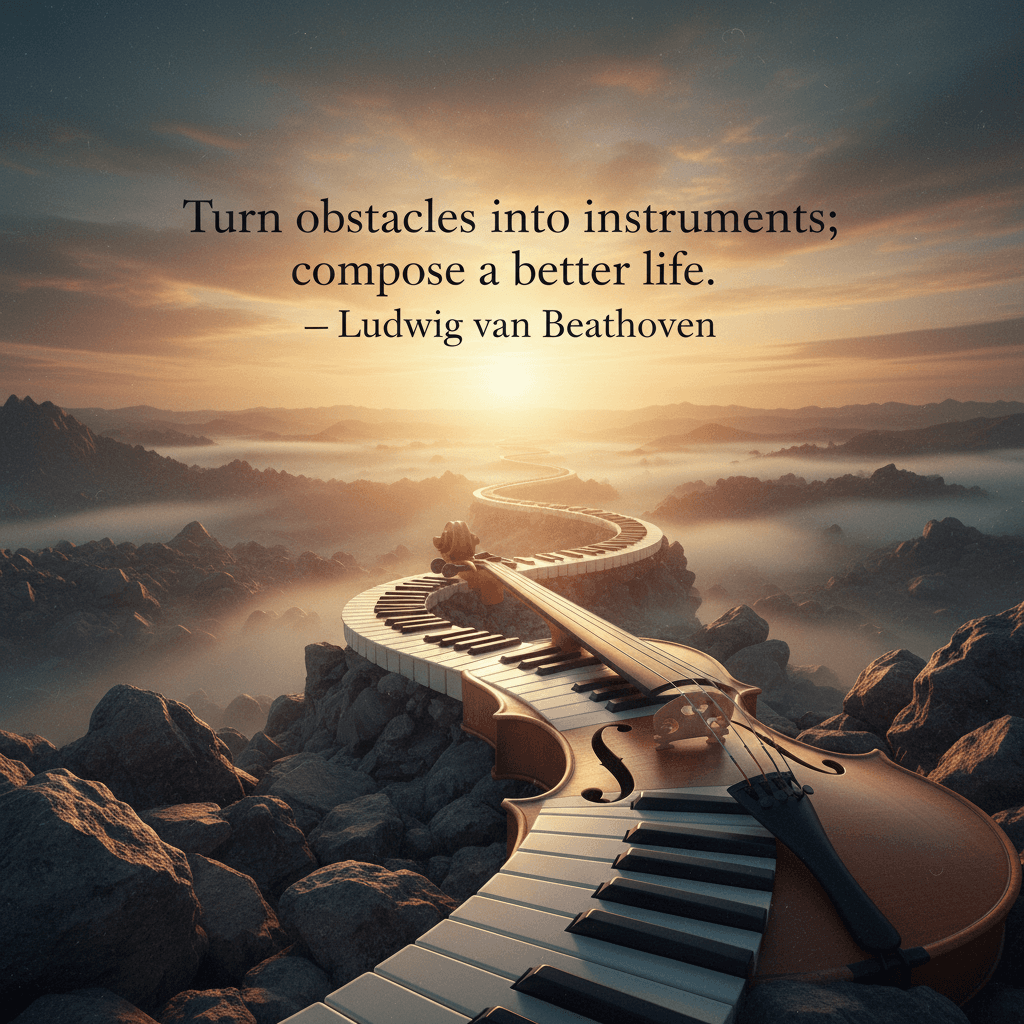
Turn obstacles into instruments; compose a better life. — Ludwig van Beethoven
—What lingers after this line?
The Maxim: Obstacles as Instruments
Beethoven’s charge to turn obstacles into instruments recasts adversity as raw material for mastery. The metaphor is musical yet practical: an impediment is not merely endured; it becomes a tool that shapes tone, timing, and structure. Just as a composer integrates dissonance to enrich harmony, we can integrate challenges to deepen character and craft. Carrying this idea forward, the quote invites us to treat constraint as a creative collaborator rather than an enemy. By composing a better life from difficult themes, we do not deny hardship; instead, we orchestrate it, arranging setbacks into motifs that drive development.
Beethoven’s Deafness as a Design Constraint
Nowhere is this principle more vivid than in Beethoven’s own struggle with hearing loss. In the Heiligenstadt Testament (1802), he confesses despair yet resolves to live for his art. As his deafness advanced, he adapted: using ear trumpets, sketchbooks, and keen inner hearing; contemporaries even reported him sensing piano vibrations through touch. These constraints did not silence him—they refined his attention to structure, rhythm, and thematic development. Moreover, the limitation became a lens. Deprived of external sound, he leaned on imagination and formal rigor, culminating in groundbreaking works from the middle period through the late string quartets (Opp. 130–135). Thus, the obstacle did not merely coexist with his output; it catalyzed it.
From Knock to Symphony: The Fifth’s Logic
Building on this, Symphony No. 5 in C minor (1808) demonstrates how a constraint can generate abundance. Its famous four-note cell—short-short-short-long—often described as "fate knocking at the door" (a later anecdote), is treated not as a melody to decorate but as a problem to solve. Through relentless variation, modulation, and rhythmic transformation, Beethoven spins a minimal fragment into a coherent, ecstatic arc. Likewise, the Eroica (1803–1804) uses disruption—heroic struggle and expansive form—to reinvent the symphony, while the Ninth (1824) channels ordeal into a choral vision of joy. In each case, a tight motif or stubborn tension becomes a method, proving that disciplined iteration can transmute pressure into propulsion.
Stoic Alchemy and Creative Process
Philosophically, this echoes Stoic practice. Marcus Aurelius writes, "The impediment to action advances action. What stands in the way becomes the way" (Meditations 5.20). Like a composer who voices dissonance to resolve it, the Stoic reframes setbacks into exercises for virtue. Reappraisal turns an external block into an internal instrument—training patience, ingenuity, and courage. Practically, the craft mirrors counterpoint: set the obstacle as a leading theme, then answer it with techniques—constraints listing, inversion (ask how the problem can help), and iterative drafts. Beethoven’s sketchbooks show this method: not flashes of perfection, but pages of patient, problem-centered exploration that gradually reveals form.
Science of Growth Through Stress
Moreover, research supports this transmutation. Tedeschi and Calhoun’s work on post-traumatic growth (1996) shows that adversity can foster deeper appreciation, stronger relationships, and new possibilities when processed constructively. Cognitive reappraisal, a strategy identified by James Gross (1998), changes emotional impact by altering interpretation—much like reharmonizing a theme. Nassim Taleb’s notion of antifragility (2012) goes further: certain systems benefit from volatility and stress. Seen together, these findings suggest that learning to "play" difficulty—through reflection, experimentation, and feedback—can enhance capability. Stress does not guarantee growth, but when skillfully scored, it becomes a practice ground for resilience and creativity.
Composing Your Daily Score
Finally, treat each day like a movement in a larger work. Begin by naming the central obstacle, then convert it into a motif: a constraint on time becomes a tempo; a scarce resource, a key that shapes voicing. Draft tiny variations—five-minute experiments, a single email, one conversation—then review what "sounds" true and revise. To sustain momentum, keep a brief sketchbook: note problems as themes, responses as developments, and lessons as codas. Seek ensemble feedback, the way chamber players refine phrasing together. Over time, these small orchestrations accumulate into a better life—one composed not despite difficulty, but because you learned to make the difficulty playable.
One-minute reflection
What feeling does this quote bring up for you?
Related Quotes
6 selectedLearning to love yourself is like learning to walk – essential, life-changing, and the only way to stand tall. — Vironika Tugaleva
Vironika Tugaleva
Vironika Tugaleva’s comparison begins with a simple but powerful truth: self-love is not a luxury, but a basic human necessity. Just as walking allows a child to move through the world with growing independence, learning...
Read full interpretation →The most gifted members of the human species are at their creative best when they cannot have their way, and must compensate for what they miss by realizing and cultivating their capacities. — Bryant H. McGill
Bryant H. McGill
Bryant H. McGill’s observation begins with a striking reversal: gifted people may not reach their highest potential when everything comes easily, but when something blocks their path.
Read full interpretation →A mind grows by staying with difficulty long enough for the experience to change it. — Mary Catherine Bateson
Mary Catherine Bateson
Mary Catherine Bateson’s observation begins with a quiet but demanding truth: the mind does not grow merely by encountering difficulty, but by remaining with it. Challenge becomes transformative only when we resist the u...
Read full interpretation →Consistency is a superpower. — Ryan Holiday
Ryan Holiday
Ryan Holiday’s line begins with a deceptively simple idea: greatness is rarely built through dramatic gestures. More often, it emerges from repeated actions that seem ordinary in isolation but become extraordinary over t...
Read full interpretation →Confidence is silent. Insecurities are loud. — Unknown (Wait—skip/replace with: True nobility is being superior to your former self. — Ernest Hemingway)
Ernest Hemingway
At its core, Hemingway’s line redefines nobility as an inward achievement rather than a social rank. Instead of measuring worth by wealth, pedigree, or dominance over others, it points to a quieter standard: becoming bet...
Read full interpretation →You are under no obligation to be consistent with the person you were yesterday. — James McCrae
James McCrae
At its core, James McCrae’s line challenges the quiet pressure to remain legible to others. Many people feel bound to opinions, habits, or identities simply because they once claimed them, as though consistency were a mo...
Read full interpretation →More From Author
More from Ludwig van Beethoven →I will seize fate by the throat; it shall never wholly overcome me. — Ludwig van Beethoven
Beethoven’s line reads like a personal manifesto: fate may exist, but it will not be allowed the final word. By picturing himself gripping fate “by the throat,” he turns an abstract force into an opponent that can be con...
Read full interpretation →To sing a wrong note is insignificant; to sing without passion is inconceivable. — Ludwig van Beethoven
Beethoven’s assertion prioritizes emotion over technical perfection in music. For him, conveying deep feeling is the essence of performance: a missed note is trivial next to the absence of passion.
Read full interpretation →Music is the mediator between the spiritual and the sensual life. — Ludwig van Beethoven
Beethoven’s assertion situates music uniquely between the intangible world of spirit and the tangible experiences of the senses. Rather than viewing art as mere entertainment or abstract philosophy, Beethoven elevates mu...
Read full interpretation →Music is the mediator between the spiritual and the sensual life. — Ludwig van Beethoven
To begin, Beethoven’s declaration that ‘music is the mediator between the spiritual and the sensual life’ encapsulates a belief that music uniquely connects realms often perceived as separate. Beethoven, a composer whose...
Read full interpretation →