
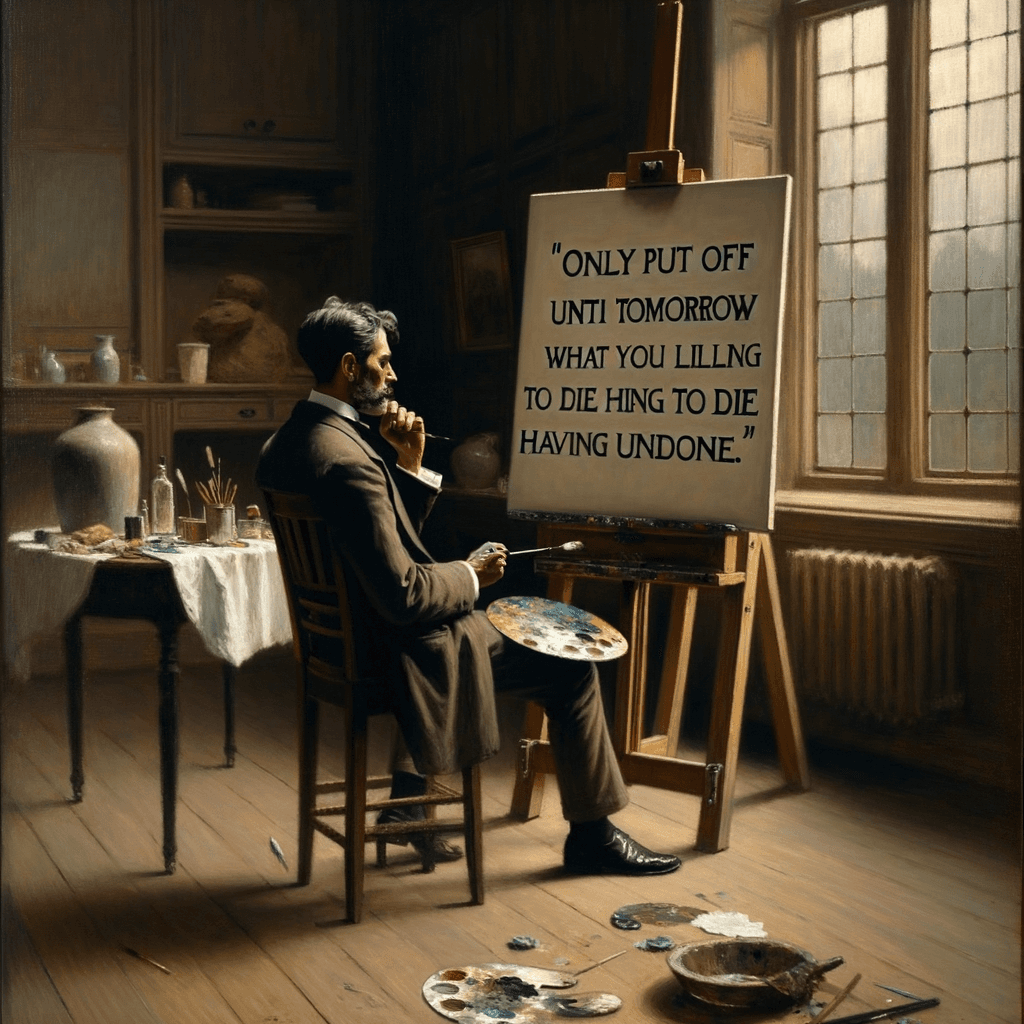
Only put off until tomorrow what you are willing to die having left undone. — Pablo Picasso
—What lingers after this line?
Procrastination and Urgency
This quote emphasizes the serious consequences of procrastination. It urges individuals to consider the importance of their tasks and responsibilities, suggesting that one should not delay actions that truly matter.
Prioritizing Life Goals
Picasso's words highlight the importance of prioritizing what is truly significant in life. If a task is worth leaving unfinished, it must be something one is willing to accept as an unfinished part of their existence.
Existential Reflection
The quote encourages deep reflection on life and mortality. It challenges individuals to think about what truly matters to them, framing it in the context of how they would feel if they had limited time left.
Motivation and Action
By linking procrastination with the concept of dying, the quote serves as a powerful motivator to take immediate action. It suggests that taking action today could be seen as a form of respecting one's own life and ambitions.
Artistic Philosophy
Pablo Picasso, a prominent artist known for his innovative style, often infused his work with profound philosophical insights. This quote reflects his belief in the urgency of creativity and the importance of pursuing one's passion without delay.
One-minute reflection
What feeling does this quote bring up for you?
Related Quotes
6 selectedThe beauty of a life well-lived is measured by the depth of the roots you grow into the lives of those standing right beside you. — Wendell Berry
Wendell Berry
At first glance, Wendell Berry shifts our idea of a successful life away from personal achievement and toward human closeness. The beauty of living well, he suggests, is not counted in status, wealth, or visibility, but...
Read full interpretation →The things that you do for yourself are gone when you are gone, but the things that you do for others remain as your legacy. — Kalu K. Ndukwe Kalu
Kalu K. Ndukwe Kalu
At its heart, Kalu K. Ndukwe Kalu’s quote redirects attention from personal gain to shared impact.
Read full interpretation →Mastery is more than technique. It's legacy, it's tradition, and it's worth preserving. — Art of Mastery
Art of Mastery
At first glance, mastery may seem like the highest refinement of technique, the polished result of repetition and control. Yet this quote insists that technical ability, while essential, is only the visible surface of so...
Read full interpretation →Life is too short to be subtle — Mary Quant
Mary Quant
Mary Quant’s line begins with a blunt accounting: life is finite, and that fact should change how we show up in the world. If time is scarce, then excessive restraint can become a kind of self-sabotage—postponing honest...
Read full interpretation →Stop acting as if life is a rehearsal. — Marcus Aurelius
Marcus Aurelius
Marcus Aurelius’ line cuts through a common habit: treating the present like a draft version of life. If we assume the “real” moment is still ahead—after we’re more prepared, more confident, more secure—we postpone the v...
Read full interpretation →Our stories are medicine for the present and lessons for the future. — Chag Lowry
Chag Lowry
Chag Lowry’s line begins by treating story not as entertainment but as care: something administered in the middle of real conditions. In the present, people reach for narratives to name what hurts, what’s changing, and w...
Read full interpretation →More From Author
More from Pablo Picasso →It is not the language of painters but the language of nature which one should listen to. — Pablo Picasso
At first glance, Picasso’s remark challenges the authority of artistic convention. By contrasting ‘the language of painters’ with ‘the language of nature,’ he suggests that art should not merely imitate established techn...
Read full interpretation →The chief enemy of creativity is good sense. — Pablo Picasso
At first glance, Picasso’s claim sounds like a provocation against reason itself. Yet his point is subtler: ‘good sense’ often means the habits, rules, and social expectations that keep people from taking imaginative ris...
Read full interpretation →The artist is a receptacle for emotions that come from all over the place: from the sky, from the earth, from a scrap of paper, from a passing shape, from a spider's web. — Pablo Picasso
At the heart of Picasso’s remark is a striking redefinition of creativity: the artist is not merely a maker, but a receiver. Rather than inventing emotion from nothing, the artist absorbs impressions that drift in from t...
Read full interpretation →Computers are useless. They can only give you answers. — Pablo Picasso
Pablo Picasso’s jab—“Computers are useless. They can only give you answers.”—is less a literal dismissal than a provocation about what humans value.
Read full interpretation →