
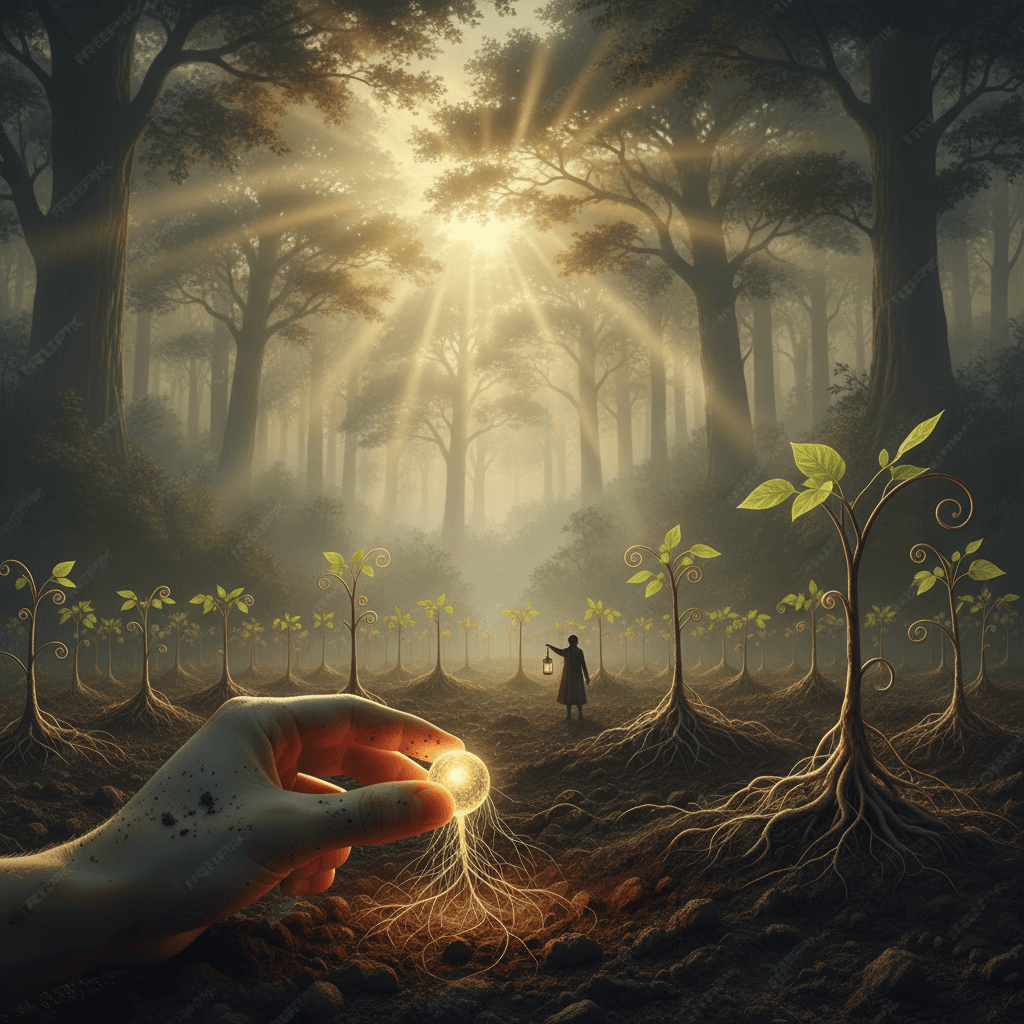
Plant ideas like seeds and tend them with courage until forests grow. — Kahlil Gibran
—What lingers after this line?
The Seed Metaphor
To begin, Gibran’s image invites us to regard ideas as living things that require soil, water, and sun—context, effort, and hope. Seeds look insignificant at first, yet they carry invisible architectures of potential. Courage, then, is the gardener’s steady hand through drought, pests, and long stretches of apparent stillness. Gibran’s The Prophet (1923) often braids nature and spirit, suggesting that growth is both organic and moral: we do not merely invent ideas; we steward them into being.
Patience and Persistence
From that image flows the discipline of time. Charles Darwin nursed his theory for decades before publishing On the Origin of Species (1859), while Gregor Mendel’s 1866 pea experiments lay dormant until rediscovered around 1900. Likewise, the mRNA vaccine platform emerged from years of incremental work, including Katalin Kariko and Drew Weissman’s 2005 advances in RNA modification, before blossoming during the COVID-19 crisis. Such timelines remind us that forests do not appear overnight; they are the cumulative result of patient tending that outlasts fashions and doubts.
Networks as Mycorrhizae
As a forest expands through hidden fungal networks, strong ideas thrive in webs of exchange. Open-source communities illustrate this ecology: Linux (1991) grew as contributors shared code, documentation, and feedback, an ethos chronicled in Eric S. Raymond’s The Cathedral and the Bazaar (1999). Network science, popularized by Albert-László Barabási in Linked (2002), shows how hubs accelerate diffusion. In practice, conferences, preprint servers like arXiv (1991), and mentoring circles act like mycorrhizae, moving nutrients—insight, critique, trust—between thinkers so individual saplings become a resilient grove.
Courage Against Headwinds
Forests face storms; ideas face resistance. Rachel Carson’s Silent Spring (1962) challenged powerful interests and endured fierce backlash, yet her careful evidence helped transform environmental policy. In a different register, Martin Luther King Jr.’s 1963 “I Have a Dream” speech seeded moral imagination that would take decades to gain legislative canopy. Wangari Maathai’s Green Belt Movement (founded 1977) married literal tree-planting with civic courage, as detailed in Unbowed (2006). These cases show that tending an idea often means standing firm when winds of ridicule or reprisal threaten to uproot it.
Tending Practices
Cultivation is not vague inspiration but daily craft. Prototyping, peer review, and small pilots—hallmarks of design thinking discussed by Tim Brown in Change by Design (2009)—let us test soil and adjust irrigation before scaling. History offers institutional models, too: Jon Gertner’s The Idea Factory (2012) recounts how Bell Labs paired long-horizon research with cross-disciplinary teams, a garden where the transistor (1947) could take root. Mentorship, diverse teams, and explicit learning loops transform fragile seedlings into saplings capable of weathering climate and chance.
Measuring Growth, Not Monocultures
As forests mature, diversity protects against blight; so too with ideas. Scott E. Page’s The Difference (2007) shows that cognitively diverse groups often outperform homogeneous ones on complex problems. Chasing single metrics—clicks, quarterly wins—can create intellectual monocultures that crash when conditions change. Better measures track resilience: replication, cross-domain uptake, and equitable access. Elinor Ostrom’s Governing the Commons (1990) suggests stewardship principles that help communities manage shared resources; similarly, we can govern knowledge ecosystems to encourage plurality, renewal, and long-term health.
Legacy and Stewardship
Finally, forests become inheritance. Richard Dawkins’s The Selfish Gene (1976) introduced “memes” to describe how ideas replicate, while Stuart Kauffman’s Investigations (2000) describes the “adjacent possible,” the next clearing that appears as the canopy expands. Institutions like libraries, universities, and archives—and symbols like the Svalbard Global Seed Vault (2008)—preserve seeds for futures we cannot yet see. Thus the work completes its circle: we plant, we tend with courage, and we leave paths and seedlings for others, trusting that tomorrow’s forest will shade lives beyond our own.
One-minute reflection
Where does this idea show up in your life right now?
Related Quotes
6 selectedPlant words of kindness; harvest a field of courage. — Kahlil Gibran
Kahlil Gibran
Kahlil Gibran’s image of planting words of kindness treats language as a living seed rather than a fleeting sound. Every remark, encouragement, or gentle reply enters the hidden soil of another person’s inner life, where...
Read full interpretation →Plant ideas like seeds and tend them with action until forests of change grow — Marie Curie
Marie Curie
Marie Curie’s metaphor treats ideas not as static thoughts but as living seeds—small, vulnerable, and full of latent potential. A seed contains an entire future, yet it remains invisible until it meets the right conditio...
Read full interpretation →The best people possess a feeling for beauty, the courage to take risks, the discipline to tell the truth, the capacity for sacrifice. — Ernest Hemingway
Ernest Hemingway
Hemingway’s line presents goodness not as politeness or success, but as a demanding inner code. The “best people” are those who combine sensitivity, bravery, honesty, and self-denial—qualities that do not always coexist...
Read full interpretation →If you are not willing to look stupid, nothing great is ever going to happen to you. — Julia Cameron
Julia Cameron
Julia Cameron’s remark begins with a hard truth: many people do not fail because they lack talent, but because they fear embarrassment. In that sense, ‘looking stupid’ becomes shorthand for being seen trying, stumbling,...
Read full interpretation →You don't have to bully yourself out of feeling fear. You just have to move while it's still there. — Annie Wright
Annie Wright
At its core, Annie Wright’s quote challenges the common belief that courage begins only after fear has disappeared. Instead, it reframes fear as something that can accompany action rather than prevent it.
Read full interpretation →For what matters in life is not whether we receive a round of applause; what matters is whether we have the courage to venture forth despite the uncertainty of acclaim. — Amor Towles
Amor Towles
At its core, Amor Towles shifts attention away from public approval and toward private resolve. The quote argues that a life’s value is not determined by applause—those visible signs of recognition—but by the willingness...
Read full interpretation →More From Author
More from Kahlil Gibran →Your home is your larger body. It grows in the sun and sleeps in the stillness of the night. — Kahlil Gibran
At first glance, Gibran transforms the idea of home from a mere structure into something intimate and organic: “your larger body.” In this image, a dwelling is not separate from the person who inhabits it, but an outward...
Read full interpretation →March on. Do not tarry. To go forward is to move toward perfection. — Kahlil Gibran
Gibran’s opening imperative—“March on. Do not tarry.”—sets a tone of disciplined urgency.
Read full interpretation →There must be spaces in your togetherness, and let the winds of the heavens dance between you. — Kahlil Gibran
Gibran’s line opens with a gentle paradox: he speaks to people who are already “together,” yet insists that togetherness is healthiest when it includes room. Rather than portraying love as fusion, he frames it as a relat...
Read full interpretation →Our anxiety does not come from thinking about the future, but from wanting to control it. — Kahlil Gibran
Kahlil Gibran reframes anxiety as something more specific than mere anticipation. The future itself—uncertain, unfolding, and not yet real—doesn’t automatically distress us; rather, distress appears when we demand certai...
Read full interpretation →