
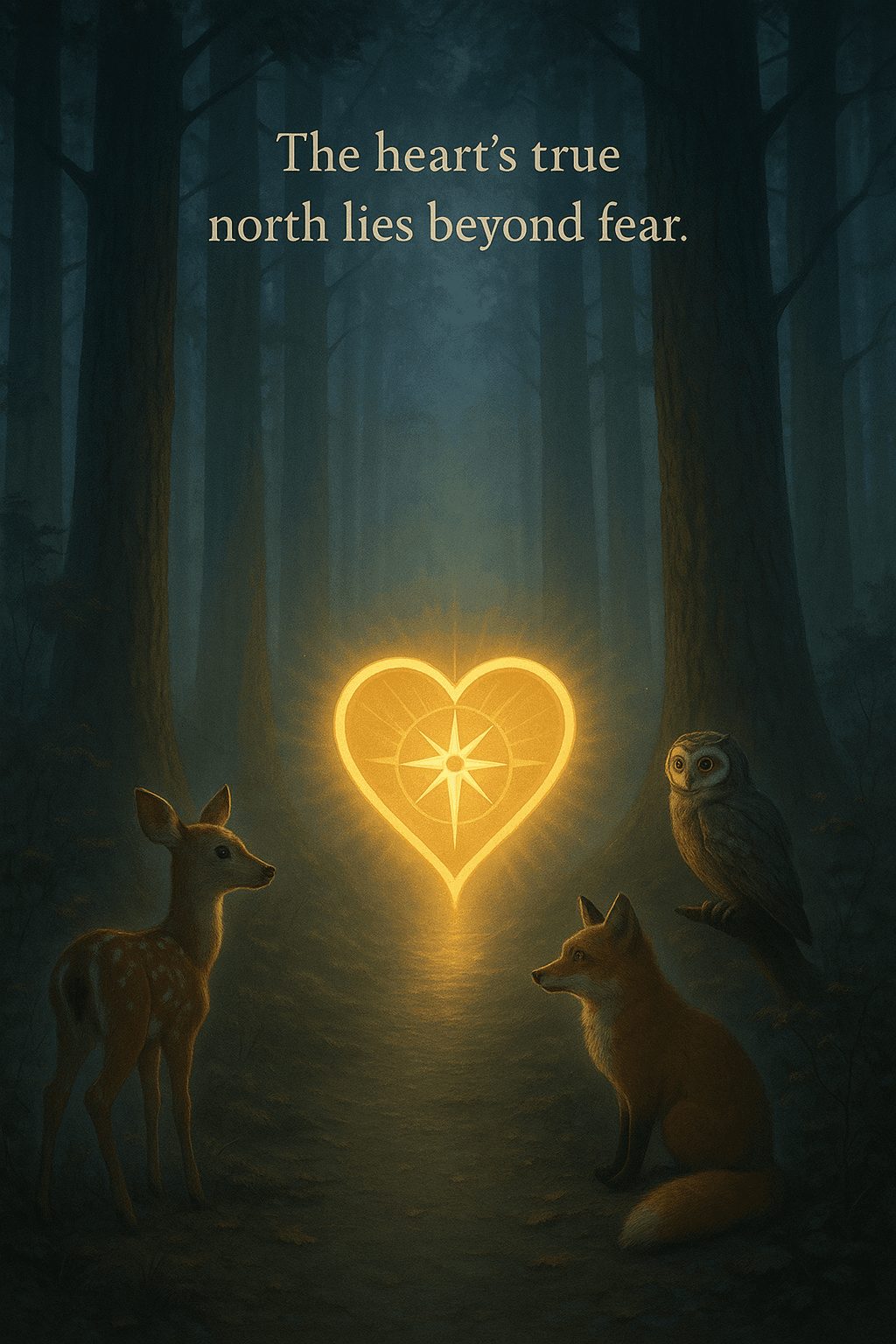
The heart’s true north lies beyond fear. — Nawal El Saadawi
—What lingers after this line?
Interpreting the Metaphor of True North
Nawal El Saadawi’s evocative phrase, 'The heart’s true north lies beyond fear,' uses the metaphor of 'true north' to symbolize our authentic purpose or deepest convictions. Just as travelers rely on the steadfast direction of the geographic north to orient themselves, so too does the heart seek a guiding principle, unclouded by uncertainty. This compass-like metaphor suggests that clarity of purpose emerges only after we transcend the constraints of our anxieties.
Fear as a Barrier to Authenticity
However, the journey toward this 'true north' is seldom straightforward. Fear often obstructs our path, manifesting as self-doubt or societal pressures. In her activism and writing, El Saadawi frequently explores how individuals—especially women—must confront ingrained fears to claim autonomy. Much like the allegory of Plato’s cave in *The Republic* (c. 375 BC), where liberation demands courage to face the unknown, El Saadawi positions fear as the immediate threshold to personal truth.
Liberation through Courage
Yet, the act of moving beyond fear does not require its absence, but rather the choice to act in its presence. Saadawi's own life, marked by steadfast opposition to oppression despite significant danger, illustrates this transition. Her experiences echo the words of Maya Angelou, who wrote, 'Courage is the most important of all the virtues.' Both thinkers highlight that liberation—and the discovery of the heart’s deepest orientation—depends on our willingness to step forward despite fear.
The Universality of the Human Compass
Transitioning from individual experience to universal principle, the heart’s search for 'true north' is a quest shared across cultures and eras. For instance, in Viktor Frankl’s *Man’s Search for Meaning* (1946), the idea that hope and purpose persist even in adversity mirrors El Saadawi's message. Both suggest that, regardless of circumstance, our moral and emotional compasses become clearest when we confront and transcend our deepest apprehensions.
Choosing Authenticity in a Fearful World
Ultimately, El Saadawi’s insight invites us to re-examine how we approach decision-making and self-discovery. Instead of allowing fear to dictate the boundaries of our lives, we can recalibrate our internal compass towards honesty and fulfillment. By choosing to venture beyond comfort zones and resist external pressures, we find that our heart’s true north—our most genuine self and direction—awaits just on the other side of fear.
One-minute reflection
Why might this line matter today, not tomorrow?
Related Quotes
6 selectedThe heart’s true north lies beyond fear. — Nawal El Saadawi
Nawal El Saadawi
Nawal El Saadawi’s evocative phrase invites us to consider ‘true north’ as our innermost values and guiding purpose. Just as a compass needle points steadfastly to the geographic north, our hearts possess an intrinsic or...
Read full interpretation →Let your heart be your compass, your mind your map, your soul your guide, and you will never get lost. — Unknown
Unknown
This quote suggests that emotions and intuition, symbolized by the heart, are crucial in navigating life's journey. Trusting in your feelings can often lead to authentic and fulfilling choices.
Read full interpretation →The sort of fearless openness required to turn toward our suffering is only possible within the spacious receptivity of love. — Frank Ostaseski
Frank Ostaseski
Frank Ostaseski’s statement begins with a striking claim: real courage is not simply toughness or willpower. Instead, the bravery required to face suffering honestly arises from love’s presence.
Read full interpretation →It is only when we are no longer fearful that we begin to create. — J.M.W. Turner
J.M.W. Turner
Turner’s statement begins with a simple but profound insight: fear often stands between imagination and expression. Before a person can create, they must first loosen the grip of self-doubt, judgment, and uncertainty.
Read full interpretation →I have a lot of things to prove to myself. One is that I can live my life fearlessly. — Oprah Winfrey
Oprah Winfrey
At first glance, Oprah Winfrey’s words shift the idea of achievement away from public applause and toward an inner reckoning. She is not speaking about proving worth to critics, rivals, or even admirers; rather, she iden...
Read full interpretation →I'll tell you what freedom is to me: no fear. I mean really, no fear! — Nina Simone
Nina Simone
Nina Simone’s line refuses abstractions and replaces them with something bodily and immediate: fearlessness. By saying “I’ll tell you what freedom is to me,” she frames freedom not as a slogan or a legal condition but as...
Read full interpretation →More From Author
More from Nawal El Saadawi →I am not afraid of anything. I am only afraid of being afraid. — Nawal El Saadawi
Nawal El Saadawi’s statement opens with an almost defiant certainty—“I am not afraid of anything”—only to pivot toward a more intimate vulnerability: she fears “being afraid.” That turn matters, because it distinguishes...
Read full interpretation →You cannot be free until you are no longer a slave to the opinions of people who don't even know who you are. — Nawal El Saadawi
Nawal El Saadawi frames freedom less as a legal status and more as an internal state: you may move without chains and still live as if restrained. The quote points to a quieter captivity—measuring your worth by judgments...
Read full interpretation →They said, 'You are a savage and dangerous woman.' I am speaking the truth. And the truth is savage and dangerous. — Nawal El Saadawi
In Nawal El Saadawi’s line, the insult—“savage and dangerous”—arrives as a social verdict meant to isolate and tame her. Rather than soften herself to regain approval, she reverses the charge: if she is dangerous, it is...
Read full interpretation →When the world says 'impossible', respond with steady practice and kind resolve — Nawal El Saadawi
Nawal El Saadawi’s line begins where many struggles start: not with an inner limit, but with an external judgment. “The world” here is less the planet than the chorus of institutions, customs, and casual voices that decl...
Read full interpretation →