
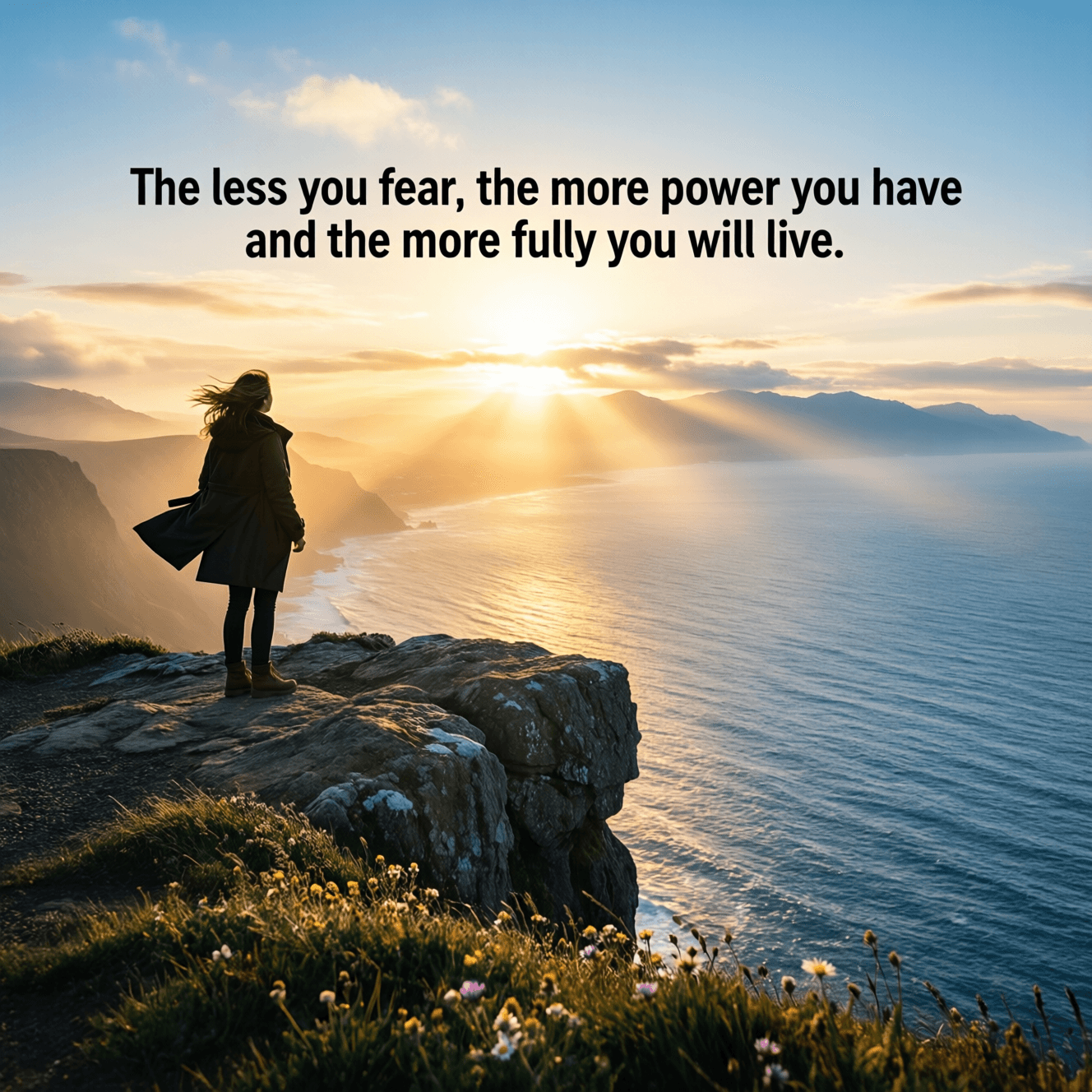
The less you fear, the more power you have and the more fully you will live. — Robert Greene
—What lingers after this line?
Fear as a Hidden Tax on Life
Robert Greene’s line begins with a blunt premise: fear quietly charges interest on everything we attempt. When we fear rejection, failure, or conflict, we pay in hesitation, overthinking, and narrowed choices, often long before any real danger appears. In that sense, fear isn’t merely an emotion—it becomes a system that limits what we try and, therefore, who we can become. From there, the quote points to a simple exchange rate: as fear decreases, capacity increases. The less energy we spend protecting ourselves from imagined outcomes, the more energy remains for action, learning, and adaptation. This is why fear can feel like a shrinking of life itself—because it reduces the number of experiences we allow in.
Why Fearlessness Looks Like Power
Moving from the inner world to the social one, Greene links fearlessness to power because power often depends on decisiveness under uncertainty. People who can tolerate discomfort—awkward conversations, temporary setbacks, public scrutiny—tend to act while others stall. That willingness to move first creates influence, not necessarily through domination, but through initiative. History and literature repeatedly frame courage as a political resource: Sun Tzu’s *The Art of War* (c. 5th century BC) notes that fear and disorder spread when leaders appear uncertain. In everyday life the same dynamic holds: the person who can speak plainly, negotiate firmly, or attempt the hard thing often becomes the reference point others orient around.
The Psychology of Expanding Your Range
At a personal level, fearlessness expands power by expanding behavioral range. Modern psychology captures this in exposure-based approaches: repeated, manageable contact with feared situations tends to reduce anxiety over time, increasing confidence and competence. The change is not magical; it’s experiential evidence accumulating in the body and mind that you can survive discomfort. As this range grows, so does a sense of agency—the feeling that your actions matter. That agency is a kind of power because it shifts life from being something that happens to you into something you can shape. Greene’s point isn’t that fear disappears, but that your relationship to fear can change from obedience to observation.
From Avoidance to Vitality
The quote then makes its most human claim: fearlessness isn’t only strategic; it’s enlivening. Avoidance compresses life into safe routines, while courage reintroduces novelty—new places, relationships, skills, and identities. Even small acts, like asking a question in a meeting or taking a class where you’re a beginner, can revive a sense of aliveness because they restore contact with possibility. Anecdotally, many people recognize this after a period of playing it safe: the job they stayed in to avoid uncertainty becomes a quiet drain, while the risk they finally take—applying elsewhere, starting a project—feels like breathing again. In that way, fearlessness doesn’t guarantee comfort, but it often restores vitality.
Courage as a Practice, Not a Trait
To bridge insight and action, Greene’s idea works best when read as practice rather than personality. Fearless people are often those who have trained themselves to take the next step despite fear, not those who never feel it. Aristotle’s *Nicomachean Ethics* (4th century BC) treats courage as a cultivated virtue—formed through repeated choices that steer between cowardice and recklessness. This framing matters because it turns the quote into a method: reduce fear by doing the feared thing in calibrated doses, reflecting afterward, and building reliable skills. Over time, competence replaces some fear, and acceptance handles what competence cannot.
The Difference Between Fearlessness and Recklessness
Finally, the promise of “more power” can be misunderstood unless it’s balanced with discernment. Fearlessness is not the absence of caution; it’s the refusal to let caution become paralysis. Recklessness ignores consequences, while courageous living assesses them and still chooses growth when the cost is worth it. Seen this way, Greene’s sentence is less a slogan than a compass: when fear is the main reason for saying no, you are likely shrinking your power and narrowing your life. But when you acknowledge fear, calculate the real risks, and act anyway, you begin to live more fully—because you’re no longer negotiating away your own possibilities.
One-minute reflection
What's one small action this suggests?
Related Quotes
6 selectedThe sort of fearless openness required to turn toward our suffering is only possible within the spacious receptivity of love. — Frank Ostaseski
Frank Ostaseski
Frank Ostaseski’s statement begins with a striking claim: real courage is not simply toughness or willpower. Instead, the bravery required to face suffering honestly arises from love’s presence.
Read full interpretation →The greatest reclamation of power is to stop letting your circumstances dictate your inner stillness. — Epictetus
Epictetus
At its heart, this statement distills a central Stoic lesson: real power begins when we stop treating external events as masters of our inner life. Epictetus, in the Discourses (2nd century AD), repeatedly argued that wh...
Read full interpretation →Nothing is powerful unless you empower it. — Epictetus
Epictetus
At first glance, Epictetus reduces power to a surprisingly intimate scale: things do not rule us on their own; they gain force when we grant them importance, fear, or authority. As a Stoic philosopher teaching in the ear...
Read full interpretation →It is only when we are no longer fearful that we begin to create. — J.M.W. Turner
J.M.W. Turner
Turner’s statement begins with a simple but profound insight: fear often stands between imagination and expression. Before a person can create, they must first loosen the grip of self-doubt, judgment, and uncertainty.
Read full interpretation →I have a lot of things to prove to myself. One is that I can live my life fearlessly. — Oprah Winfrey
Oprah Winfrey
At first glance, Oprah Winfrey’s words shift the idea of achievement away from public applause and toward an inner reckoning. She is not speaking about proving worth to critics, rivals, or even admirers; rather, she iden...
Read full interpretation →I'll tell you what freedom is to me: no fear. I mean really, no fear! — Nina Simone
Nina Simone
Nina Simone’s line refuses abstractions and replaces them with something bodily and immediate: fearlessness. By saying “I’ll tell you what freedom is to me,” she frames freedom not as a slogan or a legal condition but as...
Read full interpretation →More From Author
More from Robert Greene →In the end, you win through superior craftsmanship, not marketing. — Robert Greene
Robert Greene’s statement cuts through the glamour of promotion by placing true advantage in the work itself. Marketing may attract attention, but craftsmanship earns trust, loyalty, and endurance.
Read full interpretation →It is better to dedicate two or three hours of intense focus to a skill than to spend eight hours of diffused concentration on it. — Robert Greene
Robert Greene’s statement shifts attention away from sheer time spent and toward the quality of attention brought to practice. At its heart, the quote argues that mastery grows faster in periods of deliberate, concentrat...
Read full interpretation →Perspective is the ability to see the bigger picture rather than being focused on the immediate pain. — Robert Greene
Robert Greene’s line begins with a simple but demanding claim: perspective is not the denial of pain, but the capacity to place pain within a wider frame. In other words, the moment may hurt intensely, yet it does not al...
Read full interpretation →You cannot have everything in the present. The road to mastery requires patience. — Robert Greene
Robert Greene’s statement begins with a hard truth: life does not yield all rewards at once. By saying, “You cannot have everything in the present,” he challenges the modern temptation to expect instant results, instant...
Read full interpretation →