
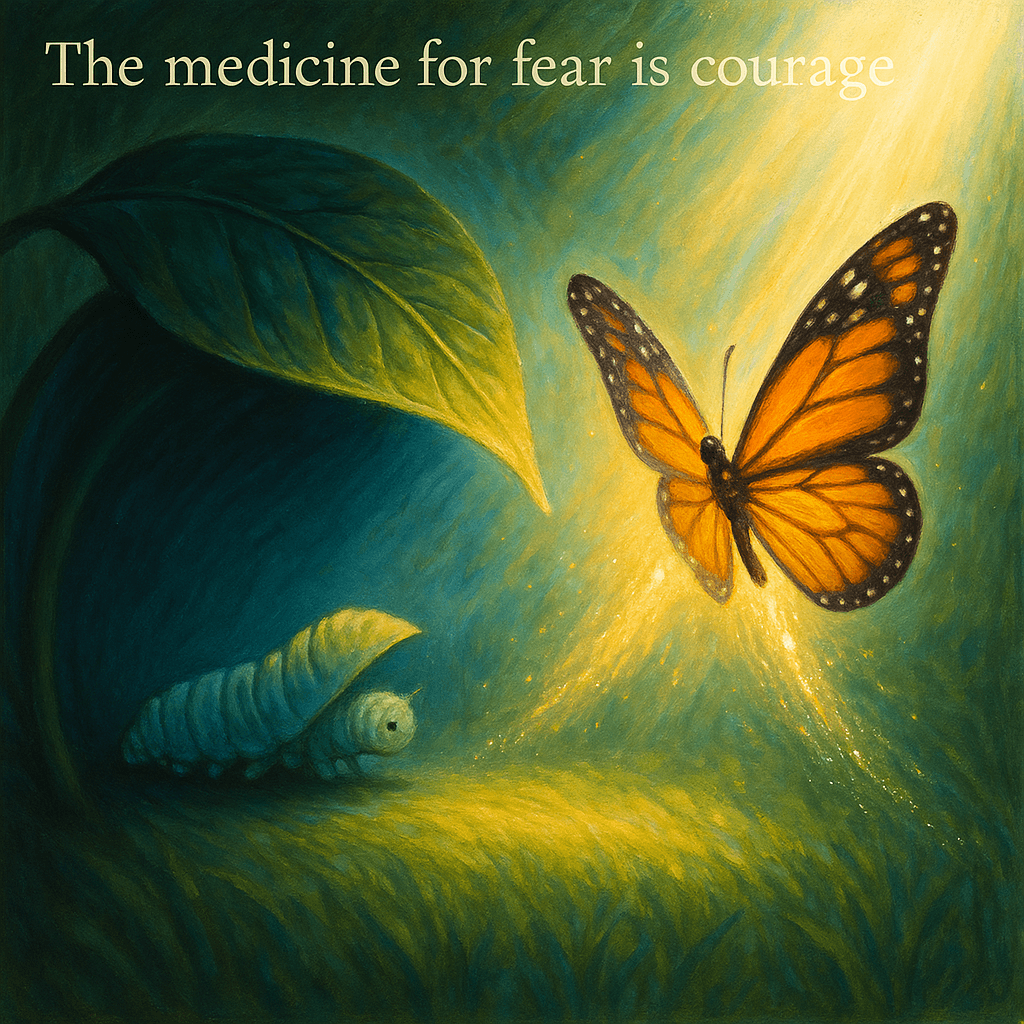
The medicine for fear is courage. — David Agus
—What lingers after this line?
Defining Fear and Its Effects
Fear is a fundamental human emotion that often arises in response to perceived threats, whether real or imagined. While fear can serve as a protective mechanism by alerting us to danger, it can also become debilitating, limiting our actions and growth. From stage fright to the anxiety of change, fear manifests in countless ways that impact both personal and collective progress.
Courage as the Antidote
Transitioning from this understanding, David Agus’ statement positions courage as the medicine for fear. Courage does not imply the absence of fear but rather the willingness to act in spite of it. This transformative quality allows individuals to move beyond paralysis and take constructive steps, as famously illustrated by Nelson Mandela, who admitted, 'I learned that courage was not the absence of fear, but the triumph over it.'
Historical and Literary Perspectives
Going further, literature and history are replete with examples where courage triumphs over fear. In Homer’s *Iliad*, warriors steel themselves before battle despite looming threats. Similarly, during the civil rights movement, figures like Rosa Parks displayed immense bravery, refusing to let fear dictate their actions. These examples reinforce Agus’ perspective by highlighting the enduring value of courage in transformative moments.
The Science Behind Courage and Fear
Moreover, psychology supports the idea that courage can be cultivated as an antidote to fear. Exposure therapy, for instance, gradually introduces people to their fears in controlled settings, allowing them to build confidence and reduce avoidance behaviors. Studies show that repeated acts of bravery, even small ones, can rewire the brain’s response to threatening stimuli, underscoring the medicinal quality of courage (American Psychological Association, 2012).
Embracing Courage in Everyday Life
Ultimately, applying courage in daily life need not involve grand gestures. Everyday acts—voicing an unpopular opinion, starting a new endeavor, or admitting vulnerability—require bravery. By consistently choosing courage, we empower ourselves to grow, adapt, and overcome obstacles. Thus, as Agus suggests, courage remains the most potent remedy we possess against the paralyzing grip of fear.
One-minute reflection
What's one small action this suggests?
Related Quotes
6 selectedCourage is less about fearlessness than training the mind to act with clarity and conviction. — Ranjay Gulati
Ranjay Gulati
Ranjay Gulati’s line begins by overturning a common myth: that courage belongs to people who simply don’t feel afraid. Instead, he frames fear as normal—and even expected—while locating courage in what happens next.
Read full interpretation →To be courageous is to act with the heart. — Molière
Molière
Molière’s line suggests that courage is not merely the absence of fear, but the decision to move despite it. By connecting courage with the heart, he frames bravery as an emotional and moral act rather than a simple disp...
Read full interpretation →The best people possess a feeling for beauty, the courage to take risks, the discipline to tell the truth, the capacity for sacrifice. — Ernest Hemingway
Ernest Hemingway
Hemingway’s line presents goodness not as politeness or success, but as a demanding inner code. The “best people” are those who combine sensitivity, bravery, honesty, and self-denial—qualities that do not always coexist...
Read full interpretation →If you are not willing to look stupid, nothing great is ever going to happen to you. — Julia Cameron
Julia Cameron
Julia Cameron’s remark begins with a hard truth: many people do not fail because they lack talent, but because they fear embarrassment. In that sense, ‘looking stupid’ becomes shorthand for being seen trying, stumbling,...
Read full interpretation →You don't have to bully yourself out of feeling fear. You just have to move while it's still there. — Annie Wright
Annie Wright
At its core, Annie Wright’s quote challenges the common belief that courage begins only after fear has disappeared. Instead, it reframes fear as something that can accompany action rather than prevent it.
Read full interpretation →For what matters in life is not whether we receive a round of applause; what matters is whether we have the courage to venture forth despite the uncertainty of acclaim. — Amor Towles
Amor Towles
At its core, Amor Towles shifts attention away from public approval and toward private resolve. The quote argues that a life’s value is not determined by applause—those visible signs of recognition—but by the willingness...
Read full interpretation →More From Author
More from David Agus →