
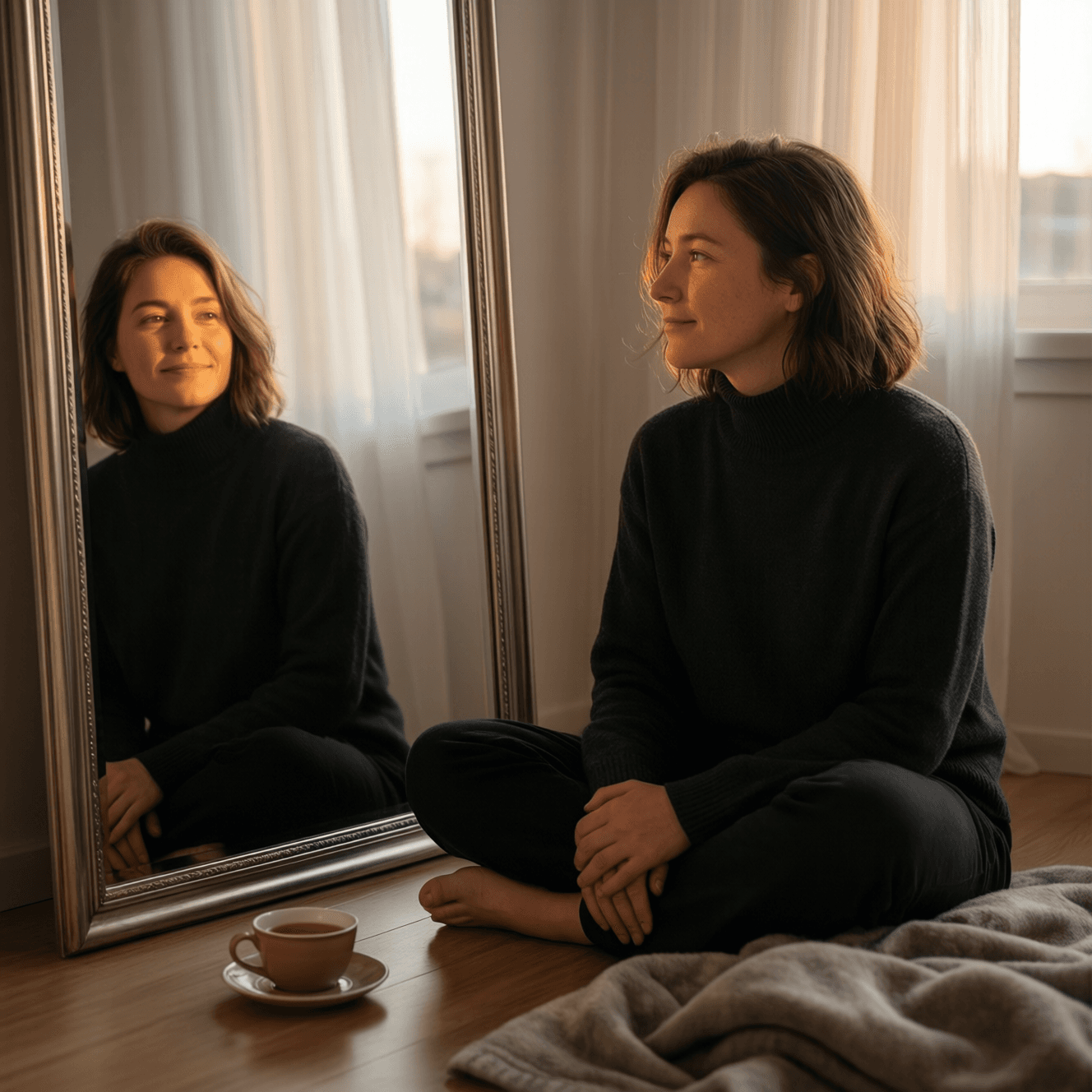
The most fundamental aggression to ourselves is to not have the courage to look at ourselves honestly and gently. — Pema Chödrön
—What lingers after this line?
Redefining Aggression as Self-Abandonment
Pema Chödrön reframes “aggression” in a startling way: not as something we do outwardly, but as a subtle violence we direct inward when we refuse to face our own experience. Instead of fists or harsh words, the harm comes through avoidance—pushing away fear, grief, envy, or neediness as if these feelings disqualify us from being worthy. From there, her point becomes less about moral failure and more about a daily pattern of self-abandonment. When we won’t acknowledge what is true inside us, we effectively turn against ourselves, creating an internal split between who we are and who we think we should be.
Honesty Without Harshness
Yet Chödrön pairs honesty with gentleness, and that pairing is the heart of the teaching. Honest self-seeing can easily become a courtroom—an inner prosecutor tallying evidence of inadequacy. Gentleness changes the posture: it suggests curiosity rather than condemnation, like noticing a trembling hand and simply admitting, “I’m scared,” without piling on shame. This shift matters because a harsh “truth” often drives more hiding, while gentle truth makes contact possible. In that sense, courage isn’t only the bravery to look; it’s the bravery to look without weaponizing what you find.
Why We Avoid Looking at Ourselves
The refusal to look honestly is rarely laziness; more often it’s protective. If we learned that mistakes bring humiliation, or that certain emotions make us “too much,” we may develop the habit of numbing, distracting, or performing competence. Even productive habits—overwork, perfectionism, constant self-improvement—can become sophisticated ways to avoid meeting the raw person underneath. Consequently, the “aggression” Chödrön names can be quiet and socially praised. The more we equate worth with control, the more threatening it feels to look openly at our confusion and vulnerability.
Buddhist Roots: Turning Toward Experience
Chödrön’s line echoes a core Buddhist movement: turning toward what is happening rather than fleeing it. In the Satipaṭṭhāna Sutta (often dated to early Buddhist canon), mindfulness practice is described as observing body, feelings, and mind states as they are—without clinging or aversion. That orientation treats experience as workable, not as an enemy. Building on that, Tibetan-influenced teachings associated with lojong (mind training) emphasize transforming difficult emotions through awareness and compassion. The goal isn’t to become flawless; it’s to stop fighting reality inside your own skin.
The Inner Critic as a Form of Violence
If avoidance is one blade, the inner critic is another. Many people can “look at themselves,” but only through contempt: replaying failures, predicting rejection, or demanding constant correction. Although it may masquerade as accountability, this stance often functions as preemptive punishment—hurting yourself before the world can. Seen this way, courage means relaxing the reflex to attack. Gentle honesty can still recognize harm we’ve caused or patterns we want to change, but it does so with a tone that keeps us connected to our humanity rather than exiling us from it.
Practicing Gentle Self-Seeing in Daily Life
A practical entry point is to notice moments of tightening—defensiveness in a conversation, a sudden urge to scroll, a spike of self-judgment after feedback—and to name what’s present in simple language: “embarrassment,” “wanting approval,” “sadness.” Then, instead of interrogating yourself, you might offer a brief gesture of friendliness, such as placing a hand on your chest or silently saying, “This is hard, and I’m here.” Over time, that approach changes the relationship you have with your inner life. Rather than treating emotions as threats to suppress or flaws to fix, you learn to meet them as visitors—sometimes unpleasant, but no longer enemies—reducing the most fundamental aggression Chödrön warns about.
One-minute reflection
What feeling does this quote bring up for you?
Related Quotes
6 selectedBe gentle with yourself. You're doing the best you can. — Pema Chödrön
Pema Chödrön
This quote encourages individuals to be kind and compassionate towards themselves. It reminds us that we aren’t perfect and that's okay—self-acceptance is a crucial part of personal growth.
Read full interpretation →Patience is the ability to be present with your own heart. — Pema Chödrön
Pema Chödrön
Pema Chödrön’s line shifts patience from something we perform for the outside world into something we practice within. Instead of merely “waiting well” while life changes, patience becomes the willingness to stay close t...
Read full interpretation →Be gentle with yourself, learn to love the sound of your own breathing. — Pema Chödrön
Pema Chödrön
Pema Chödrön’s invitation to 'be gentle with yourself' encourages a transformative shift in how we relate to our inner lives. Rather than critiquing our flaws or pushing ourselves relentlessly, gentleness fosters kindnes...
Read full interpretation →Recovery is not a race. You don't have to feel guilty if it takes you longer than you thought it would. — Anne Lamott
Anne Lamott
Anne Lamott’s reminder begins by challenging one of the quiet cruelties of recovery: the belief that healing should follow a predictable schedule. Whether the wound is physical, emotional, or spiritual, people often comp...
Read full interpretation →Confidence is not arrogance; it is the natural outcome of self-compassion. — Kristin Neff
Kristin Neff
Kristin Neff’s statement begins by separating two qualities often confused: confidence and arrogance. Arrogance tries to stand above others, while confidence rests on an inward steadiness that does not require comparison...
Read full interpretation →Mindfulness is a way of befriending ourselves and our experience. — Jon Kabat-Zinn
Zinn
At its core, Jon Kabat-Zinn’s statement reframes mindfulness as an act of friendship rather than self-improvement. To be mindful is not merely to pay attention, but to meet our thoughts, feelings, and bodily sensations w...
Read full interpretation →More From Author
More from Pema Chödrön →The only way to move forward is to stop pretending that the past is still happening. — Pema Chödrön
Pema Chödrön’s line begins with a gentle but piercing insight: suffering often persists not only because something painful happened, but because part of us keeps reliving it as if it were still unfolding. In that sense,...
Read full interpretation →The best parts of your life are the ones that happen when absolutely no one is looking. — Pema Chödrön
Pema Chödrön’s quote turns attention away from applause and toward the private texture of living. At first glance, it suggests that life’s richest moments are not always the dramatic ones shared with an audience, but the...
Read full interpretation →Learning is not a sprint toward an end goal; it is a life-long rhythm of shedding what no longer serves you to make room for what does. — Pema Chödrön
At first glance, Pema Chödrön’s reflection challenges one of the most common assumptions about education: that learning is a race with a clear endpoint. Degrees, promotions, and certifications often tempt us to think of...
Read full interpretation →The truth is rarely comfortable, but it is the only thing that will actually set you free. Stop hiding from your reality and start owning your choices. — Pema Chödrön
At its core, Pema Chödrön’s statement argues that freedom does not come from denial, distraction, or carefully managed appearances. Instead, it begins with the willingness to confront what is real, even when that reality...
Read full interpretation →