
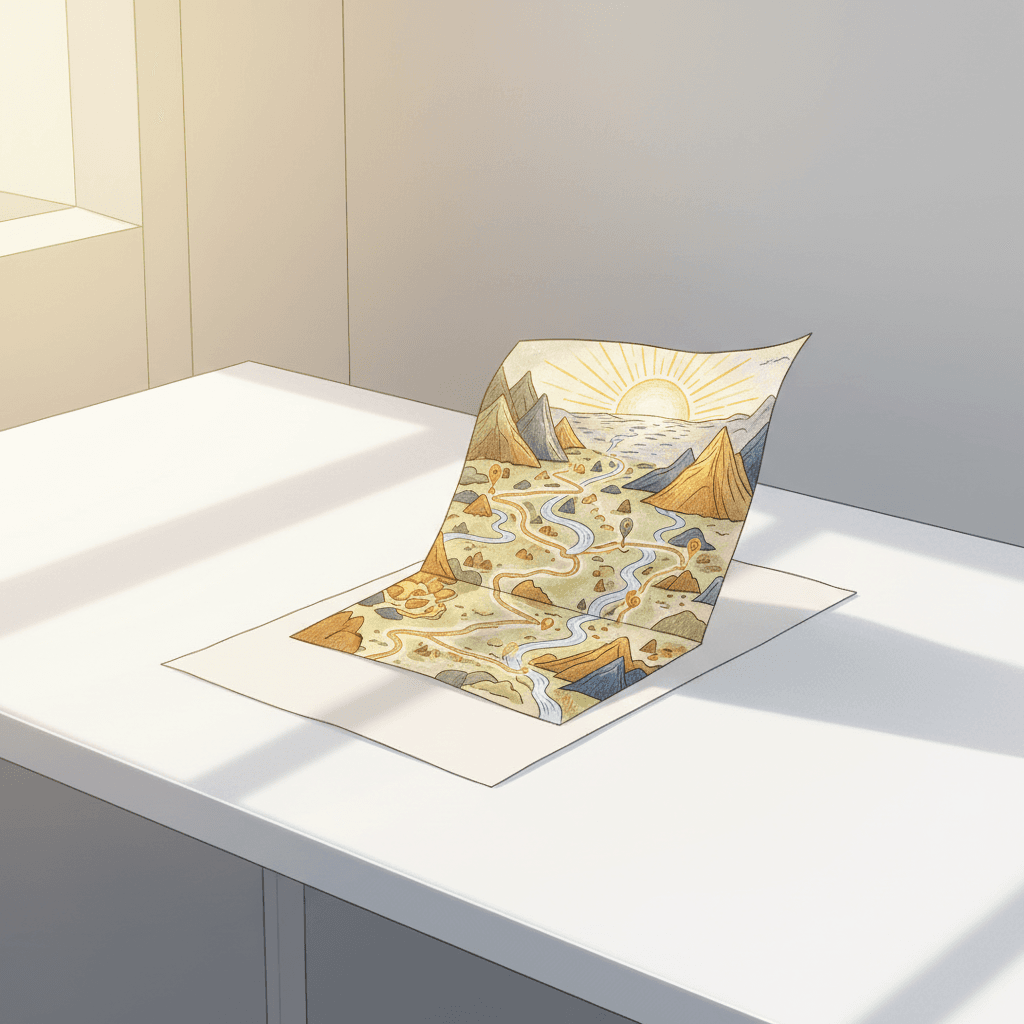
Turn the blank space into a map of your next brave decision. — Leonardo da Vinci
—What lingers after this line?
From Blankness to Possibility
Leonardo da Vinci’s invitation to “turn the blank space into a map” begins with an often-overlooked truth: emptiness is not merely absence, but potential. A blank page, an unplanned year, or a paused career can feel intimidating precisely because nothing has yet taken shape. Yet, just as Leonardo’s sketchbooks started with untouched paper, our next chapter begins with unmarked space that quietly asks what might be drawn there.
Why Maps Matter for Courage
Moving from possibility to action requires more than vague hope; it calls for orientation, which is why the metaphor of a map is so powerful. Maps do not eliminate risk, but they offer contours, routes, and reference points. In the same way, a brave decision becomes less paralyzing when we sketch out the terrain: what we value, what we fear, and where we are willing to travel. Like Renaissance explorers charting new coasts, we turn uncertainty into something navigable rather than merely overwhelming.
Bravery as a Design Practice
Once the space is seen as chartable, courage shifts from a sudden impulse to a designed practice. Leonardo combined art and engineering, layering measurements beneath beauty; similarly, bold choices can be drafted with both imagination and structure. Listing options, constraints, and small experiments transforms a looming leap into a series of plotted steps. In doing so, bravery stops looking like reckless abandon and begins to resemble thoughtful craftsmanship applied to one’s own future.
Drawing Landmarks of Meaning
Every meaningful map contains landmarks, and our personal maps are no different. Values, relationships, and long-held curiosities become mountains and rivers that give shape to our routes. By naming what truly matters—creative work, integrity, service, or exploration—we anchor our next decision in recognizable features rather than drifting aimlessly. This process mirrors how da Vinci’s anatomical and architectural drawings located each part in relation to the whole, turning scattered details into coherent design.
Navigating Risks and Unknown Regions
However, any honest map also includes edges marked by uncertainty. Medieval cartographers wrote “Here be dragons” at unexplored borders; our modern equivalent is the anxiety surrounding change. Instead of erasing these unknowns, Leonardo’s advice suggests we deliberately include them, tracing possible obstacles and worst-case scenarios. Paradoxically, acknowledging dragons shrinks their power. We can then plan alternate paths, supports, and contingency plans, treating fear as a feature of the landscape rather than its ruler.
Choosing a Direction and Taking the First Step
Ultimately, no map fulfills its purpose until a traveler moves. After sketching desires, resources, and risks, a brave decision crystallizes when we choose a direction knowing it may not be perfect. Leonardo revised his designs constantly; likewise, we can treat our decision as a living chart, updated by experience rather than frozen in regret. The blank space ceases to be an accusation and becomes a living document—a working map on which each step redraws the lines of who we are becoming.
One-minute reflection
What feeling does this quote bring up for you?
Related Quotes
6 selectedYou will never have a greater or lesser dominion than that over yourself. The height of a man's success is gauged by his self-mastery. — Leonardo da Vinci
Leonardo da Vinci
Leonardo da Vinci’s statement begins by redefining power itself. Rather than pointing to wealth, rank, or influence over others, he insists that the greatest dominion a person can possess is mastery over the self.
Read full interpretation →When the spirit does not work with the hand, there is no art. — Leonardo da Vinci
Leonardo da Vinci
Leonardo da Vinci’s statement begins with a simple but profound claim: art is never merely the product of manual skill. The hand may shape stone, guide a brush, or draft a line, yet without the animating force of spirit—...
Read full interpretation →You cannot expect the level of excitement of your audience to be greater than your own. If you want a life that is alive, lead it with purpose. — Leonardo da Vinci
Leonardo da Vinci
Leonardo da Vinci’s insight begins with a simple but demanding truth: people rarely rise above the emotional energy of the person leading them. Whether in art, teaching, or daily life, enthusiasm is contagious precisely...
Read full interpretation →It is not possible to control the outside of yourself until you have mastered your breathing space. — Leonardo da Vinci
Leonardo da Vinci
At its core, this saying argues that self-governance must begin within. Before a person can hope to influence events, relationships, or circumstances beyond themselves, they must first steady their own internal state.
Read full interpretation →Every now and then go away, have a little relaxation, for when you come back to your work your judgment will be surer. — Leonardo da Vinci
Leonardo da Vinci
Leonardo da Vinci’s advice begins with a simple but powerful claim: distance improves discernment. By urging us to ‘go away’ from our work from time to time, he suggests that constant effort can blur perception rather th...
Read full interpretation →It is easier to resist at the beginning than at the end. — Leonardo da Vinci
Leonardo da Vinci
Leonardo da Vinci’s remark turns attention to a simple but powerful truth: the first moment of temptation, error, or excess is usually the easiest point at which to intervene. At the beginning, a habit is still weak, a d...
Read full interpretation →More From Author
More from Leonardo da Vinci →You will never have a greater or lesser dominion than that over yourself. The height of a man's success is gauged by his self-mastery. — Leonardo da Vinci
Leonardo da Vinci’s statement begins by redefining power itself. Rather than pointing to wealth, rank, or influence over others, he insists that the greatest dominion a person can possess is mastery over the self.
Read full interpretation →When the spirit does not work with the hand, there is no art. — Leonardo da Vinci
Leonardo da Vinci’s statement begins with a simple but profound claim: art is never merely the product of manual skill. The hand may shape stone, guide a brush, or draft a line, yet without the animating force of spirit—...
Read full interpretation →You cannot expect the level of excitement of your audience to be greater than your own. If you want a life that is alive, lead it with purpose. — Leonardo da Vinci
Leonardo da Vinci’s insight begins with a simple but demanding truth: people rarely rise above the emotional energy of the person leading them. Whether in art, teaching, or daily life, enthusiasm is contagious precisely...
Read full interpretation →It is not possible to control the outside of yourself until you have mastered your breathing space. — Leonardo da Vinci
At its core, this saying argues that self-governance must begin within. Before a person can hope to influence events, relationships, or circumstances beyond themselves, they must first steady their own internal state.
Read full interpretation →