
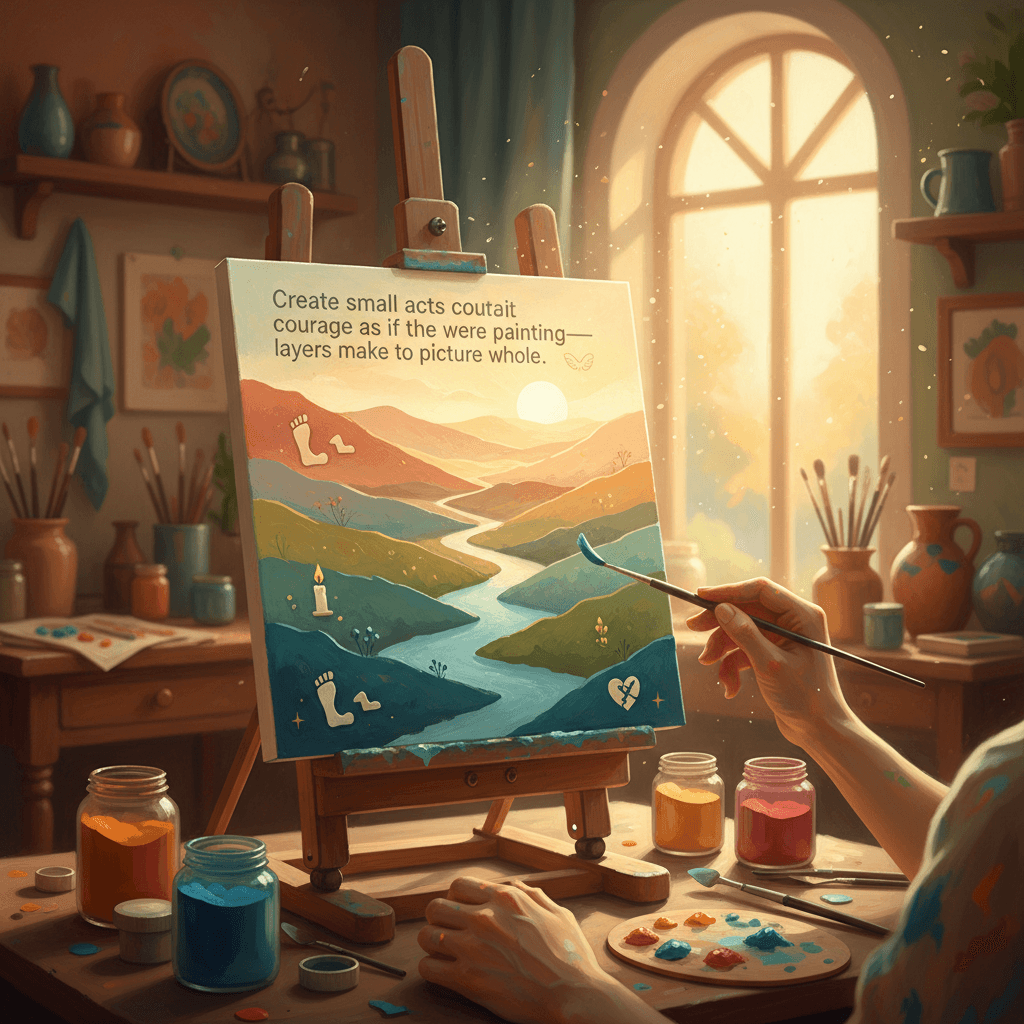
Create small acts of courage as if you were painting—layers make the picture whole. — Leonardo da Vinci
—What lingers after this line?
Courage as a Daily Practice
Da Vinci’s image begins by shrinking courage to a workable size: not a single dramatic leap, but a sequence of small acts. That framing matters because it removes the myth that bravery belongs only to heroes or crises; instead, it becomes a practice you can repeat. In this sense, speaking up once in a meeting, asking for help, or making a difficult phone call counts as a genuine stroke of courage. From there, the quote quietly suggests a shift in identity: you don’t wait to “become courageous” before acting—you act, and the repetition reshapes who you are. Each small choice becomes a building block, and the accumulation is what eventually looks like confidence.
Why the Painting Metaphor Fits
Next, the metaphor of painting emphasizes process over perfection. Paintings aren’t typically born in one pass; they emerge through underpainting, revisions, and subtle additions that only later reveal their purpose. Renaissance workshops, including those associated with da Vinci, relied on layering techniques—glazes, scumbles, and corrections—to achieve depth and lifelike realism. In the same way, courage gains depth when it’s built iteratively. A single bold gesture can be inspiring, but layered courage creates a more reliable structure—like tonal values in a portrait that make the final face feel three-dimensional rather than flat.
The Power of Tiny, Specific Actions
Then the quote points to a practical strategy: make courage concrete and small enough to do today. The “acts” are not abstract virtues but behaviors—apologizing without excuses, setting one boundary, or submitting work before it feels flawless. Because they’re manageable, these actions reduce the fear that often blocks change. Over time, tiny actions compound. Much like returning to a canvas day after day, the consistency matters more than the intensity. What once felt impossible gradually becomes familiar, and the threshold for what you can face expands almost without you noticing.
Layering Builds Resilience, Not Just Boldness
Moreover, layering implies that some strokes will be imperfect, even hidden. In painting, an early layer may be covered, yet it still contributes to the final structure; likewise, failed attempts at courage—an awkward conversation, a rejected application—aren’t wasted. They become the underlayers of resilience: evidence that you can survive discomfort and return again. This reframes setbacks as part of the composition rather than proof you should stop. The picture becomes “whole” not because every layer is beautiful, but because each one teaches the hand and steadies the eye for the next pass.
Seeing a Whole Life, Not a Single Moment
Finally, da Vinci’s line widens the lens: you are creating a picture, not performing a stunt. A whole life is the sum of decisions made in ordinary hours, and courage is often quiet—choosing integrity when no one is watching, beginning again after discouragement, or protecting what matters at a personal cost. When you view yourself as the painter, the goal becomes clearer: keep adding honest layers. In time, those small acts align into a coherent image—one that shows not just bravery in moments, but character shaped through steady, intentional creation.
One-minute reflection
Where does this idea show up in your life right now?
Related Quotes
6 selectedTo be courageous is to act with the heart. — Molière
Molière
Molière’s line suggests that courage is not merely the absence of fear, but the decision to move despite it. By connecting courage with the heart, he frames bravery as an emotional and moral act rather than a simple disp...
Read full interpretation →The best people possess a feeling for beauty, the courage to take risks, the discipline to tell the truth, the capacity for sacrifice. — Ernest Hemingway
Ernest Hemingway
Hemingway’s line presents goodness not as politeness or success, but as a demanding inner code. The “best people” are those who combine sensitivity, bravery, honesty, and self-denial—qualities that do not always coexist...
Read full interpretation →If you are not willing to look stupid, nothing great is ever going to happen to you. — Julia Cameron
Julia Cameron
Julia Cameron’s remark begins with a hard truth: many people do not fail because they lack talent, but because they fear embarrassment. In that sense, ‘looking stupid’ becomes shorthand for being seen trying, stumbling,...
Read full interpretation →You don't have to bully yourself out of feeling fear. You just have to move while it's still there. — Annie Wright
Annie Wright
At its core, Annie Wright’s quote challenges the common belief that courage begins only after fear has disappeared. Instead, it reframes fear as something that can accompany action rather than prevent it.
Read full interpretation →For what matters in life is not whether we receive a round of applause; what matters is whether we have the courage to venture forth despite the uncertainty of acclaim. — Amor Towles
Amor Towles
At its core, Amor Towles shifts attention away from public approval and toward private resolve. The quote argues that a life’s value is not determined by applause—those visible signs of recognition—but by the willingness...
Read full interpretation →Confidence doesn't mean being fearless. It means creating, even when your hands shake. — Lisa Golightly
Lisa Golightly
At first glance, Lisa Golightly’s quote overturns a common myth: that confident people move through life without fear. Instead, she presents confidence as action taken in spite of fear, not in the absence of it.
Read full interpretation →More From Author
More from Leonardo da Vinci →You will never have a greater or lesser dominion than that over yourself. The height of a man's success is gauged by his self-mastery. — Leonardo da Vinci
Leonardo da Vinci’s statement begins by redefining power itself. Rather than pointing to wealth, rank, or influence over others, he insists that the greatest dominion a person can possess is mastery over the self.
Read full interpretation →When the spirit does not work with the hand, there is no art. — Leonardo da Vinci
Leonardo da Vinci’s statement begins with a simple but profound claim: art is never merely the product of manual skill. The hand may shape stone, guide a brush, or draft a line, yet without the animating force of spirit—...
Read full interpretation →You cannot expect the level of excitement of your audience to be greater than your own. If you want a life that is alive, lead it with purpose. — Leonardo da Vinci
Leonardo da Vinci’s insight begins with a simple but demanding truth: people rarely rise above the emotional energy of the person leading them. Whether in art, teaching, or daily life, enthusiasm is contagious precisely...
Read full interpretation →It is not possible to control the outside of yourself until you have mastered your breathing space. — Leonardo da Vinci
At its core, this saying argues that self-governance must begin within. Before a person can hope to influence events, relationships, or circumstances beyond themselves, they must first steady their own internal state.
Read full interpretation →