
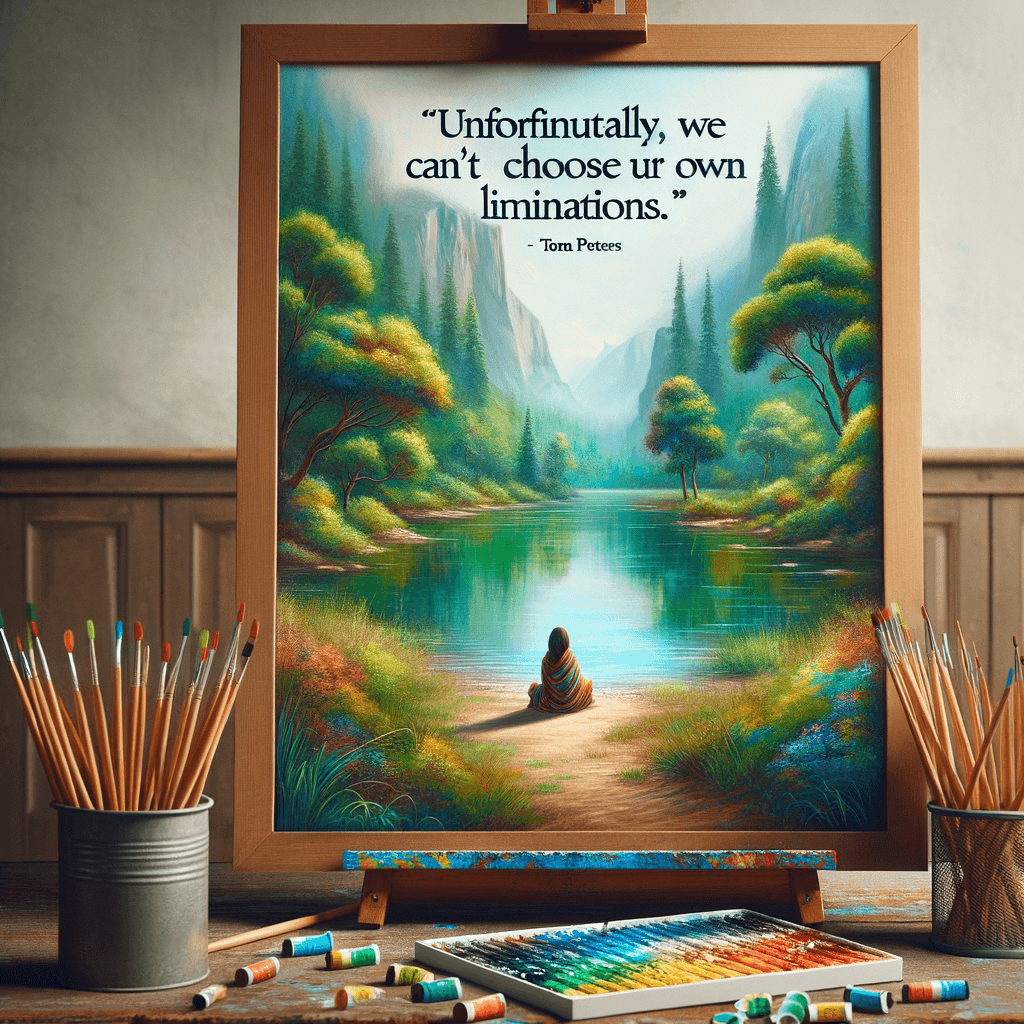
Unfortunately, we can't choose our own limitations. — Tom Peters
—What lingers after this line?
Acceptance of Reality
This quote highlights the inevitability of facing limitations in life. It suggests that individuals should accept their circumstances, as they often arise from uncontrollable factors.
Self-Discovery
The notion of limitations may encourage individuals to reflect on their strengths and weaknesses. Understanding and acknowledging these limitations can lead to personal growth and self-awareness.
Challenges of Growth
The quote implies that limitations can hinder personal and professional development. Acknowledging these barriers may motivate individuals to find alternate paths or strategies to overcome them.
Focus on Potential
Rather than lamenting the limitations we cannot choose, this perspective encourages individuals to focus on their potential and the possibilities that lie within their current constraints.
Influence on Decision-Making
Recognizing unavoidable limitations can influence how individuals make decisions in both personal and professional contexts, ultimately leading to more realistic expectations and plans.
One-minute reflection
What's one small action this suggests?
Related Quotes
6 selectedThe world is before you, and you need not take it as it was. — James Baldwin
James Baldwin
James Baldwin’s line begins as a simple act of opening a door: the world is “before you,” available to your attention and judgment rather than locked behind tradition. Instead of treating reality as fixed scenery, he fra...
Read full interpretation →I can be changed by what happens to me, but I refuse to be reduced by it. — Maya Angelou
Maya Angelou
Maya Angelou begins with a disarming admission: experience alters us. To be “changed” by what happens is not weakness but evidence of being awake to reality—loss, joy, injustice, and love all leave traces.
Read full interpretation →Hands that persist sculpt destiny out of raw days. — Helen Keller
Helen Keller
Helen Keller’s line begins with a concrete image: hands. Rather than treating destiny as a distant, abstract force, she locates power in what we can do—touch, build, practice, and return to a task again.
Read full interpretation →Stride into the margins that fear drew and claim your space with dignity — Frederick Douglass
Frederick Douglass
Douglass’s image of “margins that fear drew” suggests that oppression often works by sketching invisible borders around a person’s life—where to speak, where to go, what to hope for. These boundaries are rarely neutral;...
Read full interpretation →Keep wonder close and let it push you to act. — Langston Hughes
Langston Hughes
Langston Hughes’ line begins with an intimate instruction: keep wonder close. Rather than treating awe as a rare lightning strike—something reserved for travel, art, or childhood—he frames it as a presence we can carry.
Read full interpretation →We did not come to fear the future. We came here to shape it. — Barack Obama
Barack Obama
Obama’s statement reframes why we are present in any pivotal moment—whether in a nation, a classroom, or a community. Rather than existing simply to endure uncertainty, he insists we are here to act upon it.
Read full interpretation →More From Author
More from Tom Peters →Today, you have 100% of your life left. — Tom Peters
This quote highlights the significance of living in the present. It encourages individuals to focus on today, as they still control how they will live and what they will achieve starting from now.
Read full interpretation →Celebrate what you want to see more of. — Tom Peters
This quote highlights the power of positive reinforcement. By celebrating actions, behaviors, or results that align with our values and goals, we encourage their repetition and growth.
Read full interpretation →Fail often so you can succeed sooner. — Tom Peters
This quote highlights that failure is not something to be feared but embraced as a stepping stone toward success. By failing frequently, one gains valuable experience and insights that accelerate the journey to success.
Read full interpretation →Water the flowers, not the weeds. — Tom Peters
This quote encourages focusing time and energy on the positive or productive elements of life ('flowers') rather than on negative influences or problems ('weeds').
Read full interpretation →