
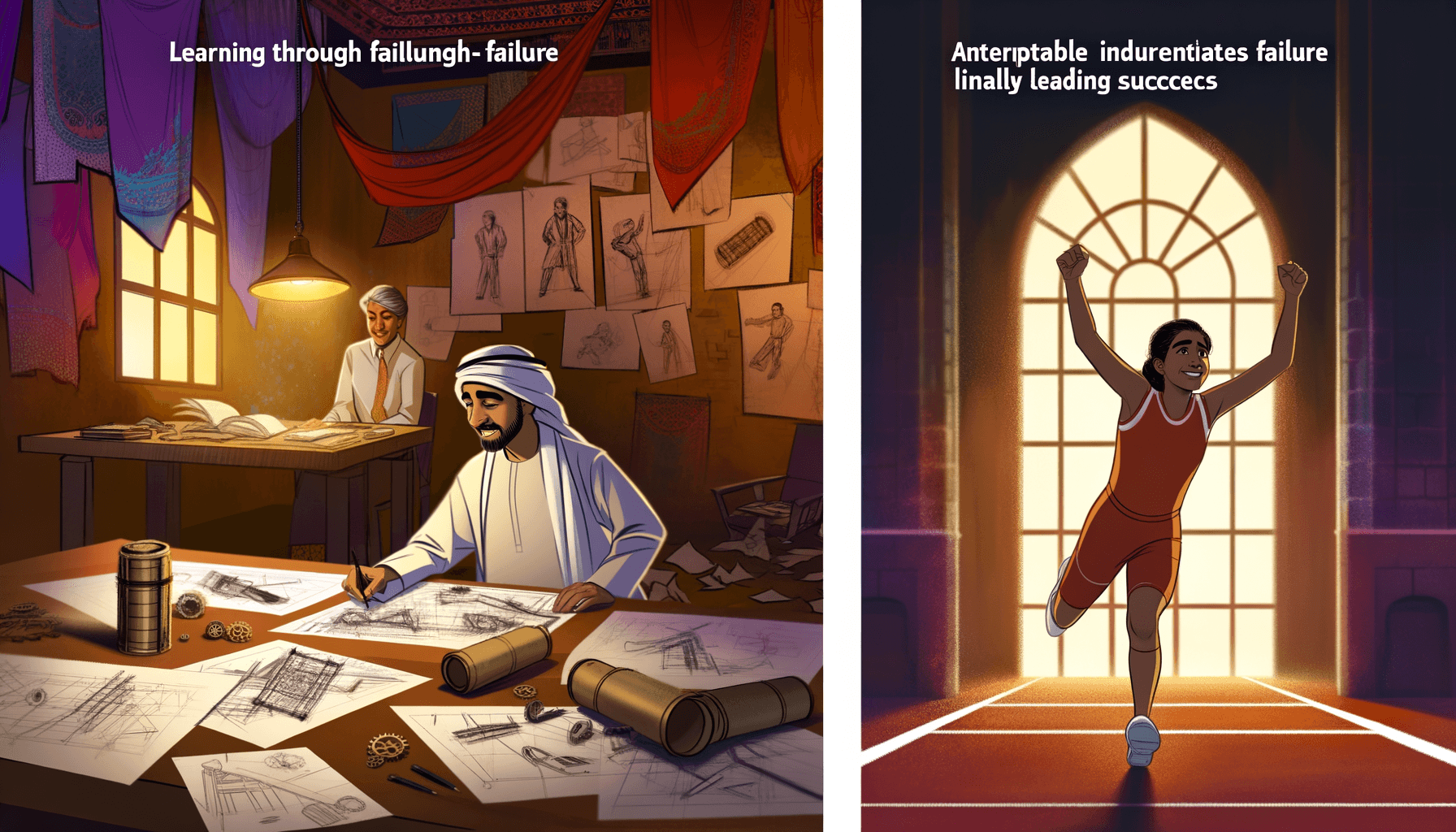
Fail often so you can succeed sooner. — Tom Peters
—What lingers after this line?
The Role of Failure in Success
This quote highlights that failure is not something to be feared but embraced as a stepping stone toward success. By failing frequently, one gains valuable experience and insights that accelerate the journey to success.
Learning from Mistakes
Every failure provides a lesson that helps refine strategies, improve skills, and avoid future mistakes. The faster one encounters and learns from failures, the quicker they can achieve success.
Encouraging Risk-Taking
Fear of failure often prevents people from taking risks. This quote promotes the idea that taking bold steps and encountering failures is an integral part of personal and professional growth.
Innovation and Experimentation
In business and creativity, experimenting with new ideas often leads to failure before achieving groundbreaking success. Failing quickly allows for rapid iteration and improvements.
Tom Peters' Management Philosophy
Tom Peters, a renowned business writer and management expert, emphasizes innovation, adaptability, and learning from failure as key principles for success in both entrepreneurial and corporate environments.
One-minute reflection
What feeling does this quote bring up for you?
Related Quotes
6 selectedIf you're making a mistake, it's better to make a new one. — Pearl Bailey
Pearl Bailey
Pearl Bailey’s line sounds playful, but it carries a sharp philosophy: once you realize you’re wrong, repeating the same error isn’t loyalty to a decision—it’s inertia. By suggesting it’s “better to make a new one,” she...
Read full interpretation →Turn hesitation into an experiment; failure is data, not a verdict. — Ada Lovelace
Ada Lovelace
Ada Lovelace’s line begins by rescuing hesitation from its usual stigma. Instead of treating uncertainty as weakness, she invites us to view it as the natural threshold of discovery, where questions form and assumptions...
Read full interpretation →Treat failure as a hypothesis to be tested, not a verdict to accept. — Albert Camus
Albert Camus
Camus’ line pivots on a simple but radical shift: failure is not a final judgment about who you are, but information about what happened. A verdict closes the case—guilty, inadequate, finished—whereas a hypothesis keeps...
Read full interpretation →Turn obstacles into experiments; results will teach your next move. — Richard Feynman
Richard Feynman
Feynman’s line reframes frustration as curiosity. An obstacle, in this view, is not a dead end but an unanswered question: What happens if I try this instead?
Read full interpretation →Let each attempt be a small experiment, not a final verdict. — Marie Curie
Marie Curie
Marie Curie’s insight invites a fundamental shift in how we view our own efforts. Instead of treating each attempt as a pass-or-fail judgment, she frames it as a small experiment—one step in a longer process of discovery...
Read full interpretation →If you are looking for different results, do not always do the same thing. - Albert Einstein
Albert Einstein
This quote emphasizes the necessity of change and innovation to achieve different outcomes. Repeating the same actions will likely yield the same results; therefore, trying new approaches is essential for progress.
Read full interpretation →More From Author
More from Tom Peters →Unfortunately, we can't choose our own limitations. — Tom Peters
This quote highlights the inevitability of facing limitations in life. It suggests that individuals should accept their circumstances, as they often arise from uncontrollable factors.
Read full interpretation →Today, you have 100% of your life left. — Tom Peters
This quote highlights the significance of living in the present. It encourages individuals to focus on today, as they still control how they will live and what they will achieve starting from now.
Read full interpretation →Celebrate what you want to see more of. — Tom Peters
This quote highlights the power of positive reinforcement. By celebrating actions, behaviors, or results that align with our values and goals, we encourage their repetition and growth.
Read full interpretation →Water the flowers, not the weeds. — Tom Peters
This quote encourages focusing time and energy on the positive or productive elements of life ('flowers') rather than on negative influences or problems ('weeds').
Read full interpretation →