
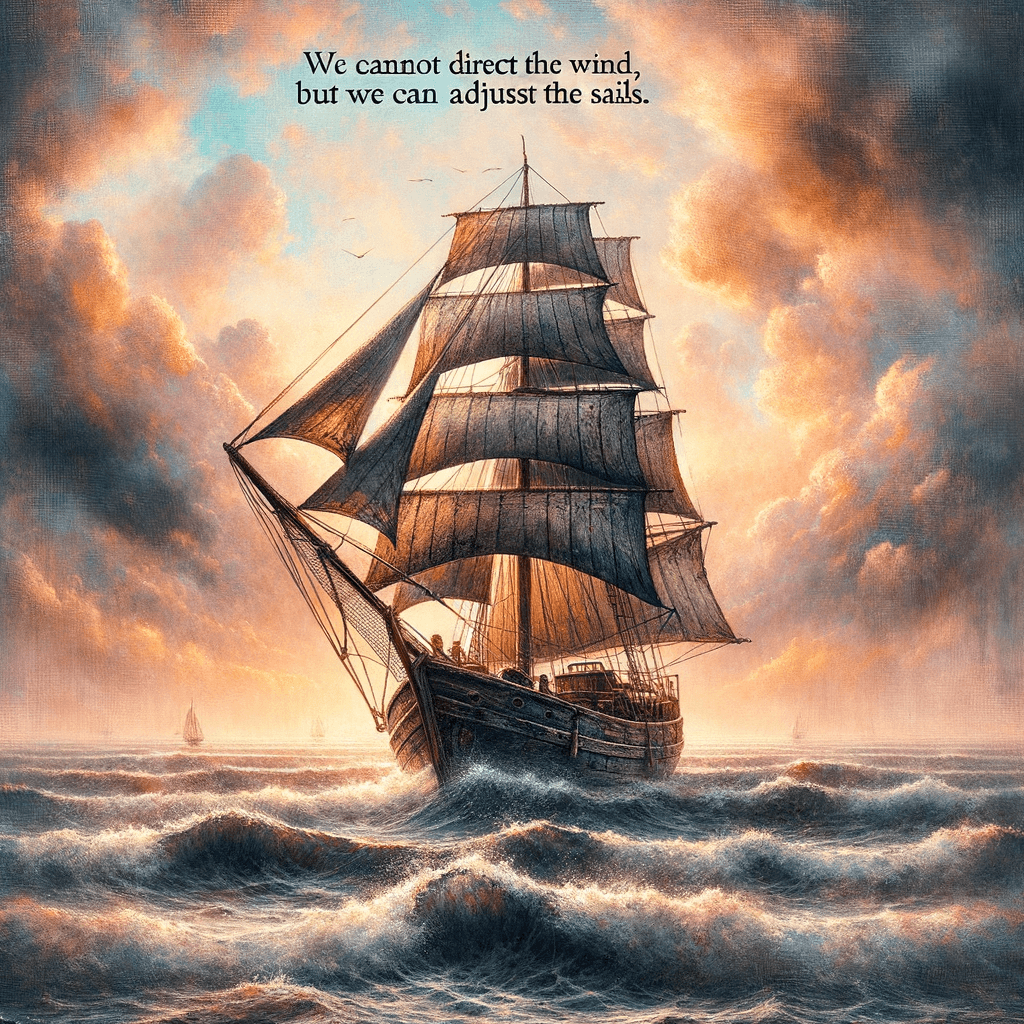
We cannot direct the wind, but we can adjust the sails. — Dolly Parton
—What lingers after this line?
Adaptability in Life
This quote emphasizes the importance of adaptability. While we cannot control external circumstances, we can modify our responses and strategies to navigate through life's challenges.
Empowerment and Agency
It conveys a sense of empowerment, reminding us that we have agency in our lives. Instead of feeling helpless in the face of adversity, we can take action to improve our situation.
Navigating Challenges
The imagery of adjusting sails represents the practical steps we can take to steer our way through obstacles. It suggests that foresight and preparation are key in managing difficulties.
Resilience and Optimism
The quote reflects a resilient mindset. Rather than succumbing to the pressures of life's unpredictability, it encourages maintaining optimism and finding ways to make the best of our circumstances.
Context of Dolly Parton's Life
Dolly Parton is a renowned singer, songwriter, and businesswoman known for her resilience and success in the music industry. This quote reflects her life philosophy, shaped by her experiences overcoming struggles to achieve her dreams.
One-minute reflection
Where does this idea show up in your life right now?
Related Quotes
6 selectedThe artist is not a solid, static being. The artist is fluid, like water, moving with the tides and changing form. — James McCrae
James McCrae
James McCrae’s image of the artist as fluid immediately challenges the common idea that creative people possess a single, fixed essence. Instead, he suggests that artistry is a process of becoming, not a stable condition...
Read full interpretation →The mind adapts and converts to its own purposes the obstacle to our acting. — Marcus Aurelius
Marcus Aurelius
At its heart, Marcus Aurelius’s line expresses a central Stoic conviction: external events do not fully determine our lives; rather, our judgments about them shape what they become. In his Meditations (c.
Read full interpretation →Adaptability is not imitation. It means power of resistance and assimilation. — Rabindranath Tagore
Rabindranath Tagore
At the heart of Tagore’s statement lies a careful distinction between changing and merely copying. Adaptability, he argues, is not the passive act of becoming like one’s surroundings; rather, it is an active power that a...
Read full interpretation →The capacity to change one's mind in the face of new reality is the highest form of intelligence. — Ursula K. Le Guin
Ursula K. Le Guin
At first glance, Ursula K. Le Guin’s statement shifts intelligence away from raw knowledge and toward responsiveness.
Read full interpretation →You cannot command things, but you can command yourself. — Michael D. Pollock
Michael D. Pollock
At first glance, Michael D. Pollock’s line draws a sharp boundary between the outer world and the inner one.
Read full interpretation →Our only security is our ability to change. — John Lilly
John Lilly
At first glance, John Lilly’s statement sounds contradictory: security usually implies stability, while change suggests uncertainty. Yet his insight reverses that assumption by arguing that real safety does not come from...
Read full interpretation →More From Author
More from Dolly Parton →You have to be the first person to believe in your own nonsense. — Dolly Parton
Dolly Parton’s line startles on purpose: calling your dream “nonsense” punctures the solemnity that often surrounds ambition. Yet the joke carries a serious instruction—if your idea sounds improbable, that is exactly whe...
Read full interpretation →I'm not offended by all the dumb blonde jokes because I know I'm not dumb and I also know I'm not blonde. — Dolly Parton
Dolly Parton’s line works first as a shield: she meets a belittling kind of joke with a sharper joke of her own. Instead of arguing with the premise, she sidesteps it, showing that the insult can’t land where there’s no...
Read full interpretation →I'm not going to limit myself just because people won't accept the fact that I can do something else. — Dolly Parton
Dolly Parton’s statement begins as a clear refusal to outsource her identity to public opinion. Rather than negotiating with other people’s comfort levels, she frames her life as something she authors—choosing action ove...
Read full interpretation →If you see someone without a smile, give them one of yours. — Dolly Parton
Dolly Parton’s line reframes a smile as a gift—portable, renewable, and immediately shareable. Like any small kindness, it operates within a quiet, human gift economy where the value lies not in price but in connection.
Read full interpretation →