
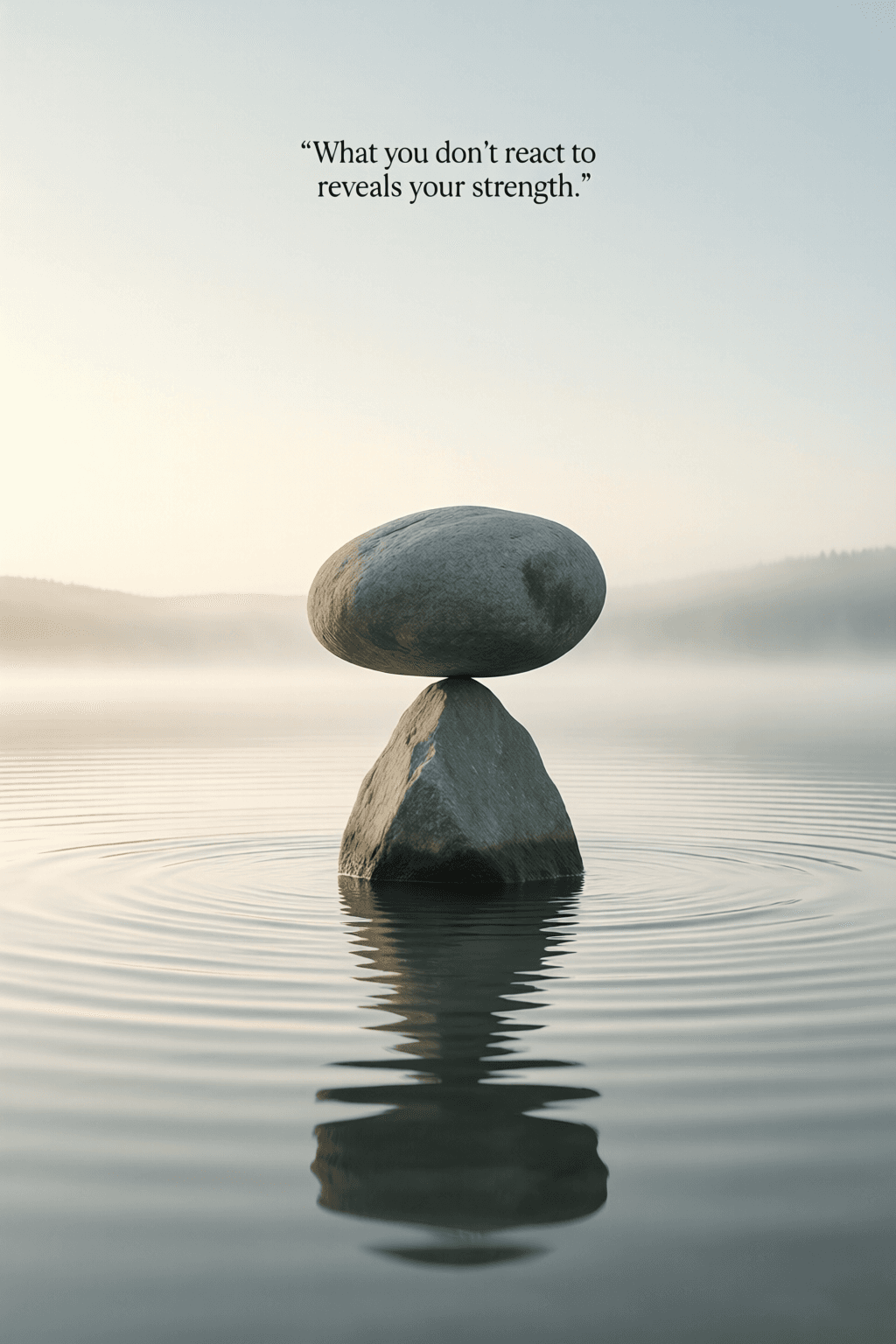
What you don't react to reveals your strength. — Thibaut
—What lingers after this line?
The Quiet Measure of Power
At first glance, Thibaut’s line shifts our attention away from dramatic action and toward restraint. Strength, in this view, is not proven only by what we confront loudly, but by what we decline to let disturb us. In other words, our unspoken responses—our refusal to flare up, retaliate, or panic—can reveal a deeper form of control. This idea matters because reaction is often instinctive, while composure is chosen. What we do not answer with anger, fear, or insecurity shows where we have gained mastery over ourselves. Thus, silence or calm is not always passivity; sometimes it is evidence of inner authority.
Restraint as Self-Mastery
From there, the quote naturally connects strength with discipline. The Stoic philosopher Epictetus, in the Discourses (early 2nd century AD), argued that freedom begins when we stop being ruled by external events. Thibaut’s statement echoes that principle: if every insult, setback, or provocation can command our emotions, then our center of gravity lies outside us. By contrast, refusing to react impulsively suggests that one’s values are stronger than one’s triggers. This does not mean feeling nothing; rather, it means placing judgment between stimulus and response. In that pause, character becomes visible, and composure turns into a practical form of power.
What Triggers No Longer Control
Furthermore, what no longer provokes us often marks a wound that has healed. A criticism that once stung, a memory that once destabilized us, or a slight that once demanded immediate defense may gradually lose its force. In that sense, nonreaction is not emptiness but evidence of growth. Psychology offers a useful parallel here. Viktor Frankl’s Man’s Search for Meaning (1946) famously notes that between stimulus and response there is a space in which freedom resides. As that space widens, old triggers lose their command. Therefore, what we do not react to can reveal not suppression, but recovery, maturity, and emotional independence.
The Difference Between Strength and Numbness
Still, the quote becomes richer when we distinguish real strength from mere shutdown. Not reacting can be noble, but it can also conceal avoidance, fear, or emotional exhaustion. Someone who stays silent may be centered—or simply disconnected. For that reason, restraint must be judged by its source, not just its appearance. A useful test is whether calm leads to clarity. If nonreaction preserves dignity, allows wiser action, and protects peace, it reflects strength. If it merely buries pain until it resurfaces elsewhere, it is less resilience than denial. Thibaut’s insight is most convincing, then, when restraint remains conscious, not frozen.
Applied in Daily Conflicts
Consequently, the quote speaks powerfully to ordinary life. In workplaces, families, and friendships, many conflicts escalate because people react to tone rather than substance. Choosing not to answer every provocation can interrupt that cycle. Nelson Mandela’s Long Walk to Freedom (1994) reflects, in a broader political context, how disciplined restraint can preserve both strategy and dignity under pressure. On a smaller scale, this may mean ignoring a petty remark, declining to defend oneself against every misunderstanding, or waiting before replying in anger. Each such moment suggests that not everything deserves access to our energy. In that practice, strength becomes less theatrical and more sustainable.
A Stronger Definition of Courage
Finally, Thibaut’s words invite a redefinition of courage itself. We often imagine strength as forceful expression, decisive confrontation, or visible dominance. Yet the quote proposes that courage may just as often appear as selective nonresponse—the ability to remain unshaken when provoked. By the end, the insight is clear: our power is measured not only by what we can do, but by what we no longer need to do. To withhold reaction from what is beneath us, untrue, or unworthy is to show that our peace is not easily purchased. In that refusal, strength quietly announces itself.
Recommended Reading
As an Amazon Associate, we earn from qualifying purchases.
One-minute reflection
Why might this line matter today, not tomorrow?
Related Quotes
6 selectedIn the face of every challenge, there lies a hidden strength. It sleeps within every heartbeat, waiting to be awakened. Embrace every setback, for it is the sprout of self-growth and steadfast conviction.
growth and steadfast conviction.
The quote suggests that every individual possesses an inherent strength that is not always apparent. This strength resides deep within, waiting to be discovered and harnessed during difficult times.
Read full interpretation →Strength does not come from physical capacity. It comes from an indomitable will. - Mahatma Gandhi
Mahatma Gandhi
Gandhi’s quote highlights that true strength arises from within oneself. It is not about physical power or ability but about mental and emotional resilience.
Read full interpretation →Every step on the path is a choice. Choose to move forward with tenacity, and you will discover that true strength resides in your heart.
Unknown
This statement emphasizes that every action we take is a result of our own choices. We're responsible for deciding whether to progress or remain stagnant.
Read full interpretation →Strength does not come from physical capacity, but from the will of the soul. - Mahatma Gandhi
Mahatma Gandhi
This quote emphasizes the importance of inner strength over physical abilities. True strength comes from within, driven by the determination and spirit of an individual.
Read full interpretation →True cultivation is a slow, private process that eventually blooms into a public strength. — Anne Lamott
Anne Lamott
At first glance, Anne Lamott’s line emphasizes a truth people often resist: meaningful self-development rarely looks dramatic while it is happening. True cultivation unfolds quietly, in habits, reflection, restraint, and...
Read full interpretation →If you can quit for a day, you can quit for a lifetime. — Benjamin Alire Sáenz
Benjamin Alire Sáenz
At first glance, Benjamin Alire Sáenz reduces an enormous challenge to a single, manageable unit: one day. That shift matters because lifelong change often feels too abstract to grasp, whereas twenty-four hours can be fa...
Read full interpretation →More From Author
More from Thibaut →