
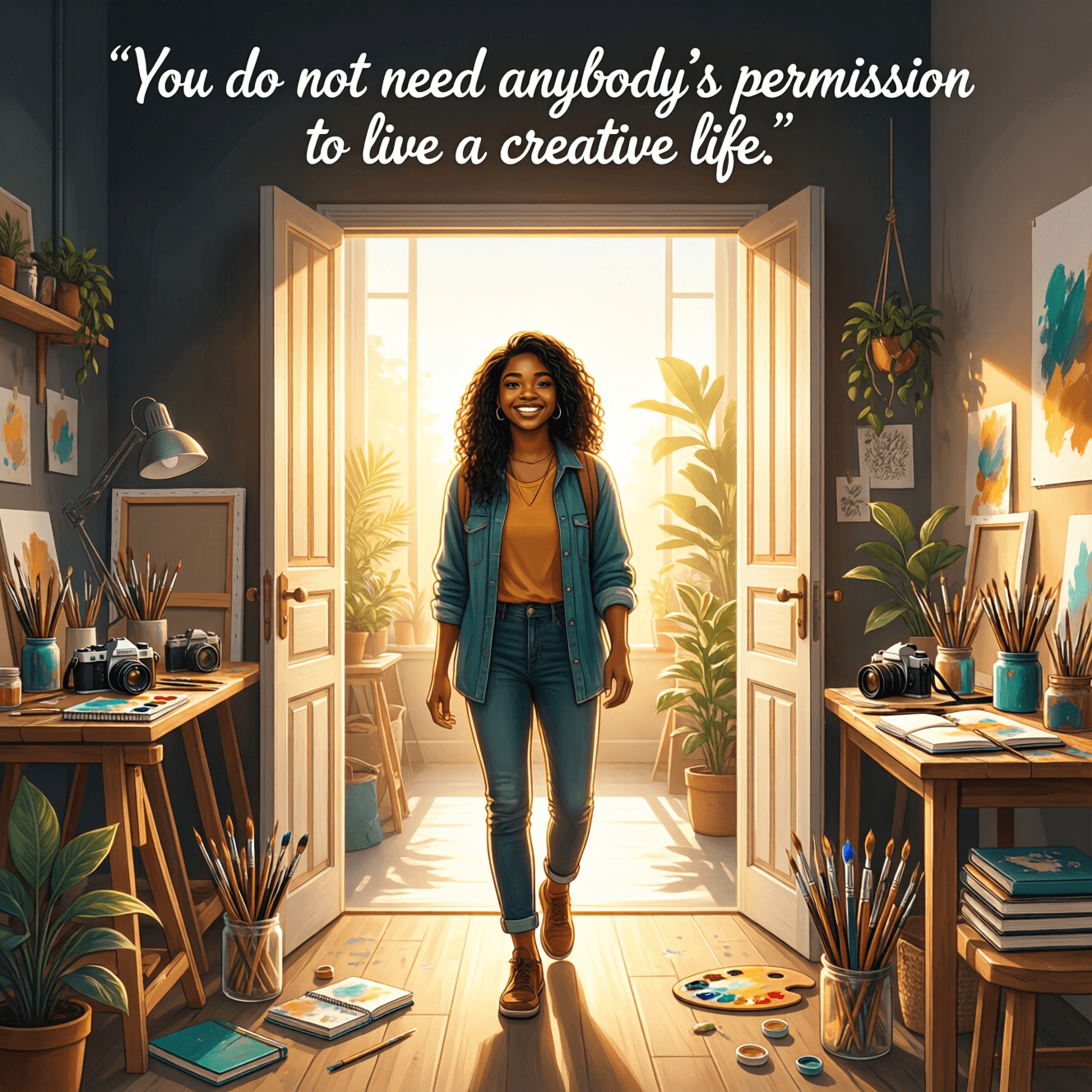
You do not need anybody's permission to live a creative life. — Elizabeth Gilbert
—What lingers after this line?
Reframing Creativity as a Birthright
Elizabeth Gilbert’s statement begins by shifting creativity from something granted to something inherent. Instead of treating art as a special status bestowed by gatekeepers—teachers, critics, institutions—she frames it as a mode of living that belongs to anyone willing to practice it. From this angle, creativity becomes less about credentials and more about willingness: the simple, stubborn act of making. That reframing matters because it relocates power from external approval to internal choice, making the creative life feel possible now rather than someday.
The Trap of External Validation
Once creativity is seen as a personal right, the need for permission reveals itself as a common barrier. Many people delay writing, painting, or building because they are waiting to be “picked,” praised, or publicly legitimized, as if silence from others is proof they should not begin. Yet this dependence on validation can quietly erode initiative. A person might have talent and even time, but still hesitate because they imagine a tribunal of opinions. Gilbert’s line counters that imagined tribunal directly: you can start before the applause, and you can continue even if it never arrives.
Courage Over Confidence
If permission is unnecessary, the next challenge is emotional, not logistical: fear. People often assume they must feel confident before they create, but in practice confidence usually follows consistent work rather than preceding it. This is where Gilbert’s idea becomes a call to courage. You do not need to feel ready; you need to show up. The creative life is built in small acts of bravery—sharing a draft, attempting a new technique, risking an awkward first version—until the unfamiliar becomes routine.
Practice Makes the Identity
Because permission is not required, identity stops being a label and becomes a habit. You are not creative because someone says you are; you become creative by doing creative things repeatedly, even privately, even imperfectly. Over time, practice turns aspiration into evidence. A notebook of poems, a folder of sketches, a series of short films made on weekends—these are not “pretend” works waiting to be validated; they are the creative life itself, accumulating into skill and voice.
Letting Go of the Myth of the Gatekeeper
Gilbert’s quote also challenges the cultural myth that art must pass through a single doorway guarded by experts. While editors, galleries, and institutions can be valuable, they are not the source of creative legitimacy, only one possible path for creative distribution. In fact, many traditions emphasize self-authorship. Virginia Woolf’s *A Room of One’s Own* (1929) argues that material conditions and inner authority matter more than social permission. Seen this way, the “gatekeeper” is often internal—a learned hesitation that can be unlearned.
Responsibility and Freedom in a Creative Life
Finally, refusing to wait for permission carries both freedom and responsibility. Freedom, because you can choose your themes, your medium, and your pace without asking. Responsibility, because the creative life then depends on your commitment rather than someone else’s endorsement. This is the quiet strength of Gilbert’s message: a creative life is not a prize handed down, but a daily posture of attention and making. When you stop seeking authorization, you can start seeking truth—what you genuinely want to express—and let the work grow from there.
One-minute reflection
What's one small action this suggests?
Related Quotes
6 selectedNo man has the right to dictate what other men should perceive, create or produce, but all should be encouraged to reveal themselves. — Ansel Adams
Ansel Adams
At its core, Ansel Adams’s statement rejects artistic authoritarianism. He insists that no individual has the moral authority to prescribe what others must see, make, or express.
Read full interpretation →We are not here to fit into a mold, but to break the ones that keep our most honest work hidden. — Virginia Woolf
Virginia Woolf
At its core, Virginia Woolf’s statement rejects the quiet pressure to adapt ourselves to preexisting expectations. To “fit into a mold” suggests becoming legible, acceptable, and predictable at the cost of what is most i...
Read full interpretation →You don't need permission to protect yourself. Self-protection is natural. — Gooltik
Gooltik
At its heart, Gooltik’s statement rejects the idea that self-defense must be justified to others before it becomes valid. By saying self-protection is natural, the quote frames personal safety not as selfishness or aggre...
Read full interpretation →Your soul is your own. You have a right to your own life. — Arundhati Roy
Arundhati Roy
Arundhati Roy’s line reads like a short manifesto: the self is not a public utility, a family possession, or a state resource. By insisting “your soul is your own,” she frames personhood as something fundamentally inalie...
Read full interpretation →Don't settle: Don't finish crappy books. If you don't like the menu, leave the restaurant. If you're not on the right path, get off it. — Chris Brogan
Chris Brogan
Chris Brogan’s line reframes “quitting” as discernment rather than failure. Instead of treating persistence as an automatic virtue, he argues that continuing something misaligned with your needs is its own kind of mistak...
Read full interpretation →You have no responsibility to live up to what other people think you ought to accomplish. — Richard Feynman
Richard Feynman
Richard Feynman’s line is a blunt declaration that your life is not an assignment handed down by an audience. Rather than treating others’ opinions as obligations, he frames them as external preferences—real, sometimes l...
Read full interpretation →More From Author
More from Elizabeth Gilbert →A good-enough novel violently written now is better than a perfect novel meticulously written never. — Elizabeth Gilbert
Elizabeth Gilbert’s line immediately shifts the argument from artistic purity to artistic existence. A “good-enough” novel, even one “violently written,” has entered the world and can move, provoke, or comfort someone; b...
Read full interpretation →A calm heart is a creative heart. When we release the frantic need to prove our worth, we finally make space for the life we were meant to live. — Elizabeth Gilbert
At its core, Elizabeth Gilbert’s quote proposes that creativity does not flourish in inner chaos but in emotional steadiness. A calm heart is not an empty or passive one; rather, it is a mind cleared of constant self-def...
Read full interpretation →You don't need a massive platform to change the world; you just need to be a decent human to the three people you see every day. — Elizabeth Gilbert
Elizabeth Gilbert reframes social change in strikingly modest terms: impact does not begin with fame, scale, or public recognition, but with ordinary decency practiced at close range. Rather than imagining the world as s...
Read full interpretation →Sometimes you have to stop and be bored, because boredom is the dream-killer's worst enemy. — Elizabeth Gilbert
At first glance, Elizabeth Gilbert’s remark sounds counterintuitive, because boredom is usually treated as something to escape. Yet her point turns that assumption upside down: when we stop filling every empty moment, we...
Read full interpretation →