
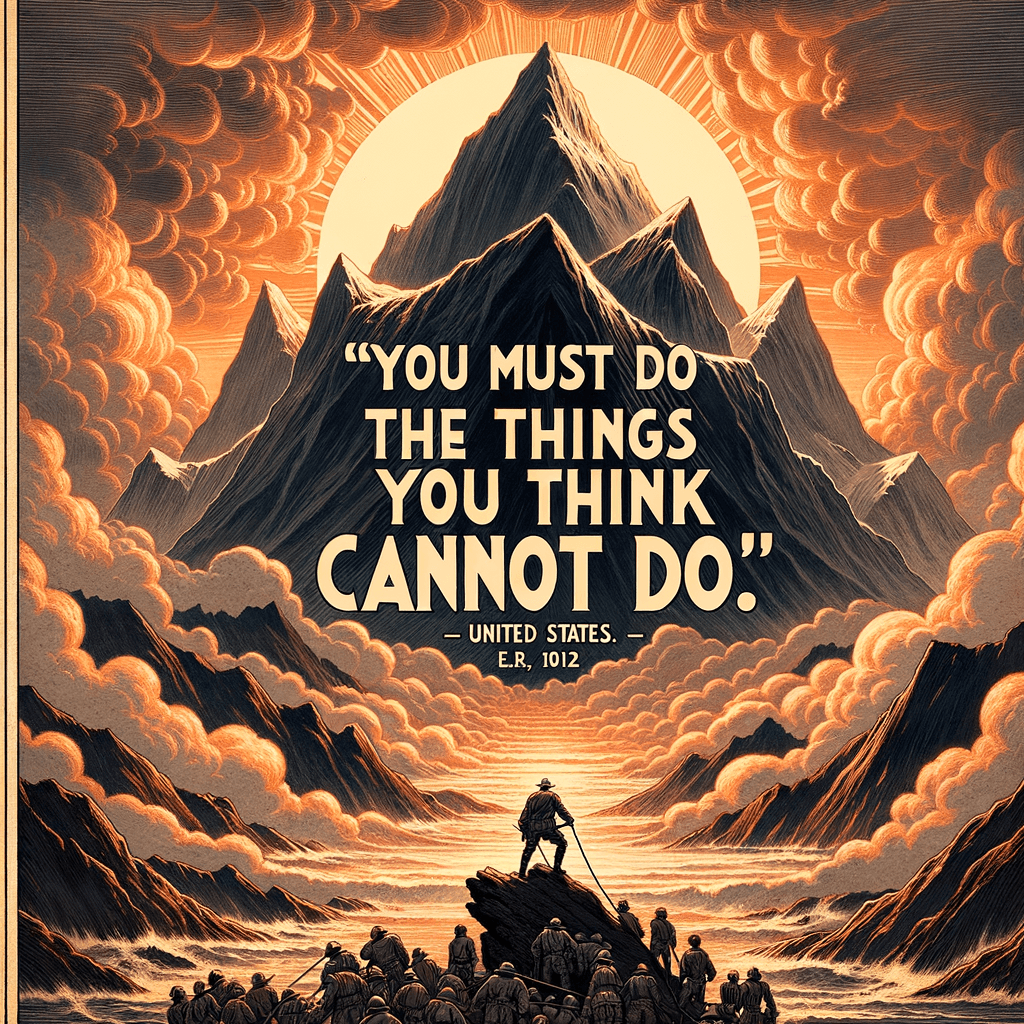
You must do the things you think you cannot do. — Eleanor Roosevelt, United States.
—What lingers after this line?
Overcoming Self-Doubt
This quote encourages individuals to confront and overcome their self-imposed limitations. The belief that one cannot achieve something often hinders personal growth and success.
Courage and Resilience
It highlights the importance of courage in facing challenges. Engaging in tasks that seem impossible fosters resilience and strengthens one's character.
Growth Beyond Comfort Zones
Eleanor Roosevelt suggests that real growth occurs outside of one's comfort zone. Taking on difficult tasks can lead to new experiences and heightened self-awareness.
Empowerment and Agency
The quote conveys a sense of empowerment, urging individuals to take control of their lives. By pushing boundaries, one can discover hidden potential and capabilities.
Historical Context
Eleanor Roosevelt was a prominent political figure and activist, known for her advocacy of human rights. Her experiences during a transformative period in American history shaped her belief in the importance of perseverance and social change.
One-minute reflection
Where does this idea show up in your life right now?
Related Quotes
6 selectedTo be courageous is to act with the heart. — Molière
Molière
Molière’s line suggests that courage is not merely the absence of fear, but the decision to move despite it. By connecting courage with the heart, he frames bravery as an emotional and moral act rather than a simple disp...
Read full interpretation →The best people possess a feeling for beauty, the courage to take risks, the discipline to tell the truth, the capacity for sacrifice. — Ernest Hemingway
Ernest Hemingway
Hemingway’s line presents goodness not as politeness or success, but as a demanding inner code. The “best people” are those who combine sensitivity, bravery, honesty, and self-denial—qualities that do not always coexist...
Read full interpretation →If you are not willing to look stupid, nothing great is ever going to happen to you. — Julia Cameron
Julia Cameron
Julia Cameron’s remark begins with a hard truth: many people do not fail because they lack talent, but because they fear embarrassment. In that sense, ‘looking stupid’ becomes shorthand for being seen trying, stumbling,...
Read full interpretation →You don't have to bully yourself out of feeling fear. You just have to move while it's still there. — Annie Wright
Annie Wright
At its core, Annie Wright’s quote challenges the common belief that courage begins only after fear has disappeared. Instead, it reframes fear as something that can accompany action rather than prevent it.
Read full interpretation →For what matters in life is not whether we receive a round of applause; what matters is whether we have the courage to venture forth despite the uncertainty of acclaim. — Amor Towles
Amor Towles
At its core, Amor Towles shifts attention away from public approval and toward private resolve. The quote argues that a life’s value is not determined by applause—those visible signs of recognition—but by the willingness...
Read full interpretation →Confidence doesn't mean being fearless. It means creating, even when your hands shake. — Lisa Golightly
Lisa Golightly
At first glance, Lisa Golightly’s quote overturns a common myth: that confident people move through life without fear. Instead, she presents confidence as action taken in spite of fear, not in the absence of it.
Read full interpretation →More From Author
More from Eleanor Roosevelt, United States. →