
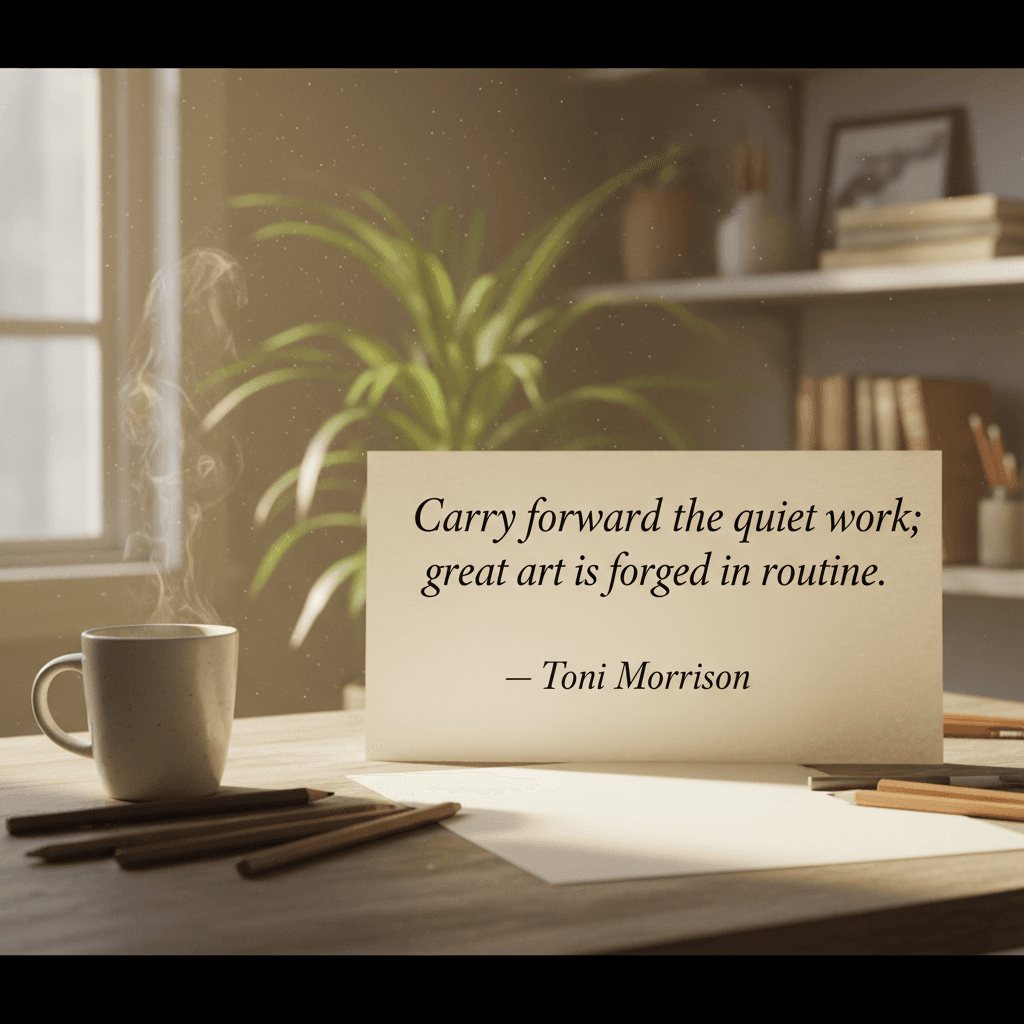
Carry forward the quiet work; great art is forged in routine. — Toni Morrison
—What lingers after this line?
Quiet Work as Creative Foundation
Morrison’s directive reframes creativity as a craft carried by calm, repetitive labor rather than sudden flashes of brilliance. The “quiet work” is not silence for its own sake, but a protective envelope around attention, where small, consistent efforts accumulate into formidable skill. Through this lens, routine is less a cage than a kiln: heat applied steadily until the form holds. Consequently, the romance of inspiration gives way to the discipline of return. Each day’s modest page or practice session becomes an investment in continuity, and continuity underwrites depth. What appears uneventful from the outside—same desk, same hour—becomes internally dramatic, as capacity expands and a voice clarifies through use.
Morrison’s Dawn Ritual
Consider Morrison’s own habits. In The Paris Review interview (Art of Fiction No. 134, 1993), she describes rising before dawn to write, leveraging the pre-sunlight hush as a sanctuary from interruption. While editing at Random House and raising children, she built pages in those early hours—day after day—until manuscripts became novels. In this light, routine was neither austerity nor accident; it was design. The dawn window, chosen and defended, turned limited time into reliable output. Her example makes the quote autobiographical without being exclusive: the principle scales for different lives, provided the hour is protected and repeated.
Rituals That Liberate
Building on this, creative rituals reduce friction so attention can go straight to the work. Twyla Tharp’s The Creative Habit (2003) argues that a fixed sequence—same commute, same warm-up—moves artists past hesitation. Similarly, Virginia Woolf’s regular hours and room-of-one’s-own ethos stabilized the conditions for risk on the page, while James Baldwin’s daily sessions forged the tempo that powered his essays. Thus, ritual is not superstition; it’s a behavioral ramp. By deciding once—place, tools, starting cue—we free the day’s courage for the real choices: form, argument, image, and tone. Routine narrows options only to widen expression.
What Science Says About Habit and Mastery
Moreover, research shows that habits automate initiation, conserving mental resources for complex tasks. Wendy Wood’s Good Habits, Bad Habits (2019) documents how stable contexts cue action with minimal willpower. When the cue is “sit, start, write,” momentum follows before doubt can intervene. Complementing this, Anders Ericsson’s work on deliberate practice (Psychological Review, 1993) emphasizes structured, repeated effort with feedback as the pathway to expertise. Routine supplies the calendar slots where such practice can occur, while feedback—editorial notes, peer critique, self-review—shapes direction. The art is forged not by accident, but through repeated, purposeful refinement.
The Power of Small, Sustained Wins
Furthermore, progress itself fuels persistence. Teresa Amabile and Steven Kramer’s The Progress Principle (2011) shows that even minor, visible advances boost motivation and creativity. Routine converts grand ambitions into tractable steps that generate these “small wins” regularly. As such, the notebook checkmark, the saved draft, or the solved stanza is not trivial bookkeeping; it’s psychological scaffolding. The record of forward motion immunizes against the day’s doubts and creates a feedback loop: progress encourages return, and return produces progress. Over time, this compound interest becomes style, confidence, and reach.
Time, Attention, and Useful Boredom
Paradoxically, routine invites a kind of gentle boredom that helps ideas interlace. Studies on insight suggest that non-urgent, less-optimal times can encourage creative leaps by loosening mental filters (Mareike Wieth and Rose Zacks, Thinking & Reasoning, 2011). Likewise, Sandi Mann’s work on boredom (The Upside of Downtime, 2016) links low-stimulus states to imaginative recombination. In practice, the steadiness of repeated sessions allows problems to incubate between sittings. Walks, chores, and quiet pauses—all part of a routinized life—become auxiliary studios. The routine holds the door; wandering attention brings back surprising guests.
A Practical Cadence for Forging Art
Finally, a workable routine is specific, small, and sacred. Choose a daily window you can defend, set a simple opening cue (light a candle, open the same document), and start with a modest target—fifteen minutes, one paragraph, eight bars. Track completions rather than outcomes to protect momentum, and close each session by leaving a prompt for tomorrow. With repetition, capacity stretches and the work deepens. As Morrison implies, carrying forward the quiet work is not about heroics; it is about keeping faith with the forge. Show up, tend the heat, and let time do its luminous work.
Recommended Reading
As an Amazon Associate, we earn from qualifying purchases.
One-minute reflection
What does this quote ask you to notice today?
Related Quotes
6 selectedMastery requires private, unglamorous repetition daily. — Dan Harrah
Dan Harrah
At first glance, Dan Harrah’s quote strips mastery of its glamour and returns it to routine. Rather than presenting excellence as a burst of inspiration or a dramatic breakthrough, it frames skill as the product of repea...
Read full interpretation →The secret to a life of significance is not in the grand gesture, but in the quiet, unrelenting consistency of your daily practice. — Henri Matisse
Henri Matisse
At first glance, Matisse overturns the common belief that meaningful lives are built through dramatic turning points. Instead, he locates significance in repetition: the small actions done faithfully when no audience is...
Read full interpretation →If you want to gain momentum, begin by setting goals that are worthwhile but highly achievable. Master the basics. Then practice them every day without fail. — John C. Maxwell
John C. Maxwell
John C. Maxwell’s quote begins with a practical insight: momentum rarely appears out of nowhere.
Read full interpretation →Make today the workshop where your best self is assembled piece by piece. — Chimamanda Ngozi Adichie
Chimamanda Ngozi Adichie
Chimamanda Ngozi Adichie’s line turns “today” from a deadline into a worksite: a place where something is being made. Instead of waiting for a future version of life to begin, she suggests the present is where constructi...
Read full interpretation →Action is the bridge from hope to habit; cross it daily. — Rabindranath Tagore
Rabindranath Tagore
Tagore’s image turns action into infrastructure: not a momentary burst of effort, but a reliable passage between what we wish for and what we become. Hope can be sincere and even inspiring, yet it remains suspended in po...
Read full interpretation →Let the small, honest reckonings of your days become your masterpiece. — Anaïs Nin
Anaïs Nin
Anaïs Nin’s line begins with a quiet redefinition of what counts as art: not only grand projects or public achievements, but the small, truthful moments that make up a day. By calling daily reckonings a “masterpiece,” sh...
Read full interpretation →More From Author
More from Toni Morrison →The role of art has never been to escape reality, but to help us understand it. — Toni Morrison
At first glance, art is often treated as a refuge from hardship, a private world where pain can be softened or forgotten. Toni Morrison overturns that expectation by arguing that art’s deeper purpose is not avoidance but...
Read full interpretation →The ability to endure is the discipline of the soul. — Toni Morrison
Toni Morrison’s line shifts endurance from a mere survival trait into a deliberate inner practice: a discipline cultivated in the soul. Rather than glorifying pain for its own sake, she suggests that the capacity to cont...
Read full interpretation →You are your best thing. — Toni Morrison
Toni Morrison’s line, “You are your best thing,” quietly overturns a common habit: looking outward for proof of worth. Instead of treating love, status, or achievement as the final measure, the quote plants value inside...
Read full interpretation →Keep a stubborn heart and a flexible plan. — Toni Morrison
Toni Morrison’s sentence splits strength into two complementary forms: a “stubborn heart” that refuses to surrender what matters, and a “flexible plan” that accepts reality’s constant revisions. Rather than treating grit...
Read full interpretation →